Brent crude lost roughly $7 a barrel in three sessions this week, sliding from about $94 on Monday morning, August 24, to the $87 handle by Wednesday, August 26, four red sessions in a row. The trigger was a Tuesday headline out of Tehran. Iran and Oman outlined a phased framework for a temporary Hormuz shipping corridor. The screen read that as a reopening and sold the war premium the way it has sold it twice before this summer. But the paper behind the headline closes the southern route and keeps the mines in the water until a joint mission clears them. It also arrived the same week Washington widened its sanctions net. In plain terms, the corridor plan is a toll lane, not a reopening, and Brent got sold as if the whole freeway had come back.
The setup in 3 lines:
- Brent fell from about $94 on August 24 to the $87 handle on August 26, its fourth straight decline, on the Iran-Oman corridor framework.
- The framework is phased, temporary and conditional: it shuts the UN-authorized southern route and still needs mine clearing before a laden tanker moves.
- The physical side didn't soften. Hormuz still ran near 4.9 million barrels a day in Q2, and Wednesday's EIA print showed gasoline and diesel stocks at seasonal lows.
---
The named moment that matters came on Monday, August 24, at the Treasury podium. Scott Bessent unveiled what the administration calls "Operation Economic Outcast." The plan hits Iran's revenue and any country still trading with it across five new areas, including shipping. Yet he gave no compliance date, and the package stopped short of immediate secondary sanctions. So the market got one hawkish headline that turned out softer than feared. A day later it got one dovish headline that turned out harder than it looked. Both got traded in the same direction. That is the mispricing we're writing about.
Brent's $7 slide priced a reopening, but the corridor paper describes a toll lane
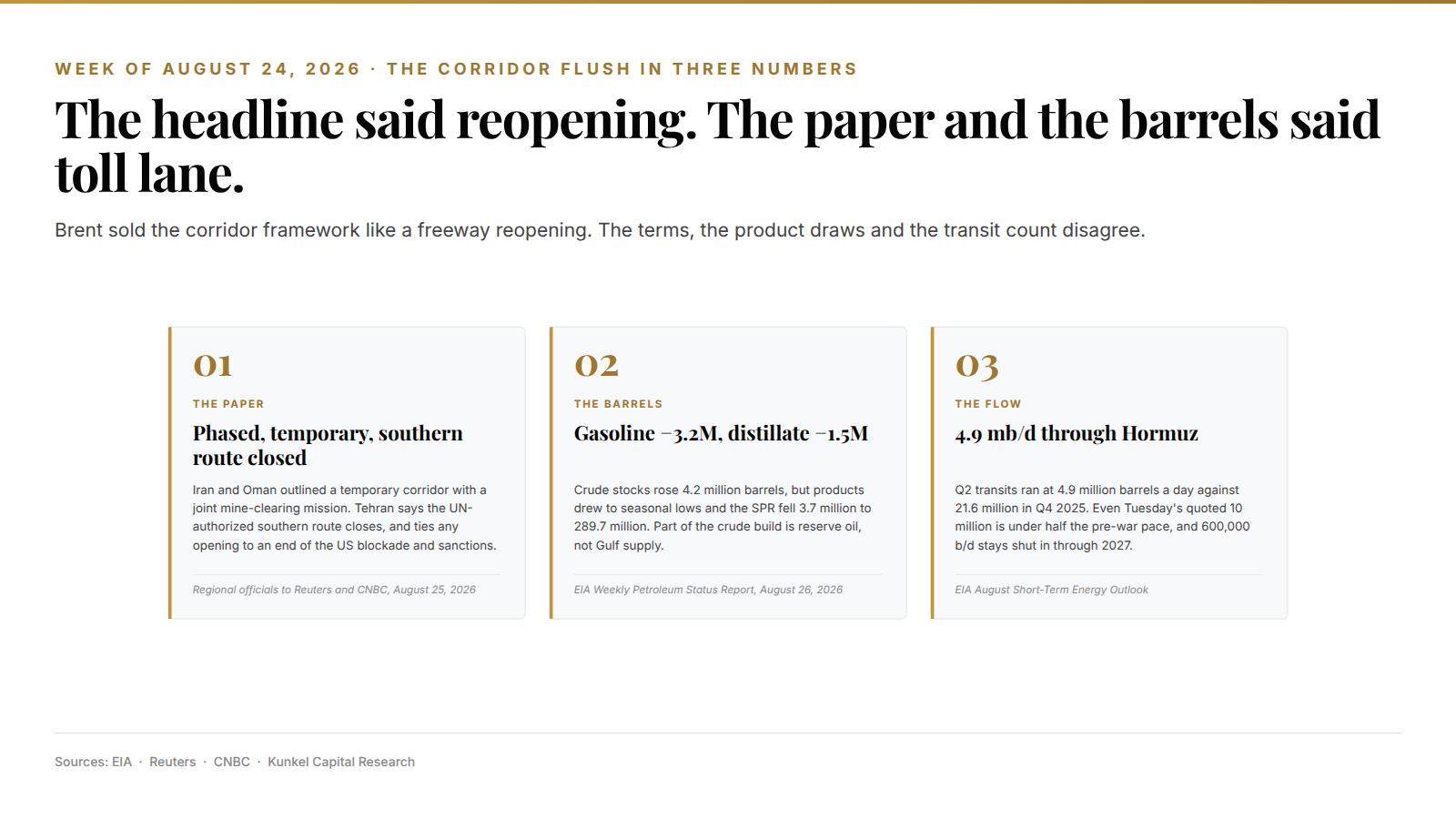
Start with what Tuesday's framework actually contains, because the details are the trade. Regional officials told CNBC and Reuters that Tehran and Muscat discussed a "phased framework" for a temporary corridor. A joint mine-clearing mission comes first, and a permanent arrangement is meant to follow. Oman's foreign minister, Sayyid Badr Albusaidi, called the Tehran talks constructive and said he hoped to announce practical arrangements soon. That's the bullish half, and it is real enough.
The other half sat in the same briefing. Iran's deputy foreign minister, Kazem Gharibabadi, said the deal would close the southern route. That's the UN-authorized channel along Oman's coast, and Tehran has opposed it for months. A senior Iranian source then told Reuters on Wednesday that nothing had been finalized. And the IRGC's own spokesman tied any opening to the US ending its port blockade, paying compensation and lifting sanctions. Which just means the corridor is a lane Iran controls, offered on conditions Washington rejected on Monday.
Think of it like a highway closed by a landslide. Someone announces a single supervised lane, open in phases, with inspection at both ends, while the old road stays shut. Traffic moves again, but not at the old speed and not for everyone. Tuesday's tape priced the old speed. On top of that, Iran blacklisted 45 ships the same day to stop sanction-evading transfers, and a tanker was disabled in an attack off Oman while the talks were running. Those two facts don't read like a reopening.
Two documents, one week. Monday's US package widened sanctions on Iran's shipping. Tuesday's corridor plan requires those sanctions to go. Brent traded both as a reopening.
Wednesday's EIA report showed a 4.2 million barrel build, and the products said the opposite
Now put the inventory data next to the headlines, because Wednesday's release is where the crude bears got their second wind. The EIA reported that commercial crude stocks rose 4.2 million barrels in the week to August 21. The desks had expected a 1.8 million build. Cushing added about a million barrels on top. At first glance that build supports the sell-off. So the bearish story had two legs by Wednesday lunchtime.
But the same report showed gasoline stocks falling 3.2 million barrels and distillates dropping 1.5 million, both to seasonal lows. Retail diesel still sits near $5.62 a gallon. The Strategic Petroleum Reserve fell another 3.7 million barrels to 289.7 million. So part of that crude build is government oil moving into commercial tanks, not fresh supply from the Gulf. In other words, the barrel count went up because the reserve was drained, while the products people actually burn kept tightening.
That distinction matters for the wave structure, and here's the plain-English bridge. Crude stocks tell you how much raw material is parked. Product stocks tell you whether refineries are keeping up with demand. When products draw to seasonal lows while crude builds from SPR releases, the tightness has moved downstream. And downstream tightness eventually pulls crude back up through refinery margins. The screen sold the headline number, while the physical market read the second line.
The IEA and OPEC both cut demand, and supply still fell twice as fast
The agencies that count barrels published their August math two weeks ago. None of it has changed since. OPEC cut its 2026 demand growth forecast to 580,000 barrels a day from 780,000, blaming the Hormuz closure. The IEA cut demand as well, and then it cut 2026 world supply by 4.3 million barrels a day, roughly eight times its demand reduction. We covered that ratio in detail when crude's five-session rally ran into the IEA's supply cut, and the balance hasn't loosened since.
The flow number underneath is the one to keep. Crude and product shipments through Hormuz averaged 4.9 million barrels a day in the second quarter against 21.6 million in the last quarter of 2025, per the EIA's August outlook. President Trump said on Wednesday that 10 million barrels passed through the strait on Tuesday. Even if that figure holds every day, it's still under half the pre-war pace. That is the gap the corridor has to close. The EIA already assumes about 600,000 barrels a day stays offline through 2027 after any reopening, because shut-in fields don't restart on a press release.
So the demand cuts are real, but they're smaller than the supply cuts, and the corridor doesn't restore the missing barrels. It restores a fraction of them under supervision. Until the transit count runs above 15 million barrels a day for weeks, the published balance stays in deficit. And a deficit puts a floor under every headline-driven flush.
4.9 million barrels a day. That's Hormuz throughput in Q2 per the EIA. Tuesday's corridor plan didn't change it. It described the terms for maybe doubling it.
Three reopening headlines have sold Brent this summer, and each floor came in higher
Zoom out and the summer looks like one trade, repeated three times. The June 17 ceasefire framework took Brent from above $120 back to $73.17 by June 29, a round trip we mapped while it happened in Brent's $120-to-$70 June round trip. Then Bessent's August 4 "deal by Wednesday" comment bled Brent 8% into $79.46 before Iran's restrictive Hormuz draft reversed it. And now Tuesday's corridor headline has taken about $7 off the top in three sessions.
Each flush found buyers higher than the last one did. Brent's July 1 low sat under $70. The August 5 low printed near $79.36 on the Brent screen while WTI closed at $75.22. This week's slide has so far held the $86 to $87 area, which was resistance in mid-August before the market pushed through it. Meanwhile the highs have stepped down: above $120 in June, $98.69 in late July, and about $94 on Monday. Lower highs and higher lows, in other words.
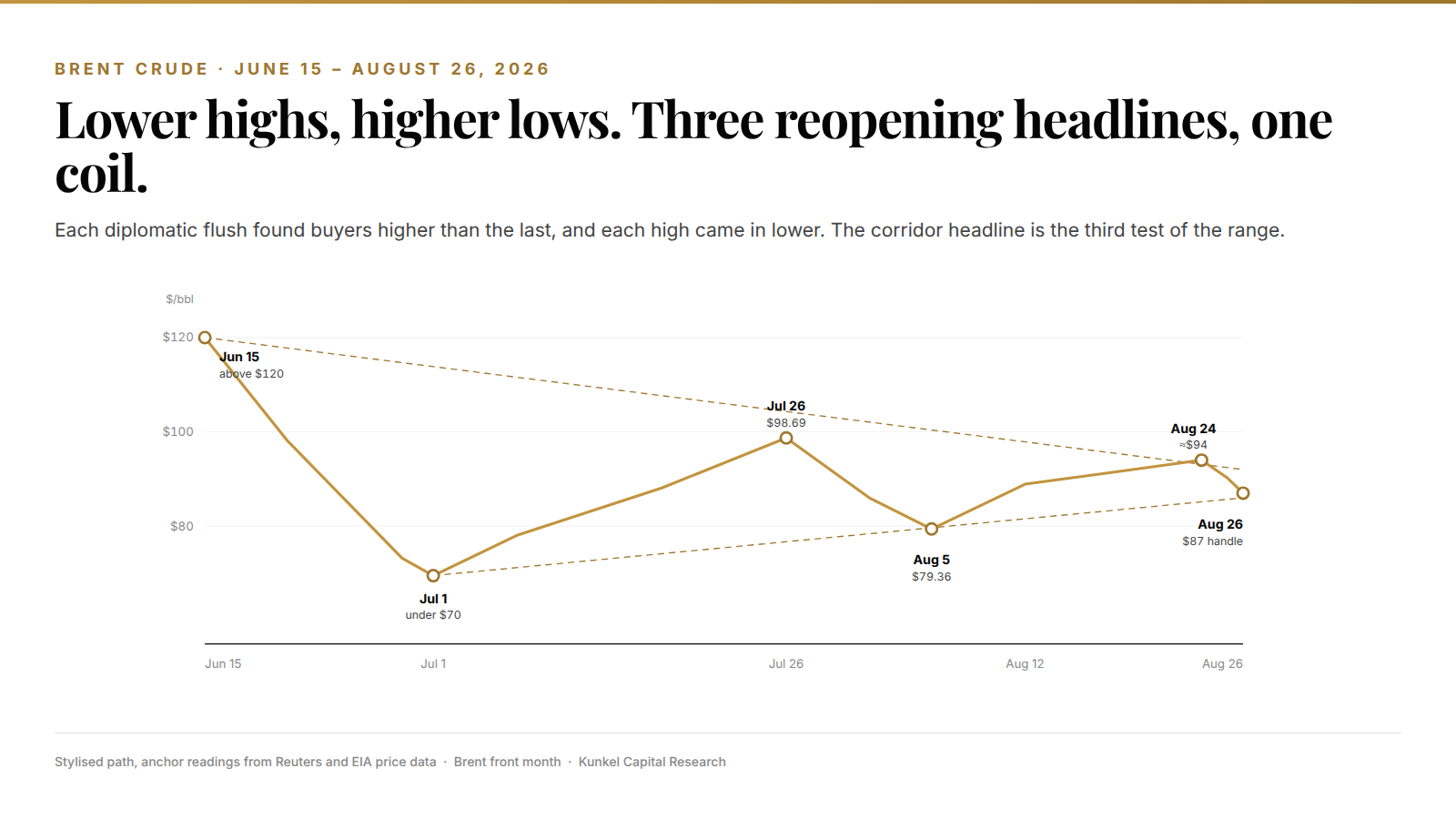
That shape has a name in the wave vocabulary: a contracting triangle, a sideways structure in which the market coils as each headline gets less power to move price. A triangle is what a market does when both sides of the argument are true at once. Here that means a real diplomatic process and a real physical deficit. It's the crude version of the compression we flagged when Brent ripped 6% as Hormuz flows collapsed and OPEC's phantom barrels stayed stranded.
Here is the honest self-correction, though. Two weeks ago we wrote that the five-session rally was balance-driven rather than a war-premium twitch. That is still our read on the physical side today. But the speed of this week's $7 drop shows there was more headline premium in the $94 print than we credited. Balances built the floor, but headlines built the last five dollars, and headlines took them back.
What separates a corridor from a reopening in the barrel count
Because the difference between the two is the entire structural read, it's worth listing the tells in one place. These are the observable conditions, none of them derived from our count, that would tell you the corridor has become a real reopening:
- Sustained transits above 15 million barrels a day for three straight weeks, per EIA or IEA tanker tracking, not one Tuesday quoted from a podium.
- Laden VLCCs moving without a supervised lane, meaning the southern route stays open alongside any Iranian corridor rather than being closed by it.
- War-risk insurance falling, with the Joint War Committee at Lloyd's dropping the Gulf listing, which is the cost line that keeps cargoes waiting.
- US product stocks rebuilding from seasonal lows for four consecutive EIA weeks while crude stocks stop depending on SPR releases.
- The 600,000 barrel a day shut-in estimate shrinking in the EIA's monthly outlook, which is the agency's own test of whether fields are restarting.
None of those five conditions were met this week, not one. One statement from Oman, one number from the White House and one crude build partly fed by the reserve are what moved the price. Crude oil is one of the assets on the Kunkel Capital rotation: members get the full structure map with entry, exit and invalidation refreshed on a fixed cycle. The triangle read above carries its price levels there, not here.
The structural read: a coiling range, and where the thesis breaks
Here's the full read, with the direction stated first. We think Brent is coiling, not trending, and that this week's $7 drop is a corrective leg inside a range that has been narrowing since July 1. The mechanism behind that is simple enough. Every diplomatic headline sells the premium, and every physical data point rebuilds it. Each side has a little less force than the time before. That's why the highs step down and the lows step up. A coil like this resolves with a thrust. And thrusts follow the balance, not the press conference.
The balance still points to deficit on every line. Products at seasonal lows, Hormuz throughput at a fraction of its old pace, an SPR at 289.7 million barrels and falling, and two agencies whose supply cuts dwarf their demand cuts. So far every reopening headline has been sold and then bought back at a higher floor. The corridor framework is the weakest of the three, because it closes a route rather than opening one. We expect the market to work that out the way it worked out June and August, which means the downside from here is the setup rather than the trade.
Now the other side, because it's the Kunkel Capital signature. Here's where we would be wrong: a weekly close back below the August 5 low while Hormuz transits hold above 10 million barrels a day for multiple weeks. Add the Joint War Committee lifting the Gulf listing, and the case is complete. That combination would mean the corridor works as a reopening in the barrel count. The physical floor we're leaning on would be gone. A break below the July 1 low under $70 on top of that would end the coil in the bears' favor, full stop. Until you see those conditions together, the physical deficit is the base case and the headline flush is the noise.
One acknowledged uncertainty remains. It is a large one. Nobody outside Tehran and Muscat has seen the final text of the corridor accord. If it reopens the southern route rather than closing it, the read above gets weaker fast. You'd see it in the transit count within days.
Know your entry, your exit, and where you are wrong on Crude Oil
The Iran-Oman corridor flush is the surface signal. Crude oil is on the Kunkel Capital watchlist: the full research maps the current wave count to a defined entry zone, an exit target and the exact invalidation level, refreshed on a fixed rotation, with alerts when levels hit. €19.99 first month, then €34.99. Cancel anytime.
Frequently asked questions
Why did Brent crude fall this week? Brent fell about $7 from Monday, August 24, to Wednesday, August 26, after Iran and Oman outlined a phased framework for a temporary Hormuz corridor. A softer US sanctions package and a 4.2 million barrel EIA crude build added to the selling.
Does the Iran-Oman corridor reopen the Strait of Hormuz? Not on the terms described so far. The framework is temporary, phased, and requires mine clearing first. Iran's deputy foreign minister said it would close the UN-authorized southern route, and Tehran still ties any opening to an end to the US blockade, compensation and sanctions relief.
What does the EIA data say about physical tightness? Crude stocks rose 4.2 million barrels in the week to August 21, but gasoline fell 3.2 million and distillates fell 1.5 million to seasonal lows. The SPR dropped 3.7 million barrels to 289.7 million, so part of the crude build came from reserve releases.
What is the Kunkel Capital structural read on crude oil? A contracting range since July 1 with lower highs and higher lows, driven by headline selling against a physical deficit. The read breaks on a weekly close below the August 5 low while Hormuz transits stay above 10 million barrels a day and war-risk insurance falls.
What would confirm a real reopening? Sustained transits above 15 million barrels a day for weeks, plus laden tankers moving without supervised lanes. Then the Lloyd's war-risk listing lifted, product stocks rebuilding, and the EIA cutting its 600,000 barrel a day shut-in estimate.
Sources: EIA Weekly Petroleum Status Report and August Short-Term Energy Outlook, IEA Oil Market Report August 2026, OPEC Monthly Oil Market Report, Reuters, CNBC, U.S. Treasury.
Last updated: 2026-08-27