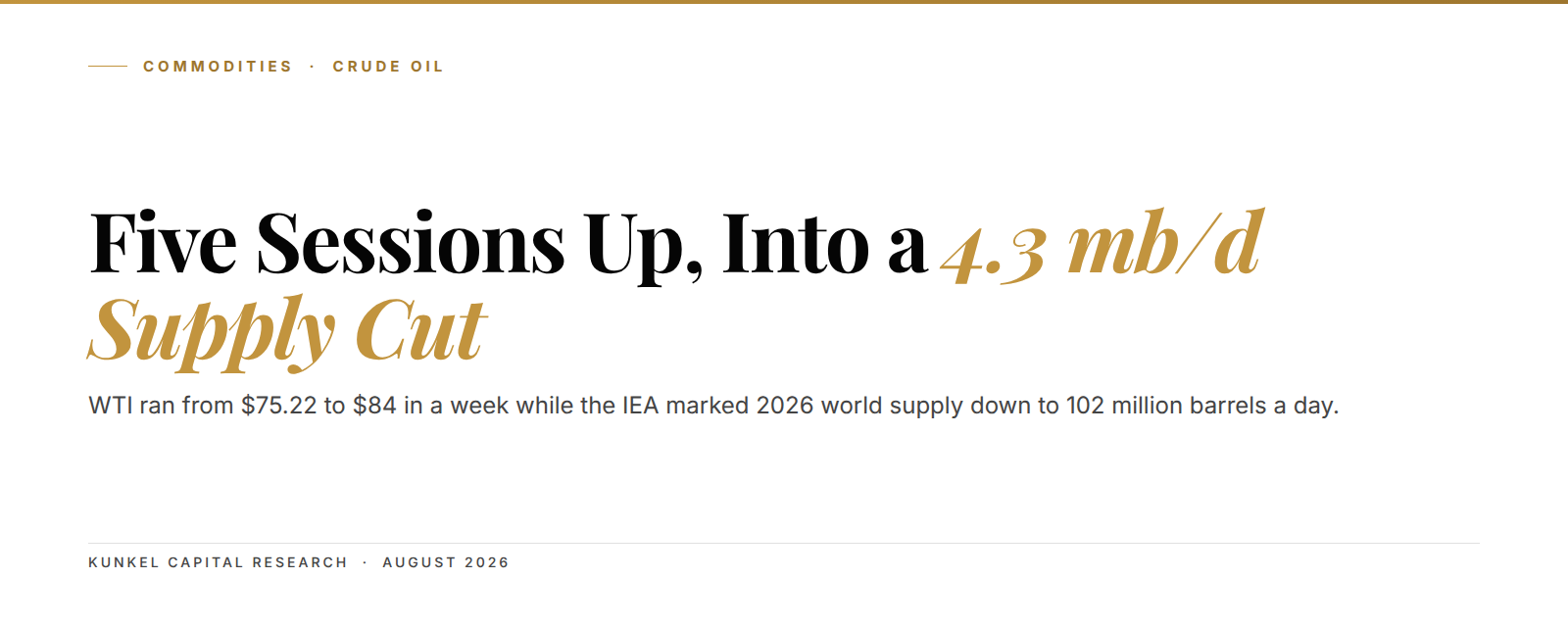
Crude oil closed its fifth straight up session on Wednesday, August 12, with WTI touching $84 intraday one week after it bottomed at $75.22. The consensus frame calls this another war-premium twitch, the kind that fades once Washington and Tehran finally shake hands. But the two agencies that count every barrel on the planet just published math that breaks the frame. The IEA now expects world supply to fall by 4.3 million barrels a day in 2026, roughly eight times its own demand cut. That ratio, not any headline, is what the tape has been pricing all week.
The setup in 3 lines:
- WTI ran from a $75.22 close on August 5 to $84 intraday on August 12, five green sessions in a row.
- The IEA's August 12 report cut 2026 world supply by 4.3 million barrels a day, about eight times its demand reduction.
- US-Iran talks stayed deadlocked all week, so the rally traces to published balances, not to a fresh war headline.
---
Start with what did not happen, because that is the tell. Nothing new blew up this week. President Trump told reporters on Wednesday that the US holds "total control over the Strait of Hormuz," while negotiations with Iran sit exactly where they sat in July. That is a stalemate, and stalemates do not print five consecutive green candles. Something else is doing the lifting, and you can trace it through two documents published 24 hours apart.
Five green sessions took WTI from $75.22 to $84 without one new war headline
The move started on Thursday, August 6, when WTI added two dollars into a soft jobs backdrop. From there the bid never left the screen. Monday printed $82.13, Tuesday added another dollar, and Wednesday morning tagged the $84 handle before settling back. Five sessions, roughly eleven percent, no fresh escalation anywhere in the tape.

Brent ran the same route a notch higher, closing Tuesday at $88.91 and holding near $88 into Wednesday. Which means the global benchmark now trades above the US government's forecast for the entire year. That forecast was published one day earlier. Spot beat it within a single trading day.
That sequencing is the story. Rallies built on fear need a fresh scare every morning, and this week supplied none. Rallies built on balances only need arithmetic.
The EIA raised its Brent forecast to $87 on Tuesday, and the market beat it in a day
On Tuesday morning, Washington time, the Energy Information Administration released its August Short-Term Energy Outlook and lifted its 2026 Brent forecast to $87, citing Hormuz shipping constraints. The detail inside matters more than the headline number. The EIA estimates Middle East production shut-ins averaged 5.5 million barrels a day in July, down from 7.5 million in June. On the surface that looks like healing. And healing is the whole bear case.
But the same report raised its estimate of shut-in production for the months ahead, because it now assumes severe constraints on strait transits persist through August. The agency also expects around 600,000 barrels a day to stay offline through the end of 2027, even after a reopening. So the shut-in number improved while the forward picture got worse. Both are true, but only one is tradeable.
Then come the flow numbers. Crude and product shipments through Hormuz averaged 4.9 million barrels a day in the second quarter, against 21.6 million in the final quarter of 2025. In plain terms: the waterway that used to carry a fifth of the world's oil is running below a quarter of its old pace, and the agency that counts the ships has stopped assuming a quick fix.
4.9 million barrels a day. That's what moved through the Strait of Hormuz in Q2 2026, down from 21.6 million in Q4 2025, per the EIA's August outlook.
The IEA followed with a 4.3 million barrel supply cut, eight times its demand cut
Paris weighed in on Wednesday. The IEA's August Oil Market Report now sees global supply falling 4.3 million barrels a day in 2026, to 102 million, as growth from the Americas only partly offsets losses in the Middle East and Russia. The same report trimmed second-half demand by roughly 550,000 barrels a day, because closed shipping lanes and high fuel prices are eating into consumption.
Sit with that ratio for a second. Demand destruction is real, and it is still getting swamped eight to one by the supply loss. A market where both sides of the balance shrink, but supply shrinks eight times faster, is a market in structural deficit. No peace-headline algorithm changes that arithmetic until ships actually sail.
The loading data inside the report is the sharpest single fact of the week. Gulf loadings peaked at 20 million barrels a day at the start of July, then fell to around 12 million late in the month. So the export collapse deepened during the exact window when shut-ins were supposedly easing. Wells can restart while exports stay trapped, which is why counting shut-ins alone kept the consensus offside. It is the same lesson we took from the phantom OPEC barrels: announced supply is not delivered supply.
20 down to 12. Gulf loadings in millions of barrels a day, from the start of July to its final week, per the IEA's August report.

A war premium that already died at $79.36 cannot explain this rebound
Here is where the structure argument starts. Brent tagged $100.69 on July 23 when the second front opened, then gave back 21 percent in eight sessions to bottom at $79.36 on August 4. That purge was the war premium dying in public, the same mechanism we tracked in our war-premium fade audit. By the first week of August, fear was priced out and the slate was clean.
So what bid Brent back nine dollars? Our first instinct was short-covering into CPI week. Wait, that read does not survive the tape: covering pops stall once the event risk passes, and this move accelerated after Tuesday's soft inflation print and again after the agency reports hit. A move that feeds on balance data while shrugging at macro events is repricing fundamentals, not squeezing positioning.
Think of a war premium like surge pricing on a ride-hail app. It spikes on fear and collapses the minute drivers flood the zone. A closed highway is different: the city reprices around it, and the repricing holds for as long as the road stays shut. July traded the surge; August is trading the road.
If you trade crude, this distinction is the whole game right now. The curve told the same story weeks ago, when backwardation flagged tight physical barrels before the screen moved, and when the Iran export flood failed to sink spot the way consensus expected.
The round trip left a structure: a spike, a purge, and a higher floor
For Elliott readers, the shape is close to textbook. The July 23 spike to $100.69 was terminal, a blow-off extension on the second-front headline that exhausted every late buyer. The eight-session purge to $79.36 retraced the entire panic without touching the base built during June's $120 round trip. And the current five-session advance is the first leg of this sequence built on published balances instead of headlines, which in our framework is the more durable kind.
The floor matters more than the ceiling here. Brent's early-August low at $79.36 is market-visible on any free chart: it is where sellers ran dry in the same week the balance data turned. A market that cannot break $80 with fear fully purged is telling you what physical tightness is worth on its own, without a single point of premium attached. Crude oil sits on the Kunkel Capital rotation: members get the full structure map, with entry, exit and invalidation levels refreshed on a fixed cycle.
Six numbers carry the whole read:
- WTI bottomed at $75.22 on August 5 and tagged $84 intraday on August 12.
- Brent trades near $88, above the $87 full-year forecast the EIA published on Tuesday.
- The IEA cut 2026 world supply by 4.3 million barrels a day, down to 102 million.
- The same report trimmed second-half demand by only about 550,000 barrels a day.
- Hormuz flows averaged 4.9 million barrels a day in Q2, versus 21.6 million in late 2025.
- Gulf loadings fell from 20 million to about 12 million barrels a day during July.
One honest caveat belongs next to that list. Nobody, the IEA included, knows how much demand these prices have already destroyed, and the 550,000 barrel estimate carries wide error bars. If the true figure lands at double that, the deficit narrows faster than the structure suggests. We hold the read anyway, because even a doubled demand hit leaves the balance short by millions of barrels a day.
Where we are wrong: ships sailing and barrels returning ahead of schedule
Every read needs a tripwire, and ours is specific. The thesis breaks if a signed agreement reopens Hormuz and tanker loadings climb back toward their old pace while shut-in barrels return faster than the EIA's schedule. Price would confirm that failure with a weekly Brent close back under the early-August low while the reopening holds. Until those ships actually sail, dips into the low $80s are re-tests of a floor that fear no longer defends, and the burden of proof sits with the bears.
What should you watch instead of headlines? Loadings, not press conferences. The IEA publishes them monthly and tanker trackers post them daily, which makes this one of the rare macro trades where the decisive data is public and frequent. OPEC+ committed in early July to keep expanding monthly output, and spot barely blinked, because spare capacity had already left the system. Paper pledges lost their pricing power this summer, the same way they did during the inventory draw streak in the spring.
Put simply: the market spent July pricing fear, spent early August purging it, and is now pricing a supply base that two independent agencies just marked down by millions of barrels a day. The direction of that repricing stays up while exports stay trapped. The speed of it depends on data nobody can forecast from a podium.
Know your entry, your exit, and where you are wrong on Crude Oil
The five-session rally and the agency math behind it are the surface signal. Crude oil is on the Kunkel Capital watchlist: the full research maps the current wave count to a defined entry zone, an exit objective and the exact invalidation level, refreshed on a fixed rotation, with alerts when levels hit. €19.99 first month, then €34.99. Cancel anytime.
Frequently asked questions
Why is crude oil up five sessions in a row this week? Because both major energy agencies repriced the 2026 supply outlook within 24 hours. The EIA lifted its Brent forecast to $87 on August 11, and the IEA cut its 2026 world supply forecast by 4.3 million barrels a day on August 12. The rally tracks those balances, not a new war headline.
Did the IEA really cut supply more than demand for 2026? Yes, and by a wide margin. The August report sees supply falling 4.3 million barrels a day to 102 million, while second-half demand was trimmed by roughly 550,000 barrels a day. Supply is shrinking about eight times faster than demand.
Is this crude oil rally just the war premium coming back? The evidence says no. Brent's war premium died in public between July 23 and August 4, a 21 percent slide with no resolution to the conflict. The current advance began with talks still deadlocked and accelerated on agency data, which points at balances rather than fear.
What would make this bullish crude oil read wrong? A signed reopening of the Strait of Hormuz, tanker loadings recovering toward their old pace, and shut-in barrels returning ahead of the EIA's schedule. A weekly Brent close back under the early-August low while a reopening holds would confirm the failure.
Sources: EIA Short-Term Energy Outlook (August 11, 2026), IEA Oil Market Report (August 12, 2026), Reuters.
Last updated: 2026-08-13