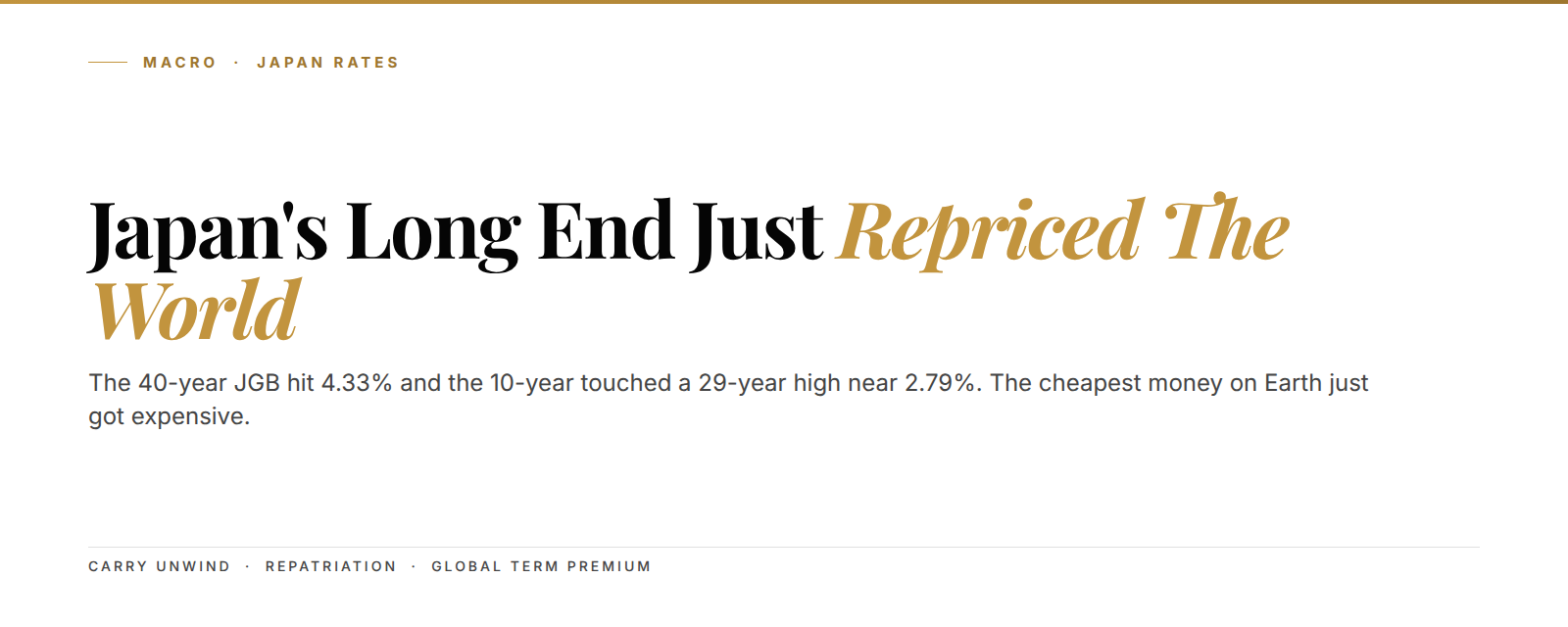
Japan's 40-year government bond yielded 4.33% last week, the highest since the bond first sold in 2007. For three decades Japan was the world's source of nearly free money. That run just ended. The 10-year now sits near 2.79%, a level last seen in September 1996, and the move is quietly resetting the price of capital from Treasuries to tech stocks.
The setup in 3 lines:
- Japan's 40-year yield hit 4.33% and the 10-year touched a 29-year high near 2.79% last week.
- Japanese investors pulled ¥4.67 trillion (about $29.6 billion) out of foreign bonds in Q1, the biggest exit since 2022, and the cash is heading home.
- Watch the 40-year at 4.50%. A clean break there drains the global carry trade and drags US long yields up with it.
Here's the part most desks skipped. On May 18th, while traders in New York watched their own 30-year auction clear above 5%, Tokyo's super-long market printed that 4.33% forty-year yield with almost no coverage. The world's largest creditor nation repriced itself in near silence. That silence is the setup.
Japan's 40-year yield at 4.33% is the highest since the bond was born in 2007
Start with the raw number. The 40-year JGB, the longest bond Japan issues, closed at 4.33% on May 18th, up about 10 basis points in a single session. The 30-year trades near 3.9%. The 10-year holds around 2.79%, the highest reading since September 1996.

These are not small wiggles. The Japanese long end spent most of this century pinned near zero. Pinned on purpose. For years the Bank of Japan owned the market and capped yields through a policy called yield-curve control (a promise to buy unlimited bonds to hold rates down).
That cap is gone. Strong first-quarter growth and an energy-driven inflation scare have pushed the BoJ toward more rate hikes. The long bonds ran out ahead of the central bank. They usually do.
To put the scale in plain terms, a forty-year buyer back in 2021 locked in well under 1% for the privilege of waiting four decades. Today that same buyer collects more than four times the income for the identical wait. That repricing of patience is the quiet story sitting underneath every headline about Tokyo this month.
Translation: the safest, most boring bond on Earth just started paying 4.33% for forty years. Money notices that.
4.33%. A forty-year Japanese yield this high has not existed in the working lifetime of most traders on a desk today.
The ¥4.67 trillion Japanese investors pulled from foreign bonds is the real tell
Follow the money, not the yield. Japanese investors sold a net ¥4.67 trillion (about $29.6 billion) of foreign government, agency, and municipal bonds in the first quarter of 2026. That's the largest quarterly exit in almost four years. The selling sped up as the quarter wore on.
At the same time, March saw the biggest monthly inflow on record into Japanese sovereign bond funds. The cash isn't sitting idle. It's rotating out of foreign paper and back into JGBs.
The buyers driving this are not retail traders chasing a headline. They are the largest and slowest pools of money in the country: life insurers, the government pension fund, and the regional banks that warehouse household savings. When those institutions change direction, the move tends to last for quarters, because their mandates measure performance in decades rather than days.
Why now? Because the math finally flipped. For years a Japanese pension fund had to ship money abroad to earn anything at all. Now it can buy a 30-year bond at home near 3.9% with no currency risk and no hedging bill.
Translation: the home bond got attractive, so the home money is coming home.
Think of it like a wheat farmer who spent twenty years buying grain three states over because his own field grew nothing. This spring his own field came in. He stops importing. Every supplier that depended on his orders feels the hole at once. Japan is that farmer, and the foreign bond market is the supplier.
PM Takaichi's supplementary-budget call lit the fiscal fuse
The yield jump isn't only a central-bank story. It's a debt story too.
On May 20th, Prime Minister Sanae Takaichi told the finance ministry to put together a supplementary budget to cushion households against rising commodity and energy costs. More spending means more bond supply. Bond buyers did the math in real time. They demanded a higher yield to absorb the extra paper.
Japan carries the heaviest public-debt load in the developed world, north of 250% of GDP. For years that didn't matter, because the BoJ bought most of the new issuance. Now the BoJ is stepping back while the government wants to spend more. Two forces pulling the wrong way.
What changed is not the size of the debt, which has been enormous for twenty years, but the identity of who funds it at the margin. A central bank buying with printed reserves does not care what yield it earns. A pension fund or an overseas reserve manager cares a great deal. That handoff from one buyer to the other is exactly what the long end is repricing now.
More supply, fewer official buyers. That's the entire reason the super-long end is moving.
The May 14th 30-year auction actually drew solid demand, better than its 12-month average. Yet yields kept climbing anyway. When good demand can't hold a price down, the supply story is the one winning.
A 29-year high in the 10-year matters more than any US auction
Here's why this is a global event, not a local one.
Japan ran the cheapest money in the world for a generation. Traders borrowed yen at almost zero, then bought higher-yielding assets abroad: Treasuries, Australian bonds, emerging-market debt, US tech. That's the carry trade, borrowing where money is cheap and parking it where it pays more. Japan was the cheap aisle of the whole store.
When the cheap aisle raises prices, every shelf downstream reprices with it. A Japanese yield near zero subsidized risk-taking across the planet. A Japanese 10-year at 2.79% does the opposite. It pulls capital back toward Tokyo.
That single fact sat underneath a huge share of the last decade's risk rally, from the Nasdaq to high-yield credit. It worked even when almost nobody on a desk touched the yen directly. The funding was invisible. That's exactly why its repricing is so easy to miss.
We've written before about how the yen carry trade drives global risk. This is that same machine running in reverse. The difference this time is speed. The 2024 unwind hit in a single August week. This one is a slow grind, quarter after quarter.
Translation: the world's discount lender just turned into a competitor for capital.
You don't have to trade a single JGB to be exposed to this. If you hold long Treasuries or US growth stocks, the funding that floated them is getting pricier. That's the part the equity tape hasn't fully marked yet.
$1.24 trillion sits in Japanese hands, and it's starting to come home
Now size the contagion. Japan holds about $1.24 trillion of US Treasuries as of February 2026. That's the largest foreign stash, roughly 13% of all foreign-held US government debt.
If even a slice rotates home, US long yields feel it. Treasury TIC data already shows the move starting. TD Economics estimates that Japan tapering its US bond buying could add 20 to 50 basis points to the US 10-year over the medium term.

That lands right on top of America's own problem. US 30-year bonds cleared above 5% at auction this month, the first 5-handle since 2007, on soft demand and hot inflation prints. We covered that structural shift in the return of the Treasury term premium.
Stack the two forces. A big buyer stepping away in Tokyo. A big seller flooding supply in Washington. Both push the same direction. Up.
For two years the bond market absorbed heavy US supply partly because foreign buyers kept showing up at every auction to take down the paper. Strip out the largest of those buyers and the arithmetic of who clears the next trillion dollars in issuance gets noticeably harder to answer.
Five things a 4.33% Japanese long bond changes:
- The global carry trade loses its cheapest funding source.
- US long yields gain a fresh push from fading Japanese demand.
- The yen picks up structural support as capital rotates home.
- Risk assets that ran on cheap yen lose a quiet tailwind.
- The term premium, the extra yield for holding long bonds, rebuilds worldwide.
This is the same plumbing we mapped in net-liquidity cycles and risk assets. When the largest pool of cheap savings reprices, the liquidity tide everywhere shifts.
The level we're watching: 4.50% on the 40-year is the line
Now the positional read.
We read the 40-year at 4.33% as the front edge of a multi-quarter repricing, not a blow-off top. The structural pieces all point the same way: BoJ normalization, the supplementary budget, and steady repatriation. None of them resolve in a week. None of them resolve in a quarter.
The honest read is that we are early in a move the broad market still treats as a Japan-only curiosity rather than the global funding event it actually is.
The level that matters is 4.50% on the 40-year. A weekly close above it, and the next leg targets the high-4s, with the 30-year following toward 4.2%. A failure back under 4.0% would tell us the energy-inflation scare is cooling faster than the fiscal story.
Wait. That last point cuts both ways, so we should be honest about it. The 10-year already slipped from 2.79% to about 2.77% as oil fell on US-Iran peace hopes. If the Strait of Hormuz reopens and energy prices drop hard, the BoJ gets room to slow down, and the long end could cool for a month or two. We don't think that breaks the trend. We do think it makes the path bumpy.
The trend is structural. The path is not a straight line. Both can be true at once.
For dollar-based readers, the cleaner trade often sits in FX and cross-market spreads rather than the JGB itself. The cross-currency basis tends to flash this stress first, before the cash bond fully marks it.
What a 4.33% anchor means for the rest of 2026
Step back from the tick-by-tick. The thirty-year era of free Japanese money is closing. That's a regime change, not a headline. Regimes like this reprice slowly, then all at once.
You don't need to own a JGB to sit inside this story. If you hold long Treasuries, US tech, or any asset that floated on cheap global funding, the anchor under it is lifting. The cost of money set in Tokyo for a generation just moved, and the rest of the curve follows on a lag.
We'll keep mapping the levels as they print. The number to write down today is 4.33%. The number to watch next is 4.50%.
Frequently asked questions
Why did Japan's 40-year yield hit 4.33%?
Three forces stacked up. The Bank of Japan is moving toward more rate hikes. The government wants a supplementary budget that adds bond supply. And an energy-driven inflation scare lifted price expectations. Together they pushed the super-long yield to its highest since the bond launched in 2007.
What is the carry trade, and why does Japan matter to it?
The carry trade means borrowing in a cheap currency and investing in a higher-yielding one. Japan offered near-zero rates for decades, so it funded risk-taking around the world. Rising JGB yields shrink that cheap-funding pool and pull money home.
Could rising JGB yields push US Treasury yields higher?
Yes. Japan holds about $1.24 trillion in US Treasuries, the largest foreign position. As Japanese investors rotate home, the fading demand can add an estimated 20 to 50 basis points to the US 10-year over time.
Is the move over?
Probably not as a trend, though the path is choppy. The 10-year already eased from 2.79% to 2.77% as oil prices fell. The structural drivers, BoJ normalization and the fiscal supply, stay in place well into 2026.
See the full Japan long-bond setup
The 4.33% forty-year yield is the surface signal. The Kunkel Capital research adds the level map (our 40-year and 30-year break zones), the carry-unwind watchlist, and the multi-quarter target path that ties JGBs to Treasuries and the yen. €19.99 first month, then €34.99. Cancel anytime.
Last updated: 2026-05-25