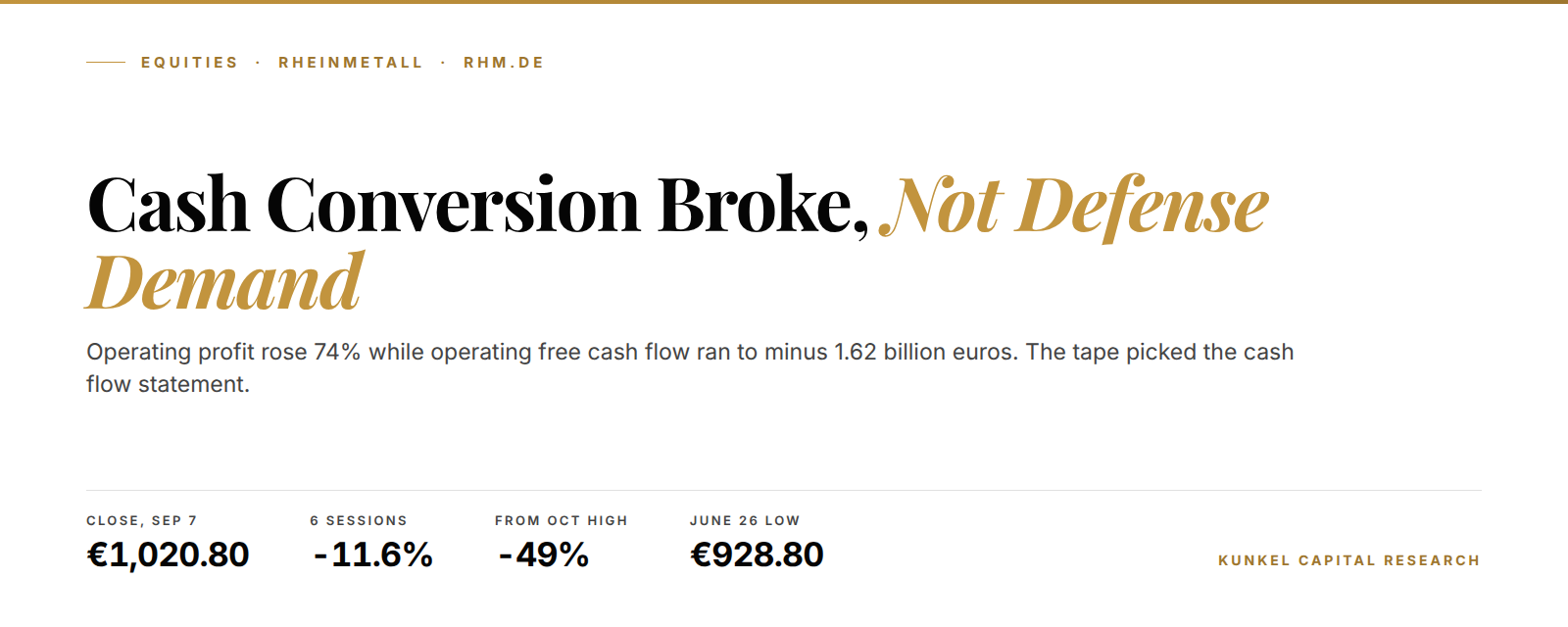
Rheinmetall closed at 1,020.80 euros on Monday, September 7, down 11.6% in six sessions and 49% below its October high of 2,008.00. Consensus still calls this the cleanest growth story in Europe, and on the operating numbers consensus is right. First-half sales rose 39% and operating profit rose 74%. The order book has never been bigger. So the demand story is intact, and yet the stock keeps bleeding. What actually broke here is the cash.
---
The setup in 3 lines:
- Operating free cash flow ran to minus 1.62 billion euros in the first half, in the same six months operating profit climbed 74% to 786 million.
- Berlin cancelled the F126 frigate program on June 24 and pulled 300 million euros straight out of the 2026 sales guide, which showed that an order book can be edited by the customer.
- Price has worked back down to the 1,020 area for the second time since late July, and the June low at 928.80 is the shelf that decides whether this stays a correction inside an uptrend.
On June 24, 2026, the German defense ministry killed a warship program it was already paying for. The F126 frigate had been scoped at roughly 8 billion euros. By the time Berlin pulled the plug, cost-to-complete was running toward 18 billion. Damen Schelde Naval Shipbuilding could not hold the schedule or the budget, and a proposal to move the lead role over to Rheinmetall's NVL yard was rejected. TKMS took the replacement work instead, up to eight MEKO A-200 DEU frigates, four of them firm at about 6.3 billion euros. That single decision is the reason a German defense champion cut its own revenue guide two months later.
Minus 1.62 billion euros of operating free cash flow is the number that moved the stock
Start with the number nobody put in a headline. Rheinmetall's half-year report shows operating free cash flow at minus 1.62 billion euros. Over the same six months, operating profit came in at 786 million, up 74% year on year. Both numbers are real. They point in opposite directions.
That gap is not an accounting quirk. It is what a build-out looks like from the inside. A manufacturer buys capacity and stockpiles material ahead of deliveries that nobody has signed off yet. Rheinmetall is building powder plants, ammunition lines and vehicle capacity now, because the demand curve says it must. The payment curve, though, follows government milestones, and those milestones arrive on Berlin's calendar rather than the company's.
Minus 1.62 billion euros. That is the first-half operating free cash flow, booked in the same period operating profit rose 74%.
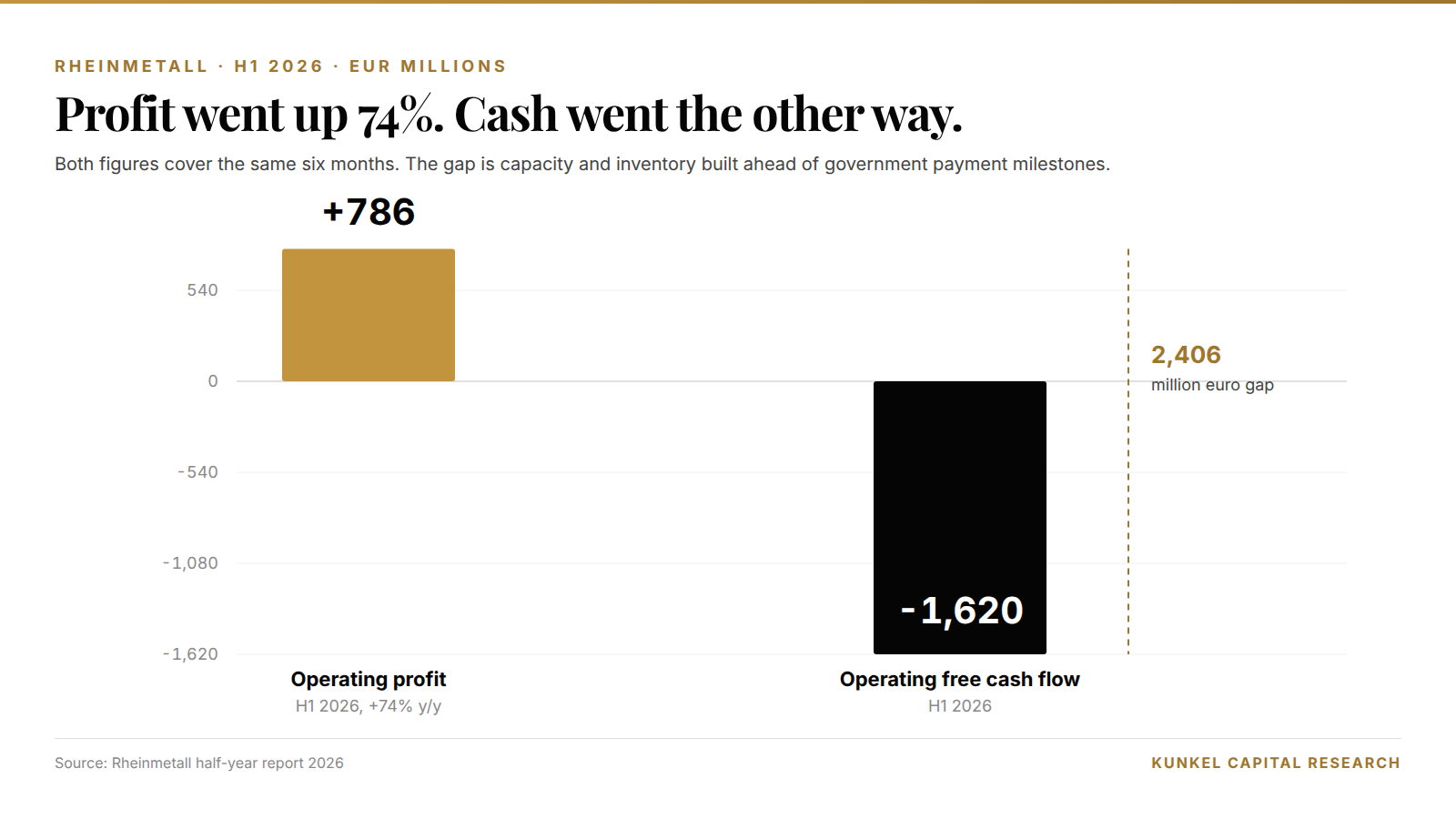
So you get a company that looks spectacular on the income statement and thirsty on the cash flow statement. Equity markets tolerated that through 2025 while the multiple was expanding. They stopped tolerating it once the revenue line itself started moving the wrong way. That is the whole repricing in one sentence.
An 80 billion euro backlog is a queue, not a contract, and Berlin proved it
The bull case has leaned on one figure for two years: an order backlog near 80 billion euros. It is a genuinely large number by any measure. It is also the reason the stock ran to 2,008.00 by October last year. But a backlog of government work is a queue of intentions, and a queue can be reordered.
Think of it like a restaurant with a two-hour waitlist. The list is real, and the demand is real, but nobody has paid yet. Any table can leave before it is seated. The F126 was a table that left.
Here is what makes this different from the usual procurement grumbling. Berlin did not delay the frigate, it replaced the whole architecture with a different ship from a different yard. Rheinmetall's naval division went from lead-role candidate to onlooker, and the 2026 group sales range moved down to 13.7 to 14.2 billion euros from 14.0 to 14.5 billion. That is a small cut in percentage terms. What it signals about the other 80 billion is not small at all.
Translation: the market did not sell Rheinmetall because one frigate died. It sold Rheinmetall because one frigate dying proved the backlog is negotiable.
Margin guidance held at 19% while the sales line got cut, and that tension is the trade
Management kept the operating margin target at 19% even as it trimmed the revenue corridor. That combination tells you something specific. Rheinmetall is signalling that the F126 was low-margin naval revenue whose loss does not damage group profitability, which is a fair read and probably an honest one.
But holding a margin target while cutting sales only works if the volume shows up somewhere else. Ammunition and vehicles carry the group's better margins. Both depend on European budgets that are being debated rather than disbursed. Germany's fiscal commitment to defense is not in doubt. The timing of the cash inside that commitment absolutely is, and timing is what a cash-conversion problem is made of.
We should flag an honest uncertainty here. It is possible the first-half cash burn is simply the trough of a build-out, and that the second half converts hard as deliveries land. Rheinmetall has guided to exactly that. The tape is not paying for the promise yet, which is the point: the market wants to see the conversion, not hear about it.
Rheinmetall sits on the Kunkel Capital rotation, so members get the full structure map with a defined entry, exit and invalidation refreshed on a fixed cycle.
Price has come back to the 1,020 shelf a second time since late July, and that is the structure
Now to the chart, because the levels here are unusually clean. After the June trough, Rheinmetall spent July and August grinding sideways in a broad band. The lower edge of that band sits around 1,020 euros, and Monday's close at 1,020.80 was the second visit to it since July 23, when the stock closed at 1,017.00.
Repeated tests of the same shelf are not automatically bullish. Each visit eats the resting bids that defended the last one. That is why third and fourth tests break more often than first ones. What matters is the behavior around the test rather than the test itself. So far the shelf has held on a closing basis, and the June low at 928.80 from June 26 remains untouched.
928.80 euros. The June 26 low is the only level on this chart that has not been retested, and it is roughly 10% below Monday's close.
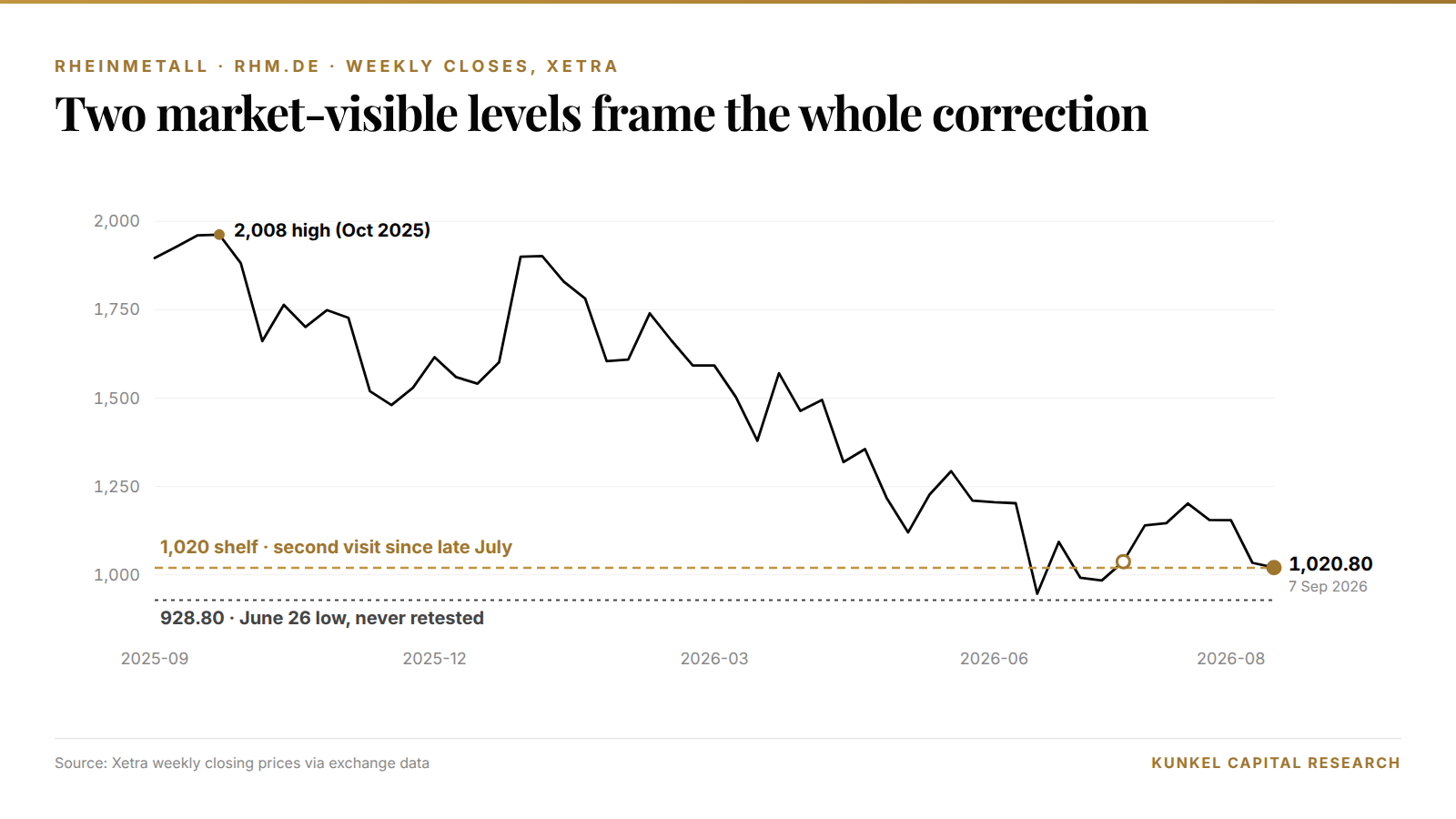
From there the read gets simpler. As long as the June low stands, this is a multi-year uptrend in a deep corrective phase. The drawdown already reached 54% at the June low, and the larger trend structure survived it. At 49% today, price sits inside the same envelope, uncomfortable as that looks.
Five things the Rheinmetall tape is saying as of September 8, 2026
- The selling is concentrated in cash-conversion doubt, not demand doubt, because the backlog grew while the multiple compressed.
- Forward earnings multiples near 30x for 2026 and 20x for 2027 mean the stock is no longer priced for perfection, but it is not cheap either.
- The F126 cancellation set a precedent that every future backlog headline will be discounted against.
- Volume expanded on the down sessions in early September and stayed thin on the bounces, which is distribution behavior rather than accumulation.
- The 1,020 shelf and the 928.80 June low are the two market-visible levels that frame the entire correction.
Read those together and a pattern shows up. Every bullish input on this stock is a forward statement, and every bearish input is a realised number. Markets discount realised numbers faster, and that asymmetry is why a company growing sales 39% can lose a third of its value in eight months. We saw the identical mechanic in Alphabet's capex selloff and again in Oracle's post-blowout fade.
Caterpillar's 63 billion backlog got the same treatment, and the comparison is instructive
Caterpillar offers a useful mirror for this exact pattern. When Caterpillar's 63 billion dollar backlog met a rotation out of industrials, the market did not argue with the backlog. It argued with the conversion timeline, exactly as it is doing now with Rheinmetall. The same thing happened when TSMC posted record earnings and still sold off.
The pattern repeats because backlogs are the easiest metric for a management team to grow and the hardest for a shareholder to bank. So the market applies a discount to the gap between the two, and that discount widens whenever a customer proves the backlog is soft. Berlin proved exactly that back in June. The discount has been widening ever since.
This is also why the bounce attempts have failed. Each one has been a multiple-expansion trade in a market that currently wants a cash-flow print, and those two things cannot be reconciled before the next report.
Where this thesis breaks
Our structural read: Rheinmetall is in a deep corrective phase inside an intact multi-year uptrend, and the correction is a repricing of cash conversion rather than of European defense demand. The demand side is not the argument. Order intake, the 80 billion backlog and 39% first-half sales growth all say the cycle is running. What the market is discounting is the distance between booked orders and banked cash, and that distance widened when Berlin showed it can rewrite the queue.
That read stays alive while the June low holds and while the backlog keeps growing. Here is where we are wrong. If Rheinmetall closes a week back below the June 26 low while the next report shows another negative operating free cash flow print, the read changes. This stops being a correction inside an uptrend and becomes a full cycle repricing. A second procurement cancellation would do the same job faster. Either of those conditions kills the read, and neither of them has happened yet.
The honest version is that this is a waiting trade, not a falling-knife trade. You are waiting for a cash-flow statement to confirm what the order book already claims. Until that print lands, the structure holds the answer and the fundamentals only frame it.
Frequently asked questions
Why did Rheinmetall stock fall on September 7, 2026? European markets traded Monday while US markets were closed for Labor Day, and Rheinmetall extended a six-session decline of 11.6% to close at 1,020.80 euros. The selling followed the reduced 2026 revenue guide and continued worry about negative operating free cash flow.
Is the European defense supercycle over? Nothing in the current data says so. Order backlog near 80 billion euros, first-half sales up 39% and operating profit up 74% all point to a cycle that is still running. The repricing is about when that backlog converts to cash, not whether the demand exists.
What was the F126 frigate cancellation? Germany scrapped the six-ship F126 program on June 24, 2026, after cost-to-complete ran toward 18 billion euros against an original scope near 8 billion. The navy moved to up to eight TKMS MEKO A-200 DEU frigates instead, and Rheinmetall removed 300 million euros from its 2026 sales outlook as a result.
Why does negative free cash flow matter if profits are rising? Because profit is an accrual and cash is a fact. Rheinmetall is spending now on plants and inventory while payment milestones arrive on government schedules, so the two lines diverge. Markets discount realised cash faster than forecast profit.
What levels matter on the Rheinmetall chart? Two levels are visible on any free chart. The 1,020 shelf has been tested twice since July 23. The June 26 low at 928.80 has not been retested at all.
Know your entry, your exit, and where you are wrong on Rheinmetall
The cash-conversion gap is the surface signal, and this post gave you the mechanism behind it. Rheinmetall is on the Kunkel Capital watchlist. The full research maps the current wave count to a defined entry zone, an exit target and the exact invalidation level. That map is refreshed on a fixed rotation, with alerts when levels hit. €19.99 first month, then €34.99. Cancel anytime.
Related reading: Amazon's 496 billion backlog gap, how wave 4 pullbacks alternate, and why earnings drift ignores the beat.
Sources: Rheinmetall half-year report 2026, Reuters, German Federal Ministry of Defence procurement announcements, Xetra closing prices via exchange data.
Last updated: 2026-09-08