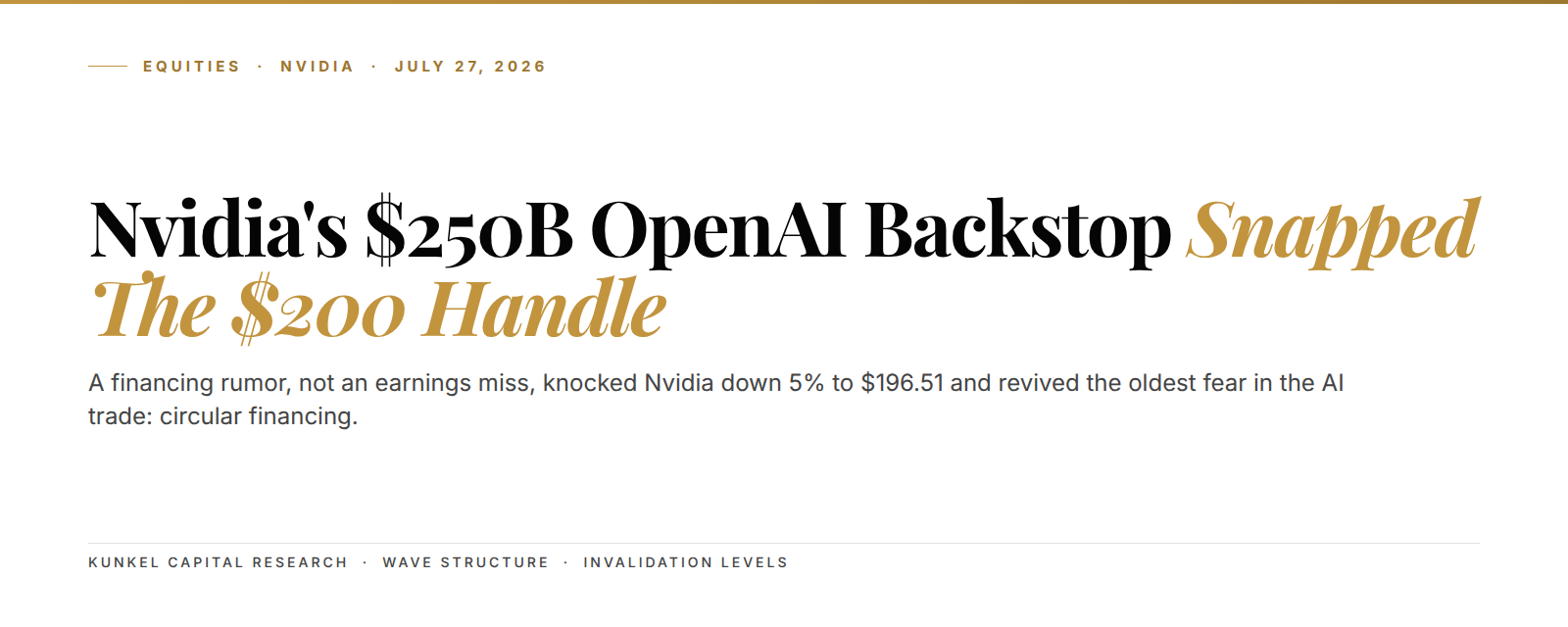
Nvidia dropped 5% on Monday, July 27, closing at $196.51 and losing the $200 handle it had held all month. That's the biggest one-day fall since February. The trigger wasn't a chip delay or a China ban. It was a financing rumor that hit over the weekend. The Wall Street Journal reported Nvidia is in talks to guarantee roughly $250 billion of OpenAI's data-center debt. Wall Street was supposed to cheer years of locked-in GPU orders. Instead it sold hard into the close. The same headline revived an old worry with a fresh number bolted on, and that worry has a name: circular financing.
The setup in 3 lines:
- Nvidia fell 5% to $196.51 on Monday, July 27, after the WSJ reported a roughly $250 billion backstop for OpenAI's data-center debt.
- The structure is vendor financing: Nvidia would guarantee the loans a customer then uses to buy Nvidia chips, which makes that demand look more solid than it is.
- Price is still inside the correction off the May 14 record of $235.47, so this reads as a pullback until the buyers who defended every dip stop showing up.
Michael Burry put it in four words on Monday afternoon. "Around and around we go," wrote the investor who shorted the 2008 housing bubble, minutes after the $250 billion figure crossed the wires. He's been circling the AI trade for months. This time he had a clean target: a chipmaker underwriting the very purchases that show up as its own demand. That single idea is why a rumor, not an earnings miss, knocked $150 billion off the most valuable company on Earth in one session.
Nvidia's 5% Monday drop to $196.51 was the tape voting on one word
The number that moved is small next to the number that scared people. Nvidia lost about 5% and gave back the $200 level. Any free chart shows it had held that line since early July. Five percent on a $4-trillion-plus company is a lot of market cap, but it isn't a crash. What made it notable was the reason. The stock didn't fall on weak orders. It fell on the shape of a deal that would, on paper, make orders stronger.
That's the tension the whole session was pricing. Stronger demand should lift the stock, so why did it drop? Because the market looked at how the demand would be manufactured and flinched. When a supplier guarantees the debt a customer raises, and the customer spends that money on the supplier, something odd happens. The revenue is real but the independence isn't. Buyers wanted to know the AI buildout stands on its own. Monday's headline suggested part of it might lean on Nvidia's balance sheet instead.
$150 billion of market cap moved on a financing rumor, not a single shipped chip. That tells you what this tape is actually trading.
So the drop was less about Nvidia's quarter and more about the plumbing behind the AI boom. Reuters, Bloomberg and CNBC all ran the same framing within hours, and each landed on the phrase the market feared most. The word wasn't "demand." It was "circular."
The $250 billion backstop guarantees OpenAI's debt on a 10-gigawatt Ohio campus
Here's the deal as reported, in plain terms. OpenAI wants to stop renting compute from Microsoft, Amazon and Oracle and build its own. To do that, it needs a 10-gigawatt data-center campus in southern Ohio, developed through SB Energy, a SoftBank subsidiary. That's a project the WSJ pegs at more than $500 billion once you count the chips inside. Nobody lends half a trillion dollars to a company that still loses money without a name behind the loan. So Nvidia is in talks to be that name.
The guarantee reported Sunday runs to roughly $250 billion of the debt. On top of that, Nvidia is said to be weighing another $350 billion to help OpenAI actually buy the GPUs. Bloomberg tallied the web of commitments at around $750 billion and put a headline on it that traders noticed: Nvidia's deals revive the fear of AI circular financing.

Techtimes framed the same fact from the other side, arguing the guarantee only exists because the debt markets said no on their own.
Translation: OpenAI couldn't borrow this much alone, so the chip seller is co-signing the loan the buyer uses to pay the chip seller. That closes a loop. And loops are exactly what makes an audit-minded investor nervous, because the same dollar can look like demand twice.
A wheat analogy helps. Picture a tractor maker who lends a farmer the money to buy the tractor, then books the sale as proof the harvest is booming. The sale is real. The proof isn't, because the maker funded it. When Nvidia guarantees the money OpenAI spends on Nvidia chips, the order is real, but it stops being independent evidence that the world needs that many chips.
Michael Burry's "around and around we go" names the real risk: vendor financing
Vendor financing isn't new, and that's the part worth sitting with. Lucent did it in the late 1990s, funding telecom customers so they'd buy Lucent gear, and the revenue looked spectacular right up until the customers couldn't pay. The mechanism inflates reported demand first and reveals the hole later. Burry's four words on Monday were shorthand for that whole history, which is why they traveled so fast.
Critics quoted by the WSJ made the risk concrete. If Nvidia backs the loans, and OpenAI or the next AI lab can't cover them, Nvidia doesn't just lose a customer. It eats the debt it guaranteed, so a demand story turns into a credit story on its balance sheet. That's a different animal from selling chips for cash. It's the difference between a shop that sells out its shelves and a shop that finances its own customers to clear the shelves.
Vendor financing inflates demand first and shows the bill later. Lucent proved it once. The market is asking whether Nvidia is rhyming with it.
Even so, there's a real bull case hiding in the same facts, and honest analysis has to hold both. Locking OpenAI into a decade of Nvidia hardware is a genuine moat if the compute demand is real. And most evidence says a lot of it is. The talks are early. People familiar with them told reporters the terms could change or the deal could collapse. So the market isn't pricing a fraud. It's pricing uncertainty about how much of Nvidia's growth is self-funded, and uncertainty is enough to take a stock down 5% when it's priced for perfection.
The $235 May peak still frames the structure, and Monday didn't break it
Step back from the headline and the chart tells a calmer story. Nvidia set its record close at $235.47 on May 14, then spent ten weeks working lower and sideways. By July 24 it closed at $206.84, already well off the high. Monday's drop to $196.51 extended a correction that was months in motion, and that context matters.

A stock that pulls back from a record on shrinking momentum is doing something normal, not something broken.
This is where our read gets structural. In wave terms, the move off the May top has the look of a correction against the larger uptrend, not the start of a new downtrend. Corrections retrace strength and shake out weak hands, and losing a round number like $200 is the kind of flush that ends pullbacks more often than it starts collapses. The Monday candle didn't take out the levels that would flip the trend. It took out a psychological handle, which is loud but not structural. We mapped the same distinction on the last big AI-capex wobble in our Nvidia $75B data-center "sell the news" read, and the pattern rhymes.
Nvidia is one of the assets on the Kunkel Capital rotation, and members get the full wave map with a defined entry zone, an exit target and the exact invalidation level refreshed on a fixed cycle. The public version stops at the framing. The structure stays inside the correction as long as the higher-timeframe swing lows hold, and every free chart shows where those are.
For the wider read on why these pullbacks behave the way they do, our wave-4 pullback and channel work walks the mechanics, and the wave-3 extension piece covers the leg that came before this one.
Circular-financing fear is now the Mag-7 story, not just Nvidia's
Monday wasn't only a Nvidia event, and that's what makes it a regime signal. Oracle, AMD and Broadcom all trade on the same AI-capex narrative, so when the market questions the funding behind one buildout, it re-rates the whole cohort. We saw the early version of this in Oracle's own capex blowout, which we broke down in our Oracle "sell the news" read, and in the custom-silicon split covered in our AMD and Broadcom piece.
The through-line is simple. As of July 28, 2026, the AI trade has moved from "is the demand real" to "how is the demand being paid for," and those are very different questions. The first one lifted every chip stock for two years. The second one separates the companies selling into cash orders from the ones financing their own order books. That distinction is the next fault line for the Nasdaq 100, which we track in our Mag-7 flush audit.
Here's the numbered version of what actually matters this week:
- Nvidia fell about 5% on July 27 to $196.51, its worst day since February.
- The trigger was a WSJ report of a roughly $250 billion OpenAI debt backstop, not an operating miss.
- Total reported commitments across the web of deals run near $750 billion, per Bloomberg.
- The structural worry is vendor financing that inflates how independent the demand looks.
- Price is still inside the correction off the May 14 record of $235.47, so this is a pullback read for now.
Where this read is wrong: the dip-buyers stop showing up
Every thesis needs the line where it breaks, and this one is clear. The read is that Monday is a pullback inside a larger uptrend, driven by a financing scare rather than a demand collapse. That read is wrong the moment the buyers who defended every dip since May stop showing up, and price closes back beneath its prior range on the weekly with the AI-capex story cracking underneath it. That's the invalidation: not a single red day, but a change in who's on the bid.
Watch two things, both visible on any chart. First, whether the round-number zone Nvidia just lost turns from support into a ceiling on the next bounce. Second, whether the selling stays orderly or turns into the kind of gap-down that signals forced hands rather than profit-taking. The condition that kills the bullish structure is behavioral: sellers taking control of the levels that have held since spring, not any one print.
For now the balance of evidence still favors a correction, not a top. The demand behind AI compute is mostly real, the deal is early and could change, and a 5% drop on a rumor is the market re-pricing risk, not calling a fraud. We told you what happened and why. The exact price where you'd act on it, and the exact level where you're wrong, is the part the full research carries.
Frequently asked questions
Why did Nvidia stock drop on July 27, 2026?
Nvidia fell about 5% to $196.51 after the Wall Street Journal reported it's in talks to guarantee roughly $250 billion of debt for OpenAI's data centers. The market read the structure as circular financing, where Nvidia backs the loans a customer uses to buy Nvidia chips, and sold the stock on the risk rather than any earnings miss.
What is circular financing in the AI trade?
It's when a supplier funds the customer that buys its products, so the supplier's own money comes back as reported revenue. The sale is real, but it isn't independent proof of demand because the seller paid for it. Critics compare it to Lucent's late-1990s vendor financing, which inflated demand before the customers defaulted.
Is the Nvidia OpenAI deal confirmed?
No. As of July 28, 2026, the talks are early. People familiar with them told reporters the terms could change or the deal could fall apart. The reported figures are roughly $250 billion in debt guarantees plus a possible $350 billion to help OpenAI buy GPUs.
Does the drop mean Nvidia's uptrend is over?
Not on the chart yet. Nvidia set its record close at $235.47 on May 14 and has been correcting since, so Monday extended an existing pullback rather than breaking the larger trend. The thesis flips if the buyers who held every dip since spring stop showing up and price closes back inside its old range.
Is Nvidia a covered Kunkel Capital asset?
Yes. Nvidia sits on the Kunkel Capital watchlist, so members get the current wave count mapped to a defined entry zone, an exit target and the exact invalidation level, with alerts when levels hit.
Know your entry, your exit, and where you are wrong on Nvidia
The $250 billion OpenAI backstop and the 5% drop to $196.51 are the surface signal. Nvidia is on the Kunkel Capital watchlist: the full research maps the current wave count to a defined entry zone, an exit target and the exact invalidation level, refreshed on a fixed rotation, with alerts when levels hit. €19.99 first month, then €34.99. Cancel anytime.
Last updated: 2026-07-28