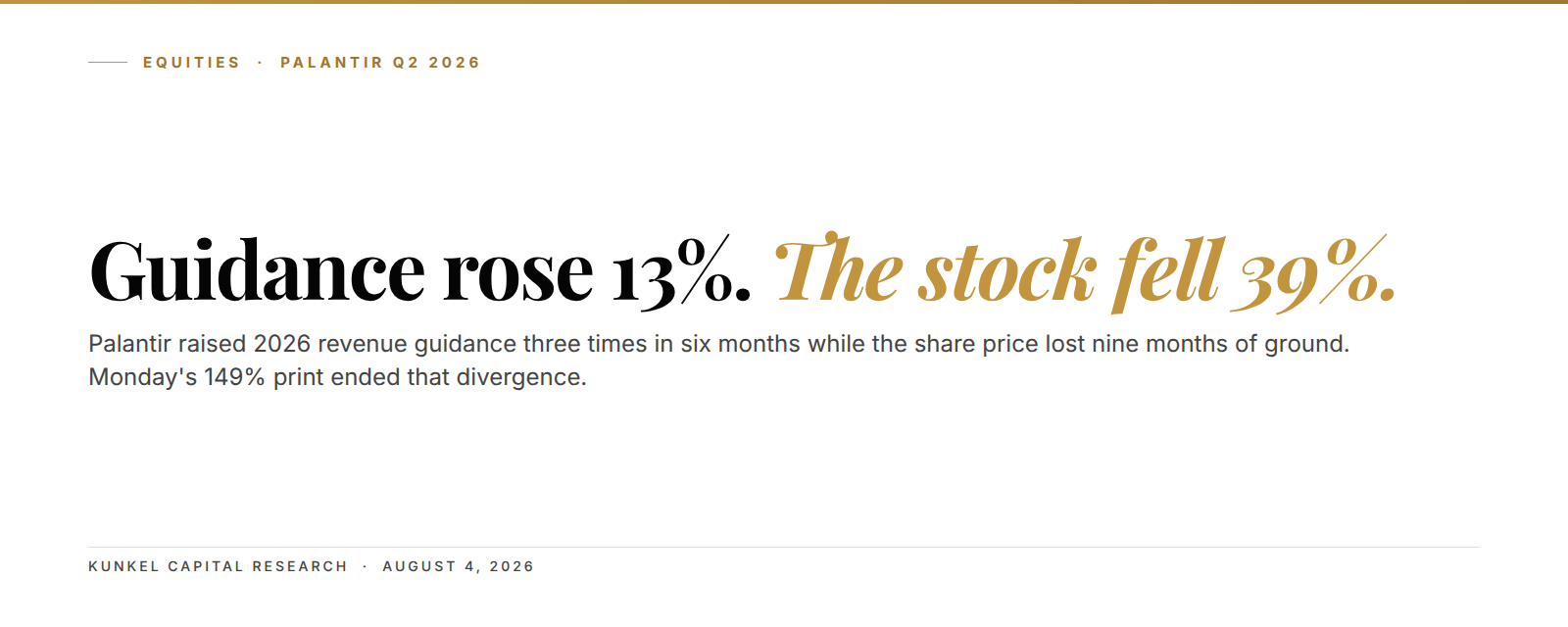
Palantir closed Monday at $125.65, about 39% below its November high, and then reported a quarter that grew revenue 93% year over year. That distance between the business and the share price has been the whole Palantir story since last autumn. The company kept compounding while the stock kept shrinking, and most of the tape read the drawdown as a verdict on the fundamentals. It was not. On August 3 Palantir raised full-year 2026 revenue guidance to $8.15 billion, its third raise in six months, and shares traded as high as $142.91 in extended hours.
The setup in 3 lines:
- US commercial revenue grew 149% year over year to roughly $764 million, up from 133% growth in the March quarter.
- Full-year 2026 guidance climbed from $7.19 billion in February to $8.15 billion on August 3, while the share price fell 39% from its November peak.
- Three months ago the same shape of news produced a 7% drop the next session, so the reaction is the signal.
Alex Karp took the call at 5pm Eastern on Monday and called the quarter "otherworldly," which is the word a CEO reaches for when the numbers are doing the arguing for him. He had a case, and the scorecard backs it. Palantir's Rule of 40 score, which adds revenue growth to operating margin, is the standard health check for a software company. Anything above 40 counts as good for a software business. Palantir printed 155% in the June quarter.
Palantir's 149% US commercial print was the third straight acceleration
Revenue landed at $1.94 billion against a street number near $1.8 billion, per the Q2 press release Palantir filed with the SEC on August 3. Adjusted earnings came in at $0.41 a share versus the $0.35 consensus. Those are beats, but Palantir has now beaten for eight straight quarters. A beat by itself was never going to move this stock.
The segment detail is where it gets interesting. US commercial revenue grew 149% to roughly $764 million, after growing 133% in the March quarter. Growth rates that big normally decay as the base grows. The prior-year comparison keeps rising underneath them. This one went the other way, three quarters running.
Government revenue grew 90% to about $809 million, which matters because that book was supposed to be the mature, slow half of the business. Instead the government book nearly kept pace. Total US revenue grew 115%, so the company accelerated on both legs at once.
Profitability moved right along with the growth. GAAP net income reached $1.062 billion at a 55% margin, up 225% from a year ago, and adjusted operating margin sat at 62%. Companies growing at 93% rarely print margins like that. Growth that fast is normally bought with sales spend.
$964 million. That is how much Palantir added to its own 2026 revenue guidance between February and August, while the share price fell 39%.
Guidance climbed $964 million in six months while the stock lost 39%
This is the number that reframes the whole drawdown. Palantir has guided full-year 2026 revenue three times, and every guide came in above the one before it:
- February 2026: $7.182 billion to $7.198 billion, or 61% growth.
- May 4, 2026: $7.650 billion to $7.662 billion, or 71% growth.
- August 3, 2026: $8.150 billion to $8.158 billion, or 82% growth.
Take the midpoints and the company added $964 million of expected 2026 revenue in six months. That is a 13% raise to its own top line. Over roughly the same stretch the share price went from $207.52 on November 3 to $125.65 on Monday's close. So expected revenue rose 13% and the market value of a claim on that revenue fell 39%.

Translation: the business got bigger and the price of the business got smaller, at the same time, for nine straight months.
So that is multiple compression at work. It is a sentiment event, not an operating one. Think of a rented office building where the rent went up every year of the decline and no tenant ever left. Nothing inside the building ever cracked at any point. What changed was the price other buyers would pay for that rent stream, and it more than halved.
The market punished the identical news in May and rewarded it in August
Here is the part worth sitting with. On May 4 Palantir reported 85% revenue growth. That was its fastest expansion since the 2020 debut, and it raised full-year guidance by ten points. The next session the stock closed at $135.91, down 6.9% from $146.03. Good news, punished.
Then the tape kept punishing it for another seven weeks. From that May 5 close, price ground down to $106.37 on June 25, a further 22% lower, with no bad news from the company in between. The pattern was simple: report well, guide higher, sell off. We wrote about that reaction function in why earnings drift ignores the beat, and Palantir was the cleanest case of it in large-cap software.
Monday broke the pattern. Same shape of news, bigger numbers, and the extended-hours print went to $142.91 instead of down 7%. When a market stops punishing news it used to punish, the news did not change, but the buyer did. That flip in the reaction function is worth more, structurally, than the 149% headline that caused it.

We should be honest about the other side of this. At the November peak Palantir carried one of the richest revenue multiples in large-cap software, and a stock priced that way gets hit for anything short of perfect. So the de-rating was not irrational, and some of that compression was owed. What we cannot know from one after-hours session is whether the rest of it is finished.
Nine months and 48.7% down: the correction had the shape corrections have
From the November 3 high at $207.52 to the June 25 low at $106.37, Palantir gave back 48.7%. That took roughly eight months, and it is exactly what a large corrective sequence looks like against a prior impulse of that size. Corrections tend to alternate in character and in speed. If the last pullback was sharp and quick, the next one runs long and grinding. This one was the grinder.
Price bottomed at $106.37 and has not returned there in six weeks. July then built a range between $117.89 and $138.90, and both attempts to crack the floor failed inside a single session. On July 28 the low printed $117.89 and buyers took it back the same day, closing at $123.53. Three sessions later the low printed $119.62 and the close was $123.06. Higher lows against a flat ceiling is the most common way a correction hands off.
$142.91 versus $138.90. Monday's extended-hours print cleared the entire July range on the strongest fundamental news of the year.
Monday's regular session closed at $125.65, still inside that July range. The gap above it came after the bell. A gap that clears a full month of range-building on news this strong behaves differently from a gap that fades back into old supply. We walked through that distinction in the TSMC wave 4 pullback piece, and the mechanics carry over cleanly here.
Palantir is one of the names on the Kunkel Capital rotation: members get the full structure map with entry, exit and invalidation refreshed on a fixed cycle.
$3.4 billion in closed contract value is what carries the read into Q3
Total contract value closed in the quarter reached $3.4 billion, up 49% from a year ago. Palantir signed 220 deals worth at least $1 million and 73 deals worth at least $10 million. Contract value is not revenue yet, and that is the point. It is revenue Palantir has already been contracted to deliver.
Think of a wheat farmer who has already sold next year's crop forward at a fixed price. He is not betting on where wheat trades, he is delivering against a lock he signed months ago. The $3.4 billion is Palantir's version of that lock. It is why this raise carries more weight than a guide resting on a pipeline that has not closed.
The cash generation confirms the same picture. Adjusted free cash flow was roughly $1.2 billion in the quarter at a 63% margin, and the full-year guide went to $4.5 billion to $4.7 billion. A company converting revenue to cash at that rate does not need the equity market to be friendly. That is precisely what let the business keep accelerating while the shares fell.
Six things Monday's print changed for the Palantir structure
- US commercial growth accelerated for a third consecutive quarter, to 149% from 133%.
- Full-year revenue guidance moved to 82% growth, up from 61% guided in February.
- US commercial full-year guidance moved to at least 134% growth, from 115% in February.
- Adjusted operating margin reached 62%, so growth is no longer being bought with margin.
- Closed contract value rose 49% to $3.4 billion, which pre-funds the raised guide.
- The reaction function flipped from selling good news to buying it, for the first time since autumn.
The structural read, and where the thesis breaks
Our read is that the nine-month correction completed at the June 25 low, and Monday's report is the fundamental confirmation the tape had been waiting for. The mechanism is simple once you separate the parts. The multiple did all the damage while the business did none of it. A de-rating can only run until the estimates underneath it grow fast enough to catch the falling price, and at an 82% guided growth rate against a 39% price decline, that math ran out.
What follows is a market that has to re-price forward. The June low was made against a 71% guided growth rate. That same low now sits against an 82% guide and a contract book 49% larger, so the fundamental floor underneath the technical floor moved up while price did nothing. We flagged the same setup across AI infrastructure names in the Nasdaq 100 Mag-7 flush audit, and it resolved the same way there.
Now for the part that keeps this honest. Where the thesis breaks: a daily close back inside the July range that holds for a week, combined with a Q3 report showing US commercial growth rolling over from 149%, kills this read outright. Together those two conditions would say the gap was short covering. The de-rating would still have work to do. A single red session does not do it. Neither does a soft macro tape on its own, because broad index weakness drags good structures around without breaking them.
The one thing we would not do is treat the after-hours print as settled. Extended-hours prices trade thin and get revised hard at the open. Today's regular session is where the number becomes real. If you want the honest version: the direction is clear, the confirmation is not, and the difference between those two states is worth respecting.
Frequently asked questions
Why did Palantir stock jump after the August 3 earnings report?
Palantir reported Q2 2026 revenue of $1.94 billion, up 93% year over year, with US commercial revenue growing 149%. It also raised full-year revenue guidance to $8.15 billion, the third consecutive raise. Shares traded as high as $142.91 in extended hours.
How far had Palantir stock fallen before the Q2 print?
Shares peaked at $207.52 on November 3, 2025 and bottomed at $106.37 on June 25, 2026, a decline of 48.7%. Going into Monday's report the stock closed at $125.65, roughly 39% below the November high.
Was the Palantir drawdown caused by weakening fundamentals?
No, and this is the core point. Revenue growth accelerated through the entire decline, from 85% in the March quarter to 93% in June, and full-year guidance was raised at every report. The decline came from multiple compression, which just means investors paid less for each dollar of revenue.
What is Palantir's Rule of 40 score and why does it matter?
Rule of 40 adds a software company's revenue growth rate to its operating margin, and anything above 40 counts as healthy. Palantir reported 155% for the June 2026 quarter. That is why the quarter drew the "otherworldly" description on the call.
What should traders watch next on Palantir?
The regular session on August 4 is the first real test, because extended-hours prices trade thin and often get revised at the open. After that, the Q3 report is where US commercial growth either holds near 149% or confirms the deceleration bears have waited for.
Know your entry, your exit, and where you are wrong on Palantir
The 149% commercial print and the guidance ladder are the surface signal. Palantir is on the Kunkel Capital watchlist: the full research maps the current wave count to a defined entry zone, an exit target and the exact invalidation level, refreshed on a fixed rotation, with alerts when levels hit. €19.99 first month, then €34.99. Cancel anytime.
Related reading: Alphabet's capex selloff and the cloud backlog · Amazon's gap and the AWS backlog · Wave 4 pullbacks and channel alternation · NVIDIA, OpenAI and circular financing.
Sources: Palantir Q2 2026 press release filed with the SEC (August 3, 2026), Palantir Q1 2026 and FY2025 press releases, Reuters, Bloomberg.
Last updated: 2026-08-04