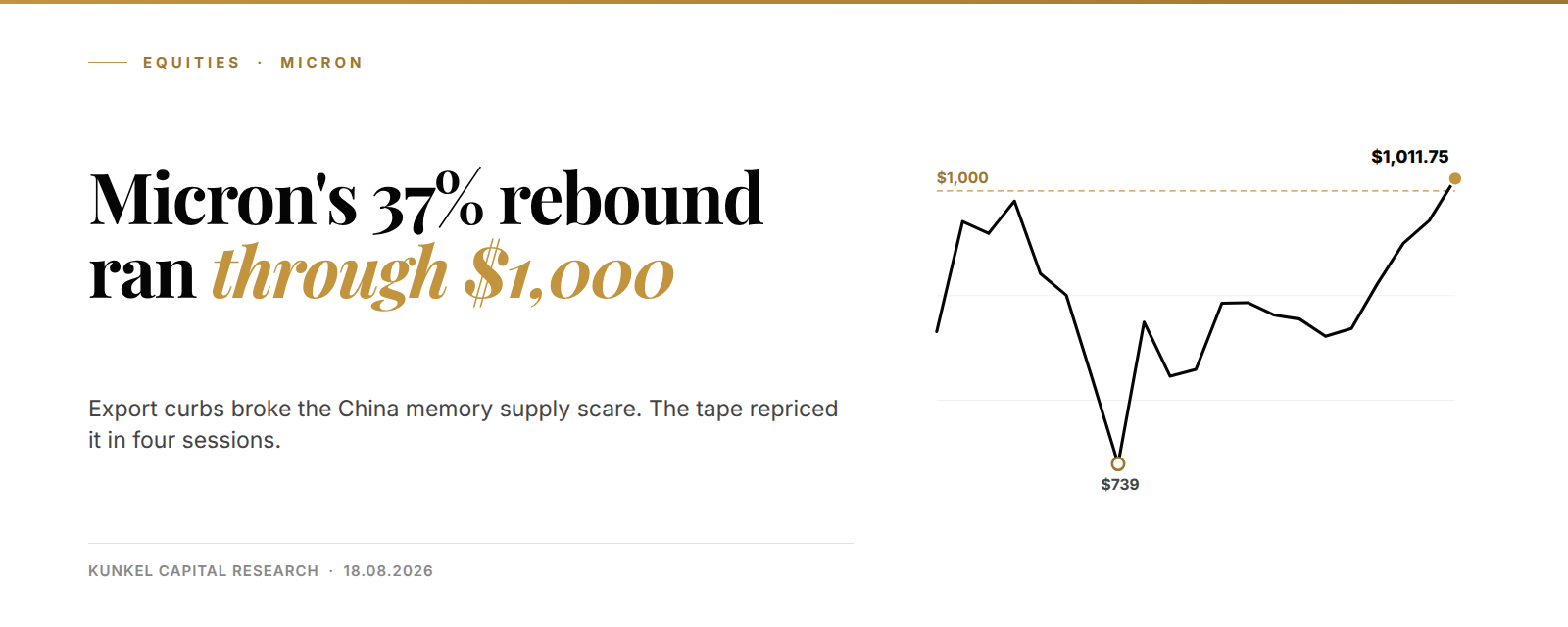
Micron closed Monday at $1,011.75, up 4.1% on the session. That's the first close back above the $1,000 handle it lost in July. Thirteen sessions earlier the stock had finished at $739, a 41% collapse from June's $1,255 high. The bear story pinned to that flush was tidy. China's CXMT would flood the DRAM market with state-funded supply, ending the memory cycle early. That story just lost its tools, and the tape spent four straight sessions repricing what that means.
The setup in 3 lines:
- Micron finished August 17 at $1,011.75, a 37% recovery from the July 29 capitulation close of $739.
- Applied Materials said on Thursday's call that US export curbs now block its memory-tool sales into China, cutting the legs off the CXMT supply scare.
- New Street Research raised its Micron valuation to $1,250 on Monday, arguing AI will take two-thirds of memory demand.
Here's the stat the July sellers skipped. Micron lifted its global DRAM share to 25% in the second quarter, up from 22% and one point behind SK Hynix. Its quarterly DRAM revenue ran roughly five times the prior year's level. You don't normally get a 41% drawdown from a company taking share in a shortage. So the real question was never demand. It was whether Beijing could build the supply response, and that answer changed on Thursday evening.
July's 41% flush priced a Chinese supply wave that exists mostly on paper
The damage arrived in two waves. First came the late-July semiconductor break, the same air pocket that dragged the whole index down (we mapped it in our July S&P 500 post-mortem). It compressed Micron to that $739 close in a handful of sessions. The stock tried to bounce off that print. Then Reuters reported on August 3 that CXMT is in early talks for a second 12-inch DRAM fab in Beijing's Yizhuang district, fresh off an $8.6 billion Shanghai listing. That headline smothered the recovery, and the shares sat pinned under $900 for two more weeks.
The fear wasn't small. CXMT is already the world's fourth-largest DRAM producer, and its active buildouts across Hefei, Shanghai and Beijing point toward 600,000 wafers per month, more than double its current output. If that capacity lands on schedule, contract prices roll over and every memory model on Wall Street gets rewritten. We flagged the first leg of this repricing in July's DRAM contract-price gap, back when the stock first gapped away from its own pricing data.
But a fab announcement is only a press release, while capacity is a purchase order. Between those two sits the toolset: lithography, deposition, etch, metrology. Most of it comes from a few American vendors plus ASML and Tokyo Electron. And that's exactly where the story broke down last week.
Gary Dickerson handed memory bulls their best datapoint while his own stock fell 5%
Thursday evening, on Applied Materials' fiscal third-quarter call, CEO Gary Dickerson told analysts the company can no longer supply China's memory-chip market under the tightened US export controls. The quarter itself was a record, with revenue of $9.12 billion, up 25%, and earnings up 41%. The stock still fell 5% on Friday, because China has shrunk from 35% of Applied's revenue to 28%. Management expects Chinese equipment spending to fall further in 2026.
Now read that same call from Micron's side of the trade. The bear case needs CXMT to double its output, and doubling output needs tools that Washington just took off the menu. CXMT can pour concrete in Yizhuang all year, but without deposition and etch systems a fab shell is just an expensive empty warehouse. Think of a developer breaking ground on a tower in a city where the crane operators aren't allowed on site. The foundation gets photographed, but the floors never rise.
Put simply, the market sold the toolmaker for losing a customer, and the exact same fact means that customer can't build the supply wave that was supposed to crush memory prices.
Friday's tape showed the divergence cleanly, with Applied Materials closing down 5% while Micron rose 2.3% to $971.66. Same headline, opposite trades, and both moves priced the same physical constraint. By Monday, the read-through had a sponsor.

28% from 35%. That's China's shrinking share of Applied Materials' revenue, and the reason CXMT's second fab is a plan without a toolset.
New Street's $1,250 note prices HBM as an AI component, not a commodity
Pierre Ferragu at New Street Research raised his Micron number to $1,250 on Monday, and the stock ran 4.1% into the close. His argument is structural. High-bandwidth memory (the stacked DRAM that feeds AI accelerators) consumes far more wafer capacity per bit than standard chips. So AI demand tightens the entire market, not just one product line. Ferragu models AI at roughly two-thirds of total memory demand with 15% annual growth beyond 2030, against a 10% historical rate.
The numbers underneath that note are worth lining up:
- Monday's close: $1,011.75, a 37% recovery from the July 29 print in thirteen sessions.
- Valuation: about 13x forward earnings, near the low end of the megacap AI complex.
- Adjusted gross margin last quarter: 84.9%, a level memory makers historically never touched.
- Free cash flow last quarter: $18.3 billion.
- DRAM share: 25% and rising, one point behind SK Hynix.
- Contract pricing: desks tracking memory now model DRAM up 15% to 20% this quarter, with another leg in the fourth.
- Management's own guide: tightness beyond 2027, with 2027 tighter than 2026.
In plain terms, the market is paying a commodity multiple for a company currently printing component-maker economics. That mismatch is the whole bull case. And it's also the thing that snaps back hardest if contract pricing ever turns.
13x forward earnings. That's the multiple on a stock that just reported an 84.9% adjusted gross margin quarter.
The chart reads as a positioning flush, not a cycle top
Structurally, the July decline carries the signature of forced selling rather than distribution. The drop from June's $1,255 high ran its full 41% in about six weeks, spent two sessions near the low, and reversed without building any base. Tops in this sector don't usually behave that way. They grind, they retest, they fail at lower highs. This one v-bottomed the moment the supply story met the export-control wall.

There's also information in the two weeks the stock spent going nowhere. For seven straight sessions after the CXMT headline, Micron closed between $829 and $894, absorbing the news without making a new low. Bases like that are where weak hands pass inventory to stronger ones. So when the Applied call landed on Thursday, the supply of sellers under $900 had already been spent.
You can also see it in how fast the round numbers gave way on the way back up. The stock reclaimed $900 on August 12 and took $950 a day later, before Monday's close finished the job on the $1,000 handle. Each level held as support within a session of breaking. That's short covering plus underweight funds chasing, not a crowd selling into strength. We ran the same forensic on the Nasdaq's Mag-7 flush in July, and the tell was identical there.
The overhead marker is plain enough, since June's high still sits 24% above Monday's close. Micron is one of the assets on the Kunkel Capital rotation: members get the full structure map with entry, exit and invalidation refreshed on a fixed cycle. What we can say here is that the advance off the July low looks impulsive, and first legs off a capitulation print rarely die at the first round number they touch.
The bear case worth respecting is dated 2028, not stamped Beijing
Now the honest caveat, because we were early on this one. Our July coverage treated the DRAM contract-price gap as an open cycle risk, and for two weeks the tape agreed with us. Wait, actually, the cycle risk didn't disappear at all. What changed is the timing, because the next real supply response just got pushed out by policy rather than by economics.
And the cycle will still turn eventually. Consensus models Micron's earnings peaking near $154.89 per share in 2027, then sliding toward $100 in 2028 as new American and Korean capacity finally lands. Pricing momentum is already expected to cool from here even as absolute prices rise. The genuine unknown is whether Chinese domestic toolmakers can backfill Applied's role faster than anyone models. Nobody has clean data on that pace, including us. If you're sizing anything off this read, that's the assumption to stress first.
So here's the regime read. Memory stays supply-constrained while China can't tool up. The AI build keeps HBM wafer-hungry, the same capex river we traced in NVIDIA's circular-financing map. And Micron still trades at a discount to that reality. The invalidation is behavioral rather than a price on this page. A daily close back below the July capitulation print, while DRAM contract prices roll over, is where we are wrong. That combination would mean the supply wave is arriving anyway, tools or no tools. Short of that, dips into the round numbers are a fight over positioning, not over the thesis.
Know your entry, your exit, and where you are wrong on Micron
The 37% rebound is the surface signal. Micron is on the Kunkel Capital watchlist: the full research maps the current wave count to a defined entry zone, an exit objective and the exact invalidation level, refreshed on a fixed rotation, with alerts when levels hit. €19.99 first month, then €34.99. Cancel anytime.
Frequently asked questions
Why did Micron stock go up this week?
Two triggers stacked on top of each other. Applied Materials said on Thursday's call that export curbs now block its memory-tool sales into China, which undercuts the CXMT supply scare behind July's flush. Then New Street Research lifted its valuation to $1,250 on Monday, and the stock closed at $1,011.75, up 4.1%.
Why did Micron fall 41% in July?
The late-July semiconductor break did most of the damage, compressing the stock from June's $1,255 high to a $739 close on July 29. The August 3 Reuters report on CXMT's second Beijing fab then smothered the bounce. The shares sat under $900 until the export-control picture flipped the story.
Is Micron still cheap after a 37% bounce?
On the numbers, yes. The stock trades near 13x forward earnings against an 84.9% adjusted gross margin. Free cash flow ran $18.3 billion last quarter. The catch is that consensus already models an earnings peak in 2027, so the multiple is low because the market doubts the cycle's length, not the current quarter's strength.
What would break the recovery thesis?
A daily close back below the July capitulation print while DRAM contract prices roll over. That combination would say new supply is arriving despite the export curbs, and it would put the 2028 downturn scenario back on the front foot well ahead of schedule.
Sources: Reuters, Applied Materials fiscal Q3 2026 results, Yahoo Finance price data.
Last updated: 2026-08-18