The breakout candle prints green. Volume runs two standard deviations above the 20-day average. You see the alert, click through to the chart, and price is already 3% above the level you were watching. You skip it, waiting for the pullback. Three weeks later silver is 12% higher and the pullback never came.
That's almost every trader with silver breakouts. The setup is not the breakout candle. The setup is the retest.
I want to walk through what the retest actually looks like, why it's the only entry that gives you defined risk, and the three confirmation filters that separate the ones that work from the ones that fail. Call it a trade idea. Really it's a template you can run every time silver clears a multi-year range, which happens maybe once every 18 to 30 months and pays for a year of losers when it does.
What a silver breakout retest actually is
Silver spends most of its life in horizontal ranges. Not trends. Ranges. The metal will chop between a support shelf and a resistance shelf for anywhere from 8 to 24 months, and the resistance shelf is usually the prior cycle high from the last real move.
When price finally clears the shelf on heavy volume, you get the breakout candle. That's the move everyone sees on Twitter. The breakout candle is not the trade.
The trade is what happens next. Roughly 60 to 70% of real breakouts retest the level they broke, usually within 5 to 15 sessions. Price fades back down, touches or briefly undercuts the old resistance, and then buyers defend it. That defense is the confirmation. Old resistance has become new support. The structure has changed.
Silver does this more cleanly than most metals. Maybe because the options market on SLV is liquid enough that dealer gamma pins price at round numbers, maybe because the futures curve is usually in contango and the long side has a borrowing cost, maybe I'm overthinking it. Whatever the reason, the retest pattern prints often enough that you can build a template around it.
The key insight: the breakout tells you what's happening. The retest tells you where your risk is. Without a defined risk level, you're guessing at size. With one, you're trading.
Why the breakout entry is the wrong entry
Most traders buy the breakout. I don't, and here's why.
Buy the breakout and your stop has to go somewhere structural. The nearest structural level is the midpoint of the prior range, which on a long consolidation might be 8 to 15% below the breakout. That's a terrible risk unit. Any half-decent target gives you 1:1 or worse.
Shrink the stop to something tighter, say 2 to 3% below the breakout, and you get stopped out on every normal pullback. Silver doesn't move in straight lines. It moves in 3 to 5% waves even in strong trends. You'll get tagged, puked out, and then watch the move run without you. I've done this more times than I want to remember.
Wait. Actually there's one case where the breakout entry works. When silver breaks out on a weekly close with a macro trigger (a Fed pivot, a real yield collapse, a dollar breakdown below a major moving average) and the weekly candle closes in the top 20% of its range. That's a different setup. It's a momentum trade, not a structure trade, and it needs different risk rules. For most breakouts, the retest entry is the one that pays.
The retest entry solves the risk problem. You have a level (the old resistance). You have a trigger (the reclaim candle off the retest). You have a stop (below the retest low). You have a target (the next structural level above). Everything is defined. Nothing is vibes-based.
The retest: where the real edge lives
Here's the mechanical version.
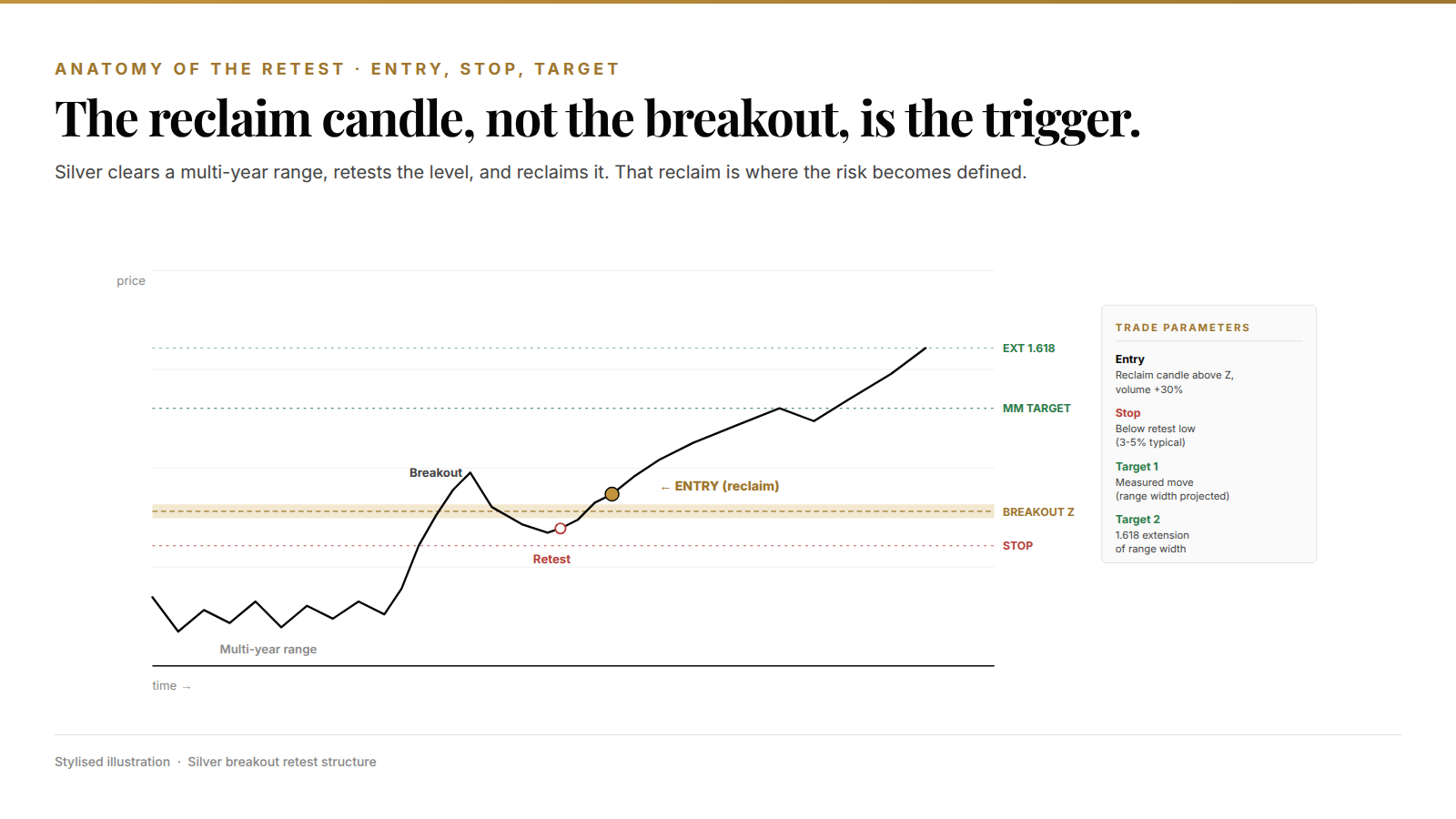
Silver clears a multi-year resistance zone. Call that zone Z. The zone isn't a single price. It's usually a 2 to 4% band between the closing high from the last cycle and the intraday high. Use the band, not a point.
After the breakout, watch for price to decline back toward Z. The decline can take 3 days or 3 weeks. Patience is the hard part. Most traders give up and go chase something else, which is fine. The setup isn't going anywhere.
When price reaches Z, one of three things happens. Either it reclaims immediately (bullish, but less common), it briefly pierces Z and then reverses (a spring, most common), or it closes decisively below Z for two or more sessions (invalidation, rare but real). Only the first two are trades.
The trigger is the reclaim candle. Price touches or undercuts Z, then closes back above it with volume at least 30% above the 20-day average. That candle, not the breakout candle, is the signal. The stop sits below the retest low. The risk is defined. The trade is on.
One more detail. If the retest comes on a Friday with low volume, I'd rather wait for Monday's action. Friday closes on silver often get reversed by Sunday night's Asia open because thin liquidity amplifies position squaring. Not a rule. A tendency.
Three confirmation signals that separate the winners
You will not get certainty in advance. You will get probability. These three filters together raise the probability enough to size up.
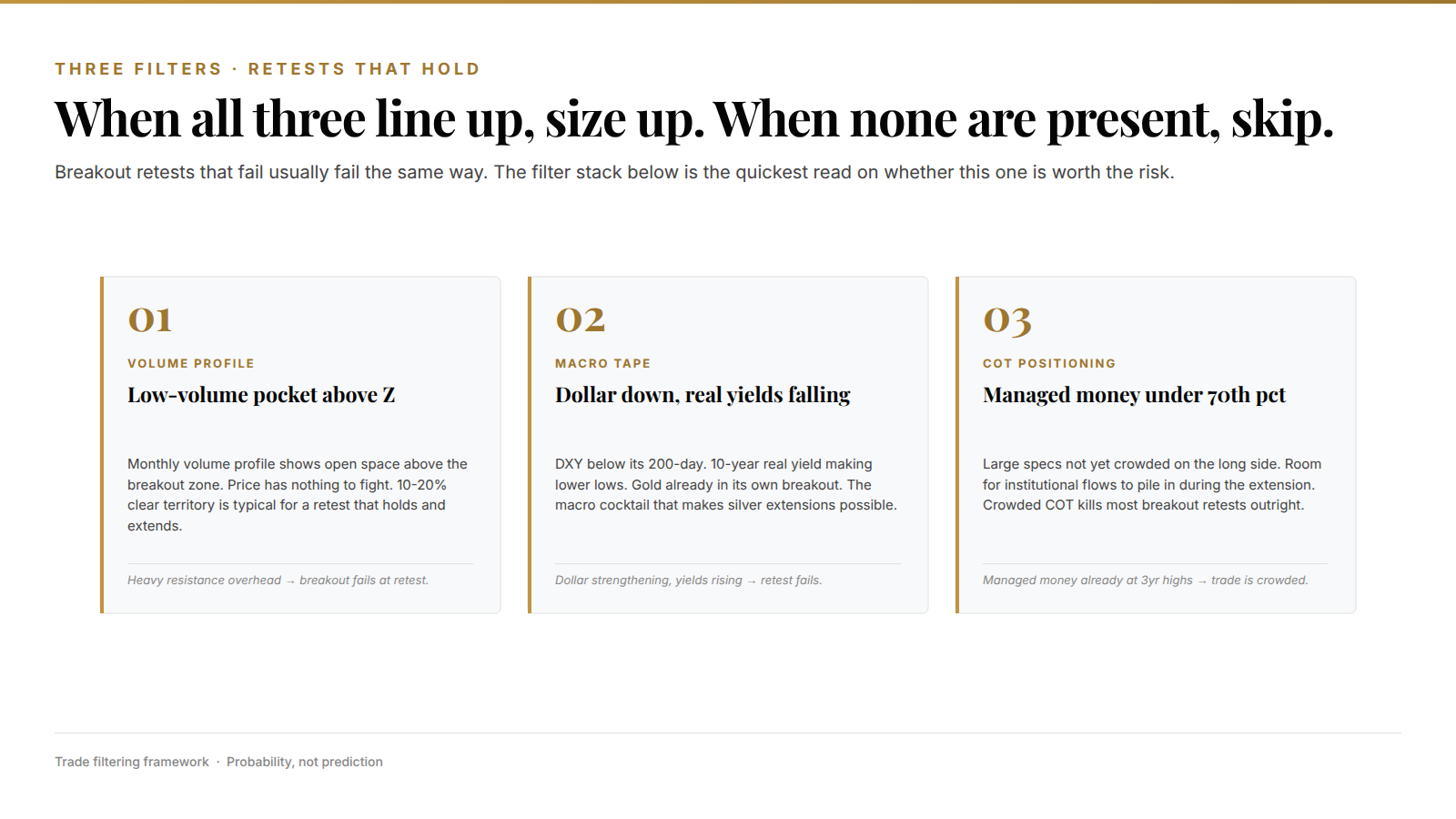
1. Volume profile shows a low-volume pocket above the breakout zone. Pull up the monthly volume profile on silver futures. If there's a low-volume node between the breakout zone and the next major high, price has nothing to fight. Breakout retests that succeed usually have 10 to 20% of open space above them on the profile. Heavy resistance above caps the move and turns it into a failed breakout.
2. Macro tape is aligned. Silver is a monetary metal. It doesn't break out on its own. When it does, the dollar is usually breaking down and real yields are dropping. The DXY below its 200-day, the 10-year real yield making a lower low, and gold already in a breakout of its own is the textbook macro cocktail for a silver extension. If the dollar is strengthening and real yields are rising, the breakout is probably going to fail on the retest. Skip it.
3. COT positioning is not crowded. The Commitment of Traders report matters here. If managed money longs are already at a 3-year high percentile going into the breakout, the trade is crowded and the retest usually fails. If managed money is still below the 70th percentile when price clears the range, there's room for the large specs to pile in and drive the extension. The crowded-trade filter catches maybe one fake breakout a year. Worth the time.
When all three signals line up, I size bigger. When only one or two are present, I size smaller and widen my target expectation. When none are in place and silver is running on a commodity-wide short squeeze, I often skip the trade and wait for the next one. There will be another.
Entry, stop, target, invalidation
The specifics.
Entry: The reclaim candle off the retest of the breakout zone. Typically a daily close back above the prior resistance band after a touch or brief undercut. Confirmation is a volume spike at least 30% above the 20-day average.
Stop: Below the retest low, or below the breakout zone's lower band, whichever is tighter. On silver, that usually works out to 3 to 5% below entry, which is tight enough to size meaningfully but wide enough to avoid normal intraday noise.
First target: The measured move. Take the width of the prior range (resistance shelf minus support shelf) and project it up from the breakout point. Silver ranges tend to produce measured moves that work 70 to 80% of the time in the first wave up.
Extension target: The 1.618 extension of the prior range width, or the next major cycle high from 5 to 10 years back. Don't size for this. It's the upside surprise.
Invalidation: A weekly close back inside the prior range. Not an intraday fakeout. A weekly close. If silver closes the week below the breakout zone after you've entered, the structure has failed and you exit on Monday regardless of where price is. The trade thesis is gone.
The risk-reward on the standard target usually runs 1:3 to 1:5, depending on how tight the retest low is to the breakout zone. That's enough to justify the trade even if your hit rate is only 45%. Silver breakout retests tend to resolve around 55 to 65% of the time when the three filters are in place, which makes the expected value meaningfully positive across a year of tries.
What to do if you missed the retest
This happens. Silver sometimes breaks out and runs without a retest, especially on macro shock days (a surprise Fed cut, a dollar flash crash, a real-yield spike in the wrong direction).
When that happens, don't chase. Wait for the next structural level to get tested. On silver, the next structural level is usually the midpoint of the measured move, which you can calculate the moment the breakout happens. If the measured move projects silver to a round number, the 50% retracement of the move from breakout to target is the next defensible long entry. Your stop goes below that level.
If that pullback doesn't come either, the trade is gone. Skip it. Wait for the next multi-year range and the next breakout. Silver prints one or two of these setups per cycle. Missing one is not a career-ending decision. Forcing one is.
Bottom line
Silver breakout retests are one of the cleanest high-probability long setups available in commodities, and almost no retail trader actually runs the template because the breakout candle is too tempting to skip. The retest is where the risk becomes defined. The reclaim candle is where the trigger fires. The three filters (volume pocket, macro alignment, uncrowded COT) separate the ones that work from the ones that fail.
Entry on the reclaim candle, stop below the retest low, first target at the measured move, extension target at the 1.618 projection, invalidation on a weekly close back inside the range. Everything else is commentary.
The hard part is the waiting. The easy part is the math.
Same analysis that goes into these templates feeds the signals Kunkel Capital publishes daily. If you want the levels without running the volume profile and the COT tables yourself, that's what the subscription is for. If you'd rather build your own template, the framework above is enough to get started.
---
Not investment advice. Do your own research. Last updated 2026-04-18.