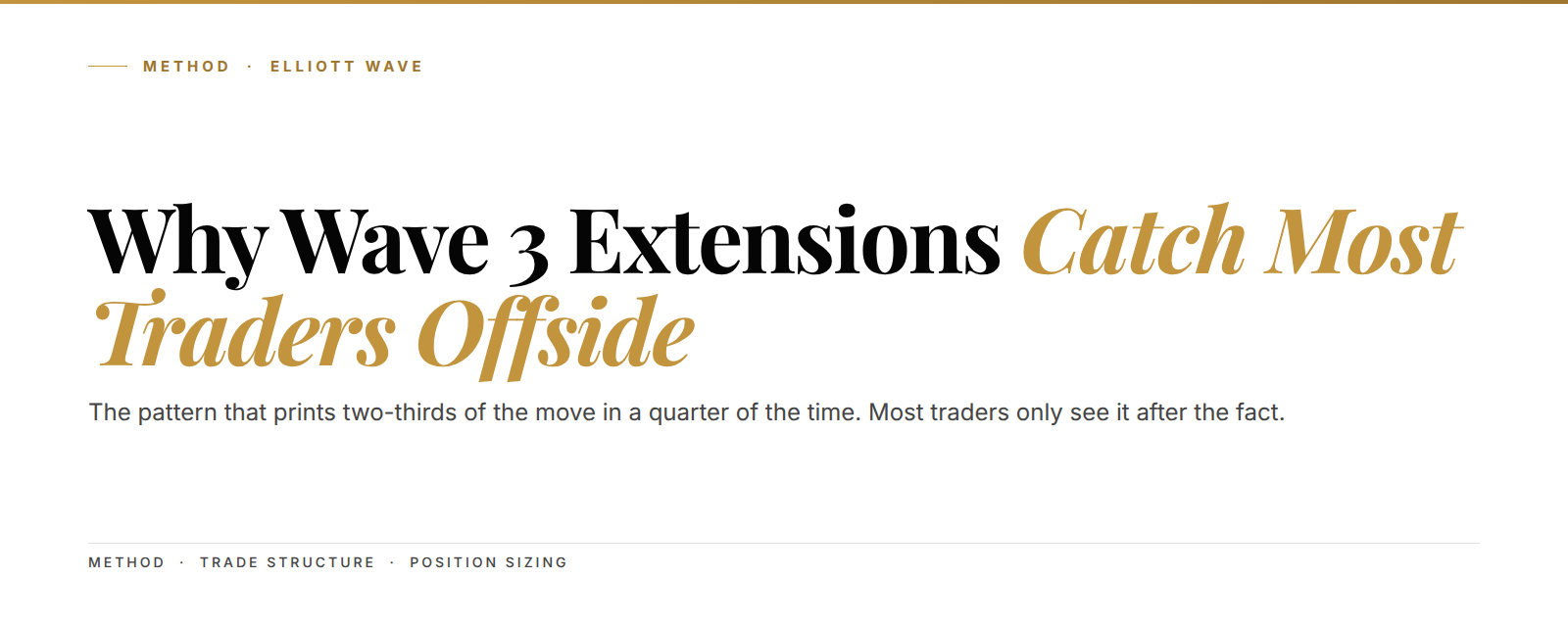
You buy the breakout. You set a stop under the prior swing low. You watch price grind sideways for two days, then explode 8% in a session you spent at the dentist. By the time you check your phone, the move you called is half over.
That move was a wave 3 extension. Most traders miss them the same way. The pattern is not random.
I want to walk through why this happens, what the setup actually looks like before it triggers, and how to position so you stop being the person reading the screenshot instead of holding the trade.
What a wave 3 extension actually is
Plain Elliott Wave is five waves up in an impulse. Three motive waves (1, 3, 5) push the trend. Two corrective waves (2, 4) push back against it. That's the textbook.
Reality has a wrinkle. One of the three motive waves is usually longer than the other two. In stocks and crypto, that's almost always wave 3. In currencies, wave 5 takes the role more often. The wave that runs longer is called the extended wave.
A wave 3 extension is when wave 3 doesn't just go further, it goes much further. Standard wave 3 is 1.618x the length of wave 1. Extended wave 3 runs 2.618x or even 4.236x. In percentage terms, that's the difference between a 12% move and a 28% move. Same setup. Different size. Different P&L by an order of magnitude.
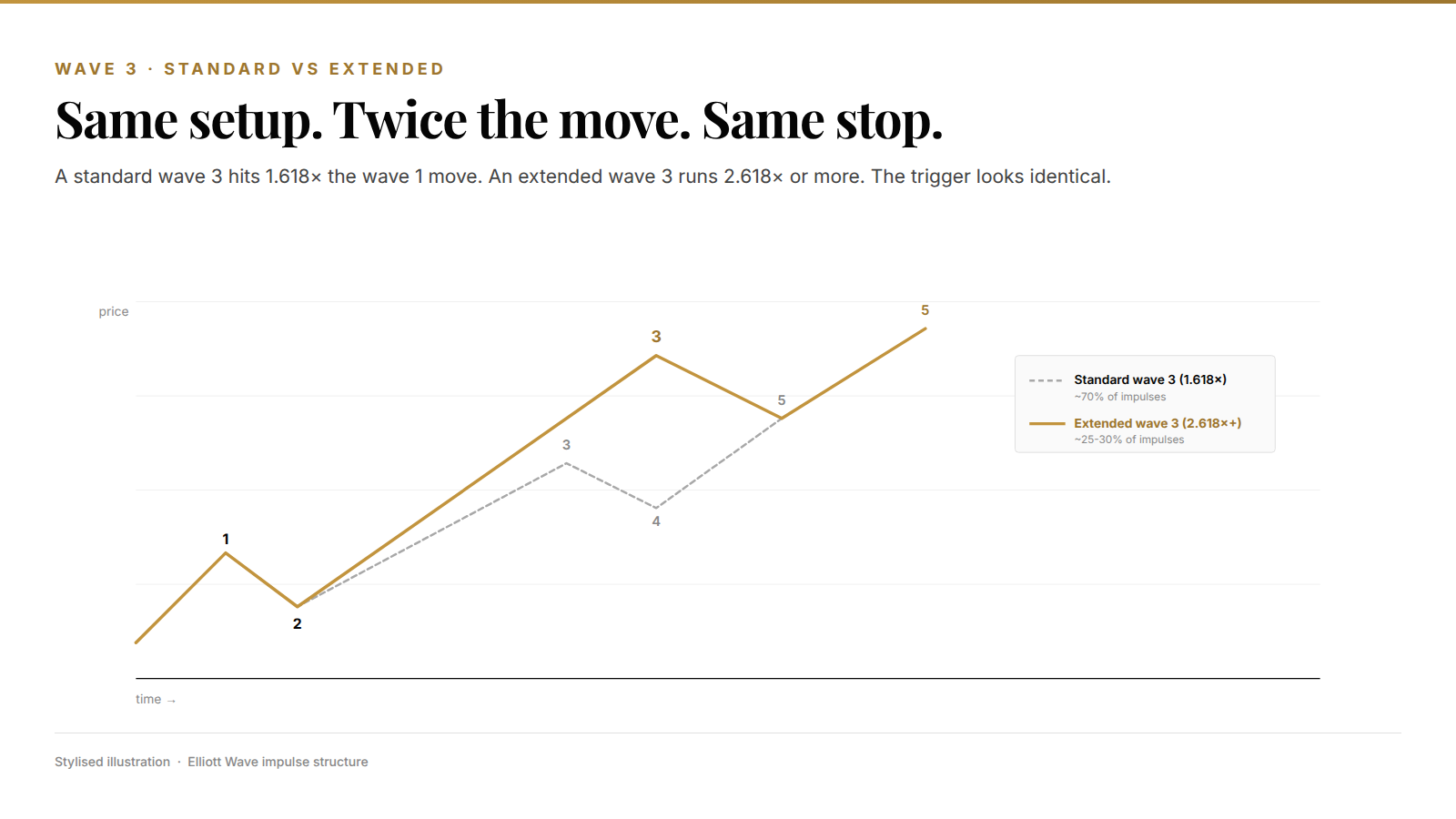
The mechanics behind it are simple. Wave 3 is where the late majority piles in. Trend followers see the breakout, momentum chases the breakout, and a chunk of the prior bears capitulate and flip long. All three flows hit the tape at the same time. The result is a vertical move that doesn't pause for breath until the inventory is exhausted.
Why most traders read it wrong
Three things go wrong, usually in this order.
First, the breakout looks ordinary. Wave 3 starts inside what looks like normal price action. The open of wave 3 is just another candle. Nothing on the chart says this is the one. Traders who entered earlier in wave 1 are already in. Traders who waited for confirmation are still waiting for the next dip.
Second, the early part of wave 3 doesn't trigger conventional alerts. The breakout above the wave 1 high is the textbook entry, but by then price has often already moved 15-20% off the wave 2 low. Most traders pass on it. They want a pullback. The pullback inside wave 3 is shallow, fast, and easy to miss.
Third, when the move accelerates, traders chase late and sit through a normal wave 4 correction with too much size. They get stopped out near the wave 4 low (often a 38.2% retracement of wave 3) and then watch wave 5 run without them.
The whole sequence is structural. The same emotional reactions produce the same trader behaviour. The market doesn't move sideways through this; it moves through people.
The three signals that flag an extension early
You will not get certainty in advance. You will get probability. These three signals together raise that probability enough to size up.
1. Wave 2 was a deep retracement, not a flat. Sharp, deep wave 2s (61.8% to 78.6% retracements of wave 1) are a positional reset. They flush late longs and bring in new shorts who think the trend is over. When wave 3 turns up off that low, the bears have to cover. That covering is the fuel for an extension. Shallow wave 2s (under 50%) lead to standard wave 3s, not extensions.
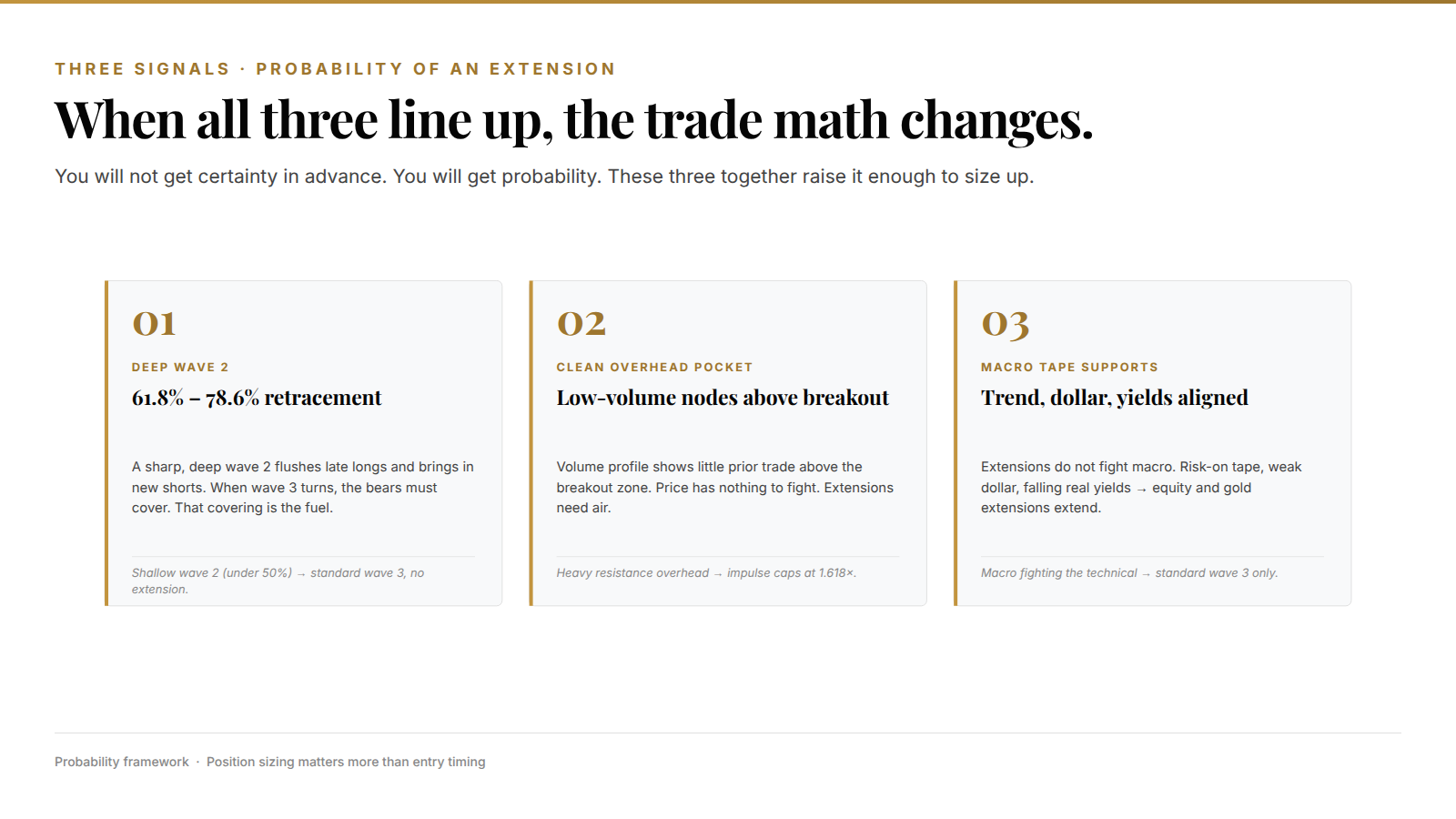
2. Volume profile shows a clean pocket above the breakout level. If the daily volume profile shows low volume nodes above the breakout zone, price has nothing to fight. Wave 3 extensions need air. Heavy resistance overhead caps the move and forces it into a regular impulse instead.
3. The macro tape supports the direction. Extensions don't fight macro. If the dollar is breaking down, equity wave 3s extend. If real yields are dropping, gold and risk assets extend. If oil is breaking out and energy stocks are basing, those impulses extend. The setup is technical but the fuel is macro.
When all three line up, the probability of an extension is high enough that the trade math changes. You don't need to be right more often. You need to size for the rare outcome that does the work.
How to position before it triggers
The trade is not the breakout. The trade is the retest of the wave 1 high during wave 2 or the early part of wave 3. That's where the asymmetry lives.
A typical entry sequence looks like this. Wave 1 makes a high at, say, 4,200. Wave 2 retraces to 4,050 (about 60% of the wave 1 advance). Buyers step in. Price reclaims 4,200 on volume. That reclaim is the structural confirmation. The stop sits below the wave 2 low at 4,025. The first target is 1.618x wave 1 from the wave 2 low (around 4,460). The extension target is 2.618x (around 4,650).
That's a 4,200 entry, 4,025 stop, 4,650 target. About 1:2.6 risk-reward on the standard target. About 1:5.5 on the extension. You don't size for the extension. You size for the standard target. The extension is the upside surprise that happens 25-30% of the time when the three signals are in place.
Most traders do the opposite. They size for the home run, get stopped out on a normal correction, and then accuse the market of running their stops. The market wasn't running anything. The size was wrong for the structure.
What to do when you missed it
This is the harder skill. When wave 3 has already extended 80% of the way to its likely target, the trade is gone. Trying to chase it produces the worst outcomes in trading. You buy the local high, watch wave 4 take 38.2% back from you, and stop out at the low while wave 5 prints.
The disciplined response is to wait for the wave 4 retracement to a structural level you can defend. The 38.2% Fib of wave 3, the prior wave 4 of one lesser degree, or the low-volume node from the volume profile. Any of those gives you a defensible entry with a stop that doesn't invalidate the count.
If wave 4 doesn't come to a level you can defend, you skip the trade. Wave 5 will run with or without you. There will be another wave 3 in another asset within the week. The opportunity cost of missing one is much smaller than the opportunity cost of taking a bad chase entry that locks you out of capital.
I want to be clear here. Patience is not optional in this kind of analysis. The traders who consistently catch wave 3 extensions are not the ones with the best entry timing. They are the ones with the best entry discipline. Different skill.
The post-mortem that actually matters
After every extension you missed, write down three things. The breakout level you would have entered at. The stop you would have used. The exit you would have planned. Compare to what actually happened.
Two things become clear after you do this for ten or fifteen extensions.
First, your structural read is usually right. The level was the level. The thesis worked. You just weren't in the trade for behavioural reasons that have nothing to do with the analysis.
Second, the times you actually were in the trade and made money usually had the three signals lined up before you took the entry. The times you were stopped out usually had only one or two signals, which is enough to call it a wave 3 but not enough to expect an extension.
That second insight is the whole game. Wave 3 extensions are not predictable in advance. They are probabilistic in advance. If you can size for the probability, the math takes care of the long run.
Bottom line
Wave 3 extensions catch most traders offside because they require a different positioning logic than the rest of the impulse. The setup is identifiable before it triggers but only barely. The signals are deep wave 2, clean overhead pocket, supportive macro. The position needs to be sized for the standard target so the extension is upside, not break-even.
If you missed it, wait for a structural retracement during wave 4. If wave 4 doesn't give you one, skip the trade. The market will produce another extension setup within days.
The traders who catch these consistently are not better at calling them. They are better at being in the trade when they do call them. That difference compounds across hundreds of setups in a year.
Same wave count. Same Fibonacci levels. Same logic that drives every Kunkel Capital signal. The reasoning is in the post; the active trade is in the dashboard.