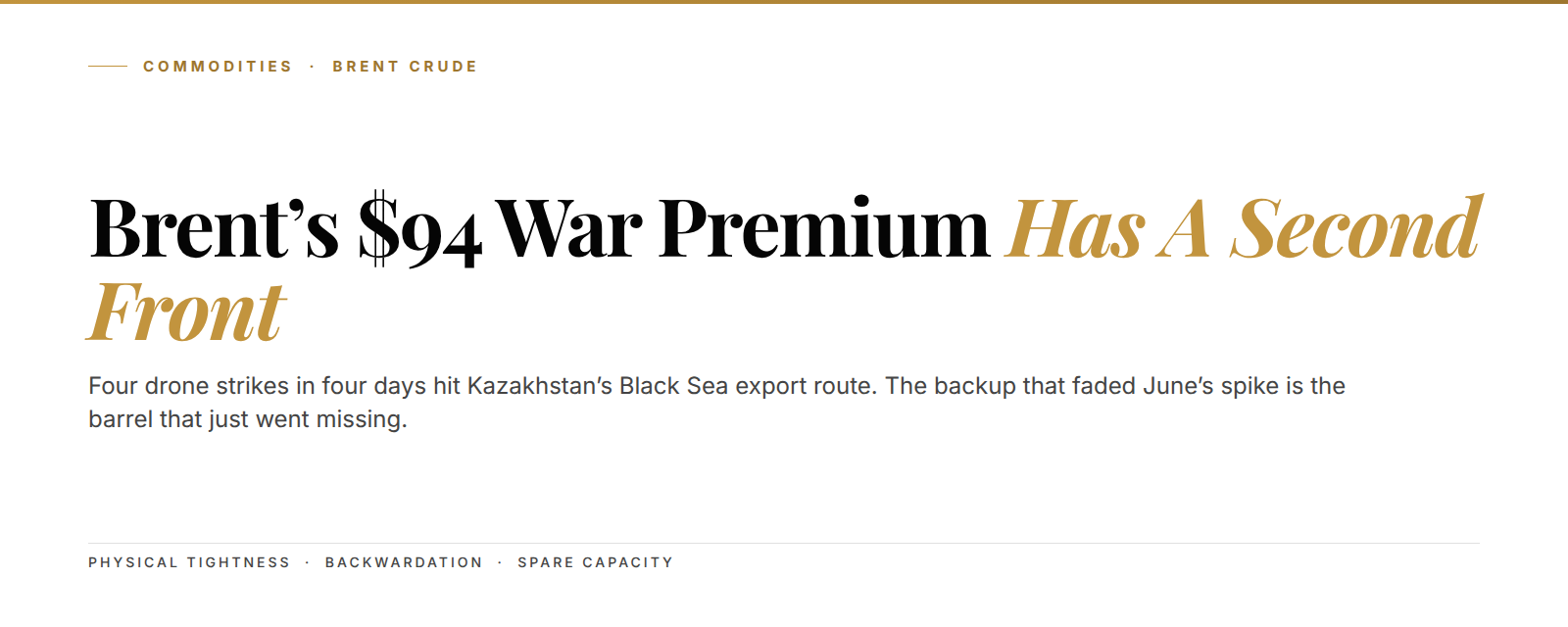
Brent crude ripped above $94 a barrel Wednesday, the highest since June 8, and this time the war premium has a second front. The screen story is Iran, but the physical story is Kazakhstan. Four drone strikes in four days hit tankers loading at the Caspian Pipeline Consortium terminal on Russia's Black Sea coast. Together they halted roughly 80% of Kazakh crude exports and more than 1% of global supply. Consensus says this spike fades the way June's Hormuz scare did. The curve disagrees, because the backup route the market leaned on is the one now burning.
The setup in 3 lines:
- Brent cleared $94 Wednesday, its highest since June 8, on a second supply shock most desks still treat as noise.
- The Caspian Pipeline Consortium route, the assumed backup for Gulf risk, took four tanker strikes in four days and stopped loading.
- OPEC+ spare capacity is thinning toward multi-year lows, so the reflex that says someone will backfill has less behind it.
On July 19, two tankers, the ASIA and the NISSOS IOS, were struck while loading at the CPC terminal near Novorossiysk. A third vessel, the Nelsa, caught fire on deck two days later. The Kazakh Foreign Ministry called the attacks deliberate actions aimed at destabilizing global energy markets. This is not a Gulf headline. It is the safety valve springing a leak, and that changes how the whole risk premium behaves.
June's Hormuz spike round-tripped in three weeks, and this one has a different spine
June set the template everyone is leaning on now. Brent spiked hard on the Hormuz scare, then handed most of it back inside three weeks as tankers kept moving and no barrel actually went missing. We walked through that entire round trip in our June Brent post-mortem, and the lesson stuck. A threat to a chokepoint is not the same as a loss of supply. The desks that faded the June rip got paid for it. The tape remembers that winning trade very well.
So the muscle memory this week is to fade again. That is the consensus, and it is not stupid. The trouble is that June and July are not the same setup, and the difference is physical, not political.
June was a single front. The fear was Hormuz, the fear stayed a fear, and the barrels kept sailing the whole time. July is a two-front problem, and the second front already produced a real, measured outage. Kazakh loadings didn't just get threatened, they actually stopped. When you fade a spike, you are betting the supply loss never shows up. This week it already showed up on the water.
That one distinction is the whole trade. You can fade the fear, and often you should. You cannot fade a cargo that never loaded.
The Caspian route was the market's backup, and four strikes in four days broke it
Here is the part the screen tape keeps missing. For two years the Caspian Pipeline Consortium has served as the release valve for Gulf risk. When Hormuz gets scary, the mental model says Kazakh and Russian Black Sea barrels pick up the slack through Novorossiysk. That assumption is exactly what four drone strikes just took offline.
The CPC terminal carries crude from Kazakhstan's giant Tengiz and Kashagan fields to the Black Sea, and it handles the bulk of the country's exports. With loadings suspended, Kazakhstan's energy ministry scrambled to reroute barrels through the Baku-Tbilisi-Ceyhan pipeline, which runs from Azerbaijan across Georgia to Turkey's Mediterranean coast. That redirect helps at the margin, but it cannot swallow 80% of a country's crude overnight. Pipelines are not garden hoses you open wider on demand.
Translation: the route the market assumed would cushion a Gulf shock is the route that got hit. When your insurance policy and your house catch fire in the same week, the premium you pay for cover goes up, not down.
Four strikes, four days, one broken assumption. The Caspian backup that faded June's spike is the barrel that went missing in July.
This is why the backwardation in the Brent curve matters more now than it did a month ago. Physical tightness with a working backup route is only a scare. Physical tightness with the backup route down is a shortage in slow motion, and the curve is starting to price the second version.
OPEC+ spare capacity near 5 million barrels sounds big until you map where it sits
The bull case rests on one comforting number, so it deserves a hard look. OPEC+ spare capacity sits around 5 million barrels a day. On paper that dwarfs the roughly 1.5 million barrels of Kazakh export flow at risk. So the tape shrugs and says the buffer covers it easily.
Map where that spare capacity actually lives, though, and the comfort thins fast. Most of it sits with Saudi Arabia near 3 million barrels and the UAE close to 1 million, both inside the Gulf. To use it, those barrels have to sail through or around the same Hormuz chokepoint that started this risk bid in the first place. The buffer that is supposed to calm a Gulf shock is parked right behind the Gulf shock.

That is a design flaw, not a detail.
The IEA also flags that this cushion is shrinking. Its estimates point toward roughly 3 million barrels a day by year-end as disruptions bite into output. We mapped that thinning buffer against falling supply in our piece on the crude draw streak, and the direction of travel is clear. Less slack, more calls on it, at the worst possible moment.
Put simply, the world has fewer easy barrels to send, and the ones it does have sit in the wrong place. Brent is on the Kunkel Capital rotation, and members get the full structure map with entry, exit and invalidation refreshed on a fixed cycle rather than a one-line headline read.
The Brent curve flipped to $8 backwardation, and physical desks are voting with cash
Watch the shape of the curve, not just the flat price. Prompt September Brent traded near $85.79 this week while the six-month forward sat around $77.49.

That gap of about $8 is steep backwardation, and it is the market screaming that a barrel you can touch today is worth far more than a barrel promised later.
Backwardation is not a mood. It is money. When the front contract trades this far above later months, refiners and traders are paying real cash to hold crude now instead of waiting. Think of a wheat farmer who pays extra to take delivery this week because he cannot risk the harvest arriving late. He is not betting on price. He is protecting his supply, and the futures spread is the lock. That is what the Brent curve is doing right now. The spread is the real tell here.
The traders built for exactly this moment are the physical houses. Vitol and Trafigura, the firms that buy, ship, store and resell cargoes for a living, sit among the biggest winners when disruption widens the gap between oil trapped near a conflict and oil already floating in the Atlantic. They are not guessing at direction. They get paid on dislocation, and the dislocation just picked up a second source this week.
$8 of backwardation is a receipt. It is what desks are paying, in cash, to own a barrel now instead of later.
Five numbers that frame the Brent tape right now
Before the structural read, here is the scoreboard in one place.
- $94 a barrel: Brent's Wednesday high, the strongest print since June 8.
- Four strikes in four days: drone hits on tankers at the CPC Black Sea terminal.
- 80% of Kazakh exports: the share of the country's crude flow the outage stalled.
- $8 backwardation: the September-to-six-month gap in the Brent curve.
- ~5 million barrels a day: OPEC+ spare capacity, most of it stranded behind Hormuz.
Every one of these is public and market-visible. What members actually pay for is the wave count and the levels layered on top of it.
Where the Brent thesis breaks, and what the June fade got right
Here is the structural read, stated plainly. Brent is carrying a two-source war premium, physical and geopolitical at once, into a market with a thinning and awkwardly located buffer. That mix argues for a higher floor under the risk premium than June's single-front scare ever justified. The path stays choppy and headline-driven, but the asymmetry now leans up, because a real outage is already on the tape rather than merely feared.
The June crowd still got one thing right, and it matters here. Chokepoint fear on its own does fade, every time, once the barrels keep moving. The reason this week is different is not the Iran headline that leads the news. It is the confirmed Kazakh outage sitting quietly underneath it. Strip that outage away and the old fade thesis comes right back to life.
So here is where we are wrong. A daily close back below the June 8 breakout level, paired with CPC loadings restarting and the tanker strikes stopping, kills this read. That is the invalidation, and it is a condition, not a promise. If the backup route reopens and the barrels sail, the second front closes and Brent trades like June all over again. Until that happens, the curve, the outage and the stranded buffer all point the same direction.
One honest caveat before you act on any of this. If Gulf diplomacy delivers a binding de-escalation faster than anyone expects, both fronts can cool at once and the premium bleeds out quickly. We flagged that same two-way risk in our Hormuz war-premium audit. This is a probability tilt, not a certainty, and the tilt is exactly what a structure map is built to measure.
Know your entry, your exit, and where you are wrong on Brent
The $94 spike and the four-day strike on Kazakhstan's export route are the surface signal. Brent is on the Kunkel Capital watchlist: the full research maps the current wave count to a defined entry zone, an exit target and the exact invalidation level, refreshed on a fixed rotation, with alerts when levels hit. €19.99 first month, then €34.99. Cancel anytime.
Frequently asked questions
Why did Brent crude jump above $94 this week? Brent cleared $94 on Wednesday, its highest since June 8, on two supply shocks at once. Renewed US-Iran tension around Hormuz did part of it, and four drone strikes in four days on tankers at the Caspian Pipeline Consortium terminal halted most Kazakh exports, adding a real outage to the fear.
What is the Caspian Pipeline Consortium and why does it matter? The CPC carries crude from Kazakhstan's Tengiz and Kashagan fields to a Black Sea terminal near Novorossiysk. It handles the bulk of Kazakh exports, and traders treated it as the backup route for Gulf risk. That is why strikes on it hit harder than another Hormuz headline would.
Will this spike fade like June's did? It can, but only if the supply loss reverses. June was chokepoint fear with no lost barrels, and it round-tripped fast. July already produced a measured outage, so the fade needs CPC loadings to restart and the strikes to stop before the June playbook applies again.
How much spare capacity does OPEC+ have? Around 5 million barrels a day, most of it held by Saudi Arabia and the UAE inside the Gulf. The IEA expects that cushion to thin toward roughly 3 million by year-end, and its location behind Hormuz limits how fast it can calm a Gulf shock.
What would prove this read wrong? A daily close back below the June 8 breakout level, paired with CPC loadings resuming and the tanker strikes ending. That combination would signal the second front has closed and Brent is trading on fear again rather than a real shortage.
Last updated: 2026-07-23