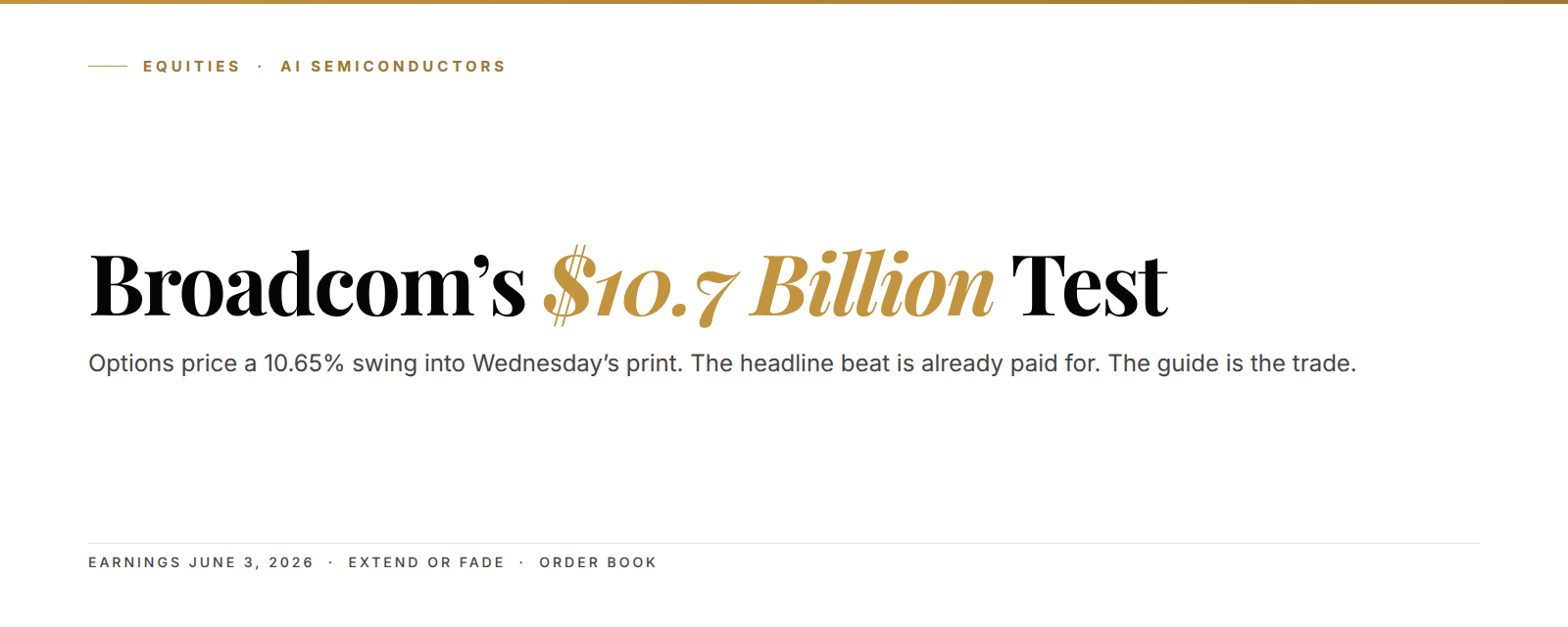
Broadcom reports Wednesday, June 3, and the options market is pricing a 10.65% swing on the print. Wall Street wants one number: $10.7 billion in AI chip revenue, up 140% from a year ago. Here is the problem: that number is already in the stock. AVGO sits near a record after a 29% run this year, and a beat everyone expects is not a surprise. The move Wednesday night will not come from the figure the headlines chase. It comes from a different line on the same page, and most traders read it twelve hours too late.
The setup in 3 lines:
- Broadcom guides to $10.7 billion in AI chip revenue Wednesday, up 140%, but options already price a 10.65% move.
- The swing factor is not this quarter's beat. It is the next-quarter AI guide and the custom-chip order book from hyperscale buyers.
- Last week gave two templates. Dell ripped 33% on a raised guide. Nvidia faded on an in-line one. The filter that told them apart is the trade.
---
Here is the contrarian read. When Hock Tan, Broadcom's CEO, closed the prior earnings call back in March, he did not lead with the revenue line. He led with bookings from three custom-chip customers, the hyperscalers building their own AI hardware. That order book, not the quarterly print, re-rated the stock for four quarters straight. Wednesday is the same test, and the screen will stare at the wrong number again.
A 140% beat is already in the price, so the guide is the real print
Broadcom has beaten estimates seven quarters running. Wednesday makes eight, almost certainly. The crowd treats the beat as the event, but it is not. A result the whole street models gets priced in before the bell rings.
Look at what the options say. As of June 2, 2026, AVGO's implied move into the print is 10.65%. The average move over the last four quarters was 6.67%. The market is braced for something bigger than a routine beat.
Translation: traders are not betting on whether Broadcom beats. They are betting on how hard the company raises the next guide.
The number that moves the stock is the Q3 AI guide. Last quarter Broadcom did $8.4 billion in AI chips, up 106%. The Wednesday guide points to $10.7 billion, up 140%. Lift the Q3 bar above that slope and the stock extends. Hold the line and the beat fades into the 29% it already ran.
Last week handed traders two templates: Dell ripped, Nvidia faded
Two mega-cap AI prints landed last week, and they split. Dell gapped 33% on Friday, May 29, its best day on record, after it raised the full-year guide near $167 billion and showed a $51.3 billion order backlog. We broke that down in our note on Dell's earnings gap and AI backlog. Same window, Nvidia beat and went nowhere. The print was fine, but the guide came in-line. The stock had already run, and the beat sold into strength. Our read on that fade sits in Nvidia's data-center print and the sell-the-news fourth wave.
So which one is Broadcom? That is the only question that matters Wednesday.
Wait, both beat and they split anyway, so the beat was never the variable. The difference was the guide and the setup. Dell raised hard into a stock that had not fully run the AI story. Nvidia held the line into a stock that had. The reaction followed the gap between expectation and the forward number, not the backward one.
That gap is the whole game.
Filter one: the beat has to clear what options already price
Filter one is mechanical: the beat has to clear the implied move. Options on the stock price a 10.65% swing into the print. A result that lands inside that band is, by definition, already paid for. The stock can beat and still drop, because the crowd sold premium expecting exactly that.
Think of it like a horse everyone bets to win. Even if it wins, you make nothing, because the odds already priced the victory. To get paid, the horse has to win by more than the track expected.
For Broadcom, the bar is a Q3 AI guide that points clearly above the $10.7 billion, 140% slope. Anything that just matches gets sold.
Filter two: the custom-chip order book is the line that re-rates the stock
Filter two is the order book, and Broadcom's AI business is not generic chips. It is custom accelerators, designed silicon built for three named hyperscale customers who want their own AI hardware instead of buying Nvidia. Custom silicon just means a company designs its own chip rather than buying one off the shelf.
That is the line analysts will hunt for on the call: bookings, design wins, and the forward commitment from Google, Meta, and the third customer Broadcom has not named. When Hock Tan flags a new multi-billion-dollar program, the stock re-rates on visibility, the same way Dell's $51.3 billion backlog re-rated Dell. We mapped that forward-visibility logic in our note on Caterpillar's $63 billion backlog and the AI rotation.
Translation: the revenue number is the past. The order book is the next two years. The market pays for the future, not the receipt.
$10.7 billion. That is the AI number everyone watches. The number that moves the stock is the order book sitting behind it.
Here is the honest bear case. Custom chips carry thinner margins than Nvidia's off-the-shelf parts. So a revenue beat does not always reach the bottom line. If the AI mix climbs but gross margin slips, the bulls lose their cleanest story, and the stock can sell a strong top line on a soft margin. Watch the margin guide next to the revenue guide. They have to move together, or the print gets messy.
Filter three: a record-high setup cuts both ways
Filter three is positioning, and Broadcom trades near the top of its 52-week range, between $234.90 and $448.90. A stock at a record into a print has two roads. It extends if the guide hands new buyers a reason, and it fades if the guide just confirms what longs already own.
This is the Nvidia trap from last week: great company, fine print, tired setup. When everyone who wanted in is already in, a beat has no fresh buyer, and the stock needs new information to pull new money rather than a re-run of the old story.
We track this stretch across the whole tape. Our work on the equal-weight S&P 500 and the breadth nobody talks about shows how narrow the leadership has gone. A late, thin tape punishes prints that only meet the bar.
The chart below lays the two paths side by side. The implied 10.65% band, the extension road Dell took, and the fade road Nvidia took.

The scorecard below runs all three filters against what we know going in. Two open unknowns, one clear risk.

Five questions that decide whether Broadcom extends or fades
Run these in order Wednesday night. Each one is a yes or no. The more that flip green, the cleaner the extension path looks.
- Did the Q3 AI guide clear the $10.7 billion, 140% slope, or just match it? A clear raise is the green light, while a match is a yellow flag worth respecting.
- Did Hock Tan name a new custom-chip program or a bigger backlog? Fresh bookings re-rate the stock, while silence on the order book is its own kind of answer.
- Did the result beat by more than the 10.65% the options priced? A beat inside that band is already paid for.
- Is the stock holding its gap an hour into the after-hours tape, or fading off the spike? Gaps that hold tend to drift. Gaps that fade tend to trap.
- Is the broad tape risk-on or wobbling? Even a great print fades if the index rolls over. The S&P just stacked nine up weeks, and stretched markets punish latecomers.
Most prints answer two or three of these cleanly. When four or five line up the same way, the reaction stops being a coin flip.
That is the entire read.
10.65%. That is the move options already paid for. The beat has to clear it before the stock can move on it.
The positional read: don't trade the print, trade the reaction
We do not trade the gap into the print. Pre-print, nobody knows the guide, and a 10.65% implied move cuts both ways. Buying the night before is a coin flip dressed up as conviction.
The setup we like is the reaction, not the report. If Broadcom gaps up and the guide clears the slope, you wait for the stock to hold above the pre-print shelf, then use the prior structure as your line. We map those volume-weighted entries in our note on anchored VWAP and institutional entries, and the upside targets in our Fibonacci confluence method.
Map the levels before the bell. The 52-week high near $448.90 is the obvious ceiling, the line a clean extension has to reclaim and hold. The pre-print shelf is your floor. Lose that on a soft guide and the fade has room to run back toward the prior breakout. We are not posting exact entries here. The structure is enough to frame the night. Reclaim the high zone and the bulls keep the tape. Lose the shelf and the sellers take it.
The drift still pays after a clean beat-and-raise. A big upside surprise keeps drifting for weeks, because funds adjust on a lag. We laid out that base pattern in why earnings drift pays the traders who ignore the beat, and where it held last quarter in our Q1 drift audit.
One honest uncertainty. We are writing this before the print. If the guide comes in soft, every filter above flips, and the 10.65% move goes the other way. We are not calling the number. We are handing you the read for Wednesday night, so you act on the reaction instead of the headline.
You watch the guide, not the beat. That is the tell.
Frequently asked questions
When does Broadcom report Q2 earnings?
Broadcom reports after the close on Wednesday, June 3, 2026. The market reaction lands in after-hours trading that night and into Thursday's session. Analysts expect about $22.12 billion in revenue, up 47% from a year ago, with AI chip revenue near $10.7 billion.
Why can a stock beat earnings and still fall?
Because the beat is already priced. Options on AVGO price a 10.65% move into this print, higher than its 6.67% average over the last four quarters. If the result and guide land inside what the market already paid for, sellers of that premium win and the stock can drop on good news.
What is the most important number in Broadcom's report?
The next-quarter AI guide and the custom-chip order book, not the headline revenue. Last quarter showed $8.4 billion in AI chips, up 106%. The market needs the forward guide to point clearly above the $10.7 billion, 140% slope to justify the record price.
What is custom silicon in plain terms?
It is a chip a customer designs for its own use rather than buying a standard part. Broadcom builds these accelerators for hyperscale buyers like Google and Meta who run huge AI systems. Those design wins lock in multi-year revenue, which is why the order book moves the stock.
How did Dell and Nvidia react to AI earnings last week?
They split. Dell gapped 33% on May 29 on a raised full-year guide near $167 billion and a $51.3 billion backlog. Nvidia beat but stalled on an in-line guide into an already-extended stock. The difference was the forward guide, not the size of the beat.
See the full Broadcom print setup
The $10.7 billion AI guide and the 10.65% implied move are the public signal. The Kunkel Capital research adds the exact anchored-VWAP entry shelf for the post-print reaction, the multi-quarter re-rate target tied to the custom-chip order book, and the extend-or-fade scorecard scored live on Wednesday night. €19.99 first month, then €34.99. Cancel anytime.
Last updated: 2026-06-02. Kunkel Capital Research. Not investment advice.