Crude oil ripped to $101.36 Brent on Wednesday, up $4.71 in a single session and roughly $35 higher than a year ago. The screen says geopolitics. The Iran standoff, the Strait of Hormuz headlines, the risk premium that comes and goes with each Trump comment. That's the loud story. The quiet one matters more, and it landed five weeks ago when the UAE walked out of OPEC+ on May 1.
The setup in 3 lines:
- The UAE exit pulled roughly 1 million barrels per day of usable spare capacity out of OPEC+'s shared buffer, which sat near 5.1M bpd before the split.
- That buffer is the world's price-shock insurance. It's heading toward 3.0M bpd by year-end and 2.5M by late 2027, and 2.5M is the line where the market stops feeling safe.
- With US crude stocks down a sixth straight week and Brent already over $100, the structural floor under oil just got built higher, quietly, while everyone watched the Hormuz tape.
Here's the part nobody priced on May 3. When OPEC+ met for the first time without Abu Dhabi in the room, the seven remaining members agreed to add just 188,000 bpd for June. A token number. A rounding error against a 100-million-barrel-a-day market. The signal wasn't the volume. It was the silence around the hole the UAE left behind.
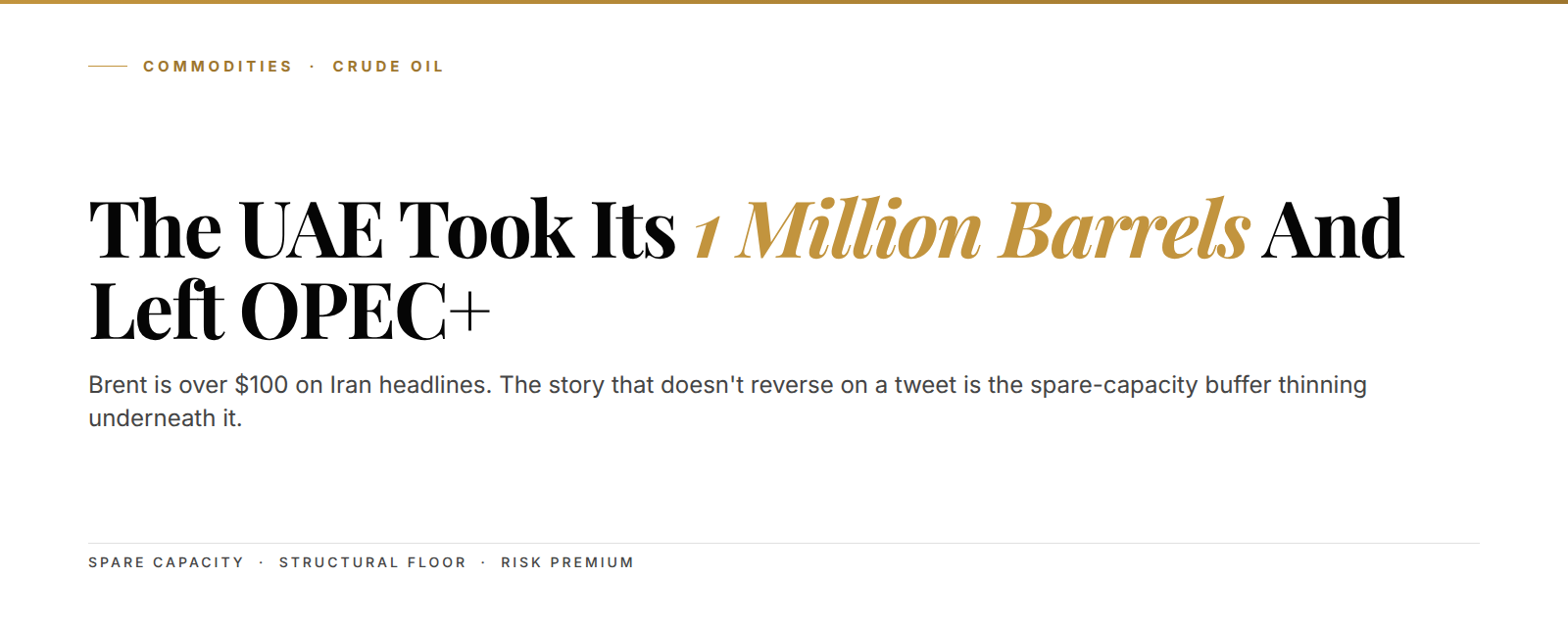
The UAE took its 1 million barrels of spare capacity and left
The UAE's exit was about one number that didn't fit. ADNOC, the state producer, says its maximum sustainable capacity runs to 4.85M bpd. The May OPEC+ quota handed it just under 3.5M bpd. That's a 1.35M bpd gap between what the country can pump and what the cartel let it sell. Year after year, that gap cost Abu Dhabi an estimated $50 to $70 billion in foregone revenue.
So it left. Effective May 1, announced April 28. The third-largest producer in OPEC+ is now a free agent.
The headlines framed it as a Gulf power story, and it is. But for the oil market the consequence is mechanical, not political. The UAE was holding roughly 1M bpd of the group's spare capacity. Spare capacity is the oil you're not pumping but could turn on inside ninety days if a rival supply source goes dark. It's the fire extinguisher behind the glass.
Translation: the cartel just lost a chunk of its emergency reserve, and the emergency it's insuring against is sitting right next door in Iran.
1 million barrels a day. That's the spare-capacity buffer that walked out of OPEC+ and onto its own balance sheet. The market hasn't repriced it.
The 5.1-million-barrel buffer is the only number that matters
Before the split, OPEC+ spare capacity sat near 5.1M bpd, by the EIA's reference framework. Saudi Arabia carried about 3M of it. The UAE held roughly 1M. Kuwait around 0.4M. Iraq, very little. That's the whole fire brigade, and four-fifths of it lived in two countries.

Now run the clock forward. The IEA and the EIA both see that buffer shrinking as demand grinds higher and the easy barrels come back online. The path looks like this: 5.1M bpd now, falling to about 3.0M by the end of 2026, then near 2.5M by late 2027.
Why does a falling buffer matter when there's no shortage today? Because the price of oil isn't set by today's barrels. It's set by the market's confidence that tomorrow's shock can be absorbed.
Think of it like a household emergency fund. Six months of expenses in the bank, and you sleep fine through a layoff scare. Drop to two weeks, and every rumor at the office spikes your heart rate. Same job, same salary, totally different risk premium. Oil's spare capacity is that emergency fund, and the balance just dropped.

Below 2.5 million barrels, the market stops sleeping
There's a rough ladder traders use for the buffer, and it's worth knowing the rungs.
- Above 2.5M bpd: comfortable. The market treats spare capacity as abundant and ignores most supply scares.
- Between 1.5M and 2.5M: adequate, but the risk premium starts widening measurably with every disruption headline.
- Below 1.5M: the market loses faith that any real outage can be covered, and price spikes get violent.
Translation: above 2.5M, a Hormuz headline is noise. Below 1.5M, the same headline is a $15 move.
So look at the trajectory again. The buffer crosses into that nervous 1.5M-to-2.5M band sometime around late 2027 on the base case. But the base case assumes the spare barrels that are reported actually exist. They may not.
The EIA spent part of early 2026 quietly redefining how it measures OPEC capacity, splitting theoretical capacity from "effective" capacity, the output a country can hold for months rather than days. The reassessment trimmed the numbers hard. One read of the revision put effective spare capacity well below the headline figure. The agency was admitting, in its own careful language, what contrarian desks have argued for years: a lot of OPEC's cushion exists on paper, not in the ground.
US crude stocks just fell for a sixth straight week
While the spare-capacity story builds in the background, the physical market is already tightening on the screen. US commercial crude inventories dropped by 7.974 million barrels last week. That's the sixth weekly decline in a row.
A single draw is weather or a maintenance quirk. Six in a row is a trend. Refiners are pulling barrels out of tanks faster than they're being replaced, which is exactly what you'd expect when summer demand ramps and the front of the curve is bid.
Globally the picture rhymes. The IEA's framework has worldwide inventories falling by an average of 8.5M bpd through the second quarter of 2026. Draws of that size don't sit alongside a relaxed price. They sit alongside backwardation, where the front month trades above the months behind it because everyone wants the barrel now, not later.
Put differently: the calendar is telling you the same thing the spare-capacity math is. Tight now, tighter later.
7.974 million barrels. The sixth straight weekly draw on US crude stocks. The trend is older than the Iran headlines.
The risk premium and the structural floor are two different trades
Here's where most takes get it wrong. They lump the Iran risk premium and the spare-capacity squeeze into one bullish blob. They're not the same trade, and they don't behave the same way.
The risk premium is fast and reversible. Trump says Iran agreed not to chase a weapon, and WTI gives back a dollar in an hour. That premium can evaporate on a single headline, and it will. Anyone long oil purely on Hormuz is renting the position, not owning it.
The structural floor is slow and sticky. A million barrels of spare capacity doesn't walk back into OPEC+. ADNOC isn't rejoining. The buffer doesn't refill on a peace deal. That's the difference between a trade you rent and an asset you own.
Wait, that's too clean. The honest version: the floor isn't a hard number you can draw on a chart today. It's a probability that shifts the whole distribution of outcomes higher over the next several quarters. A thinner buffer doesn't guarantee a spike. It raises the odds of one and removes the natural ceiling that abundant spare capacity used to enforce.
That's the entire structural case in one line.
ADNOC's $145 billion bet says the barrels are coming, just not for OPEC
Worth sitting with one more actor. ADNOC has committed roughly $145 billion to its upstream business over the decade to 2030, targeting 5M bpd of capacity by 2027, up from under 4M in 2020. So the UAE is adding barrels, aggressively.
But those barrels won't sit inside an OPEC+ quota anymore. They'll come to market on Abu Dhabi's schedule, sold for Abu Dhabi's account, not held back as a shared cushion. New supply that answers to no cartel is a real thing, and over a multi-year supply cycle it's a genuine bearish weight on price.
So you've got a bullish near-term structure, a thinning safety buffer, and a bearish long-tail of UAE barrels arriving after 2027. That tension is the trade. The window where the buffer is thinnest and the new supply hasn't fully landed, call it the next six to eight quarters, is where the asymmetry sits.
Now you can see why a token 188,000-bpd hike felt so loud. The group that used to manage the market's safety margin just got smaller, and it isn't refilling the tank.
What we're watching from here
Five things sit on the desk's screen, in plain terms.
- The weekly US inventory print. A seventh and eighth straight draw turns a trend into a regime.
- The Brent curve shape. Steeper backwardation confirms the physical pull. A flip to contango would break the thesis.
- The EIA's effective-capacity revisions. Each downward tweak pulls the nervous 1.5M-to-2.5M band closer in time.
- Saudi behavior. With the UAE gone, the kingdom is the buffer now. How it manages its 3M reads through to every spike.
- The Iran headline tape. Not for the floor, for the noise. It tells you when the rented premium is fat enough to fade.
You don't need to predict the next Hormuz headline. You need to know the buffer is thinning underneath it, because that's the part that doesn't reverse on a tweet.
Frequently asked questions
Why did the UAE leave OPEC+? The UAE's production capacity, about 4.85M bpd at ADNOC, ran far above its OPEC+ quota of just under 3.5M bpd. That 1.35M bpd gap cost an estimated $50 to $70 billion a year in foregone revenue. Abu Dhabi left effective May 1, 2026, to pump and sell on its own terms.
What is OPEC spare capacity and why does it matter? Spare capacity is oil a producer isn't pumping but could bring online within about ninety days. It's the market's shock absorber. When the buffer is large, supply scares get ignored. When it's thin, the same headlines drive sharp price spikes because the market doubts a disruption can be covered.
How much spare capacity did the UAE exit remove? Roughly 1 million barrels per day. Total OPEC+ spare capacity sat near 5.1M bpd before the split, with Saudi Arabia holding about 3M, the UAE about 1M, and Kuwait around 0.4M.
Is the oil rally just about Iran and the Strait of Hormuz? No. The Iran risk premium is real but fast and reversible. It can vanish on a single headline. The structural story, a shrinking spare-capacity buffer plus six straight weeks of US inventory draws, is slower and stickier and doesn't reverse on a peace deal.
Where is OPEC spare capacity headed? On current EIA and IEA frameworks, the buffer falls from about 5.1M bpd now to roughly 3.0M by the end of 2026 and near 2.5M by late 2027. That 2.5M level is where the market historically stops treating supply risk as abundant.
See the full crude oil spare-capacity setup
The thinning OPEC+ buffer is the surface signal. The Kunkel Capital research adds the multi-quarter Brent price-path map, the spare-capacity threshold model with the exact buffer levels that flip the risk premium, and the sized entry framework for trading the floor without renting the Hormuz premium. €19.99 first month, then €34.99. Cancel anytime.
Last updated: 2026-06-04