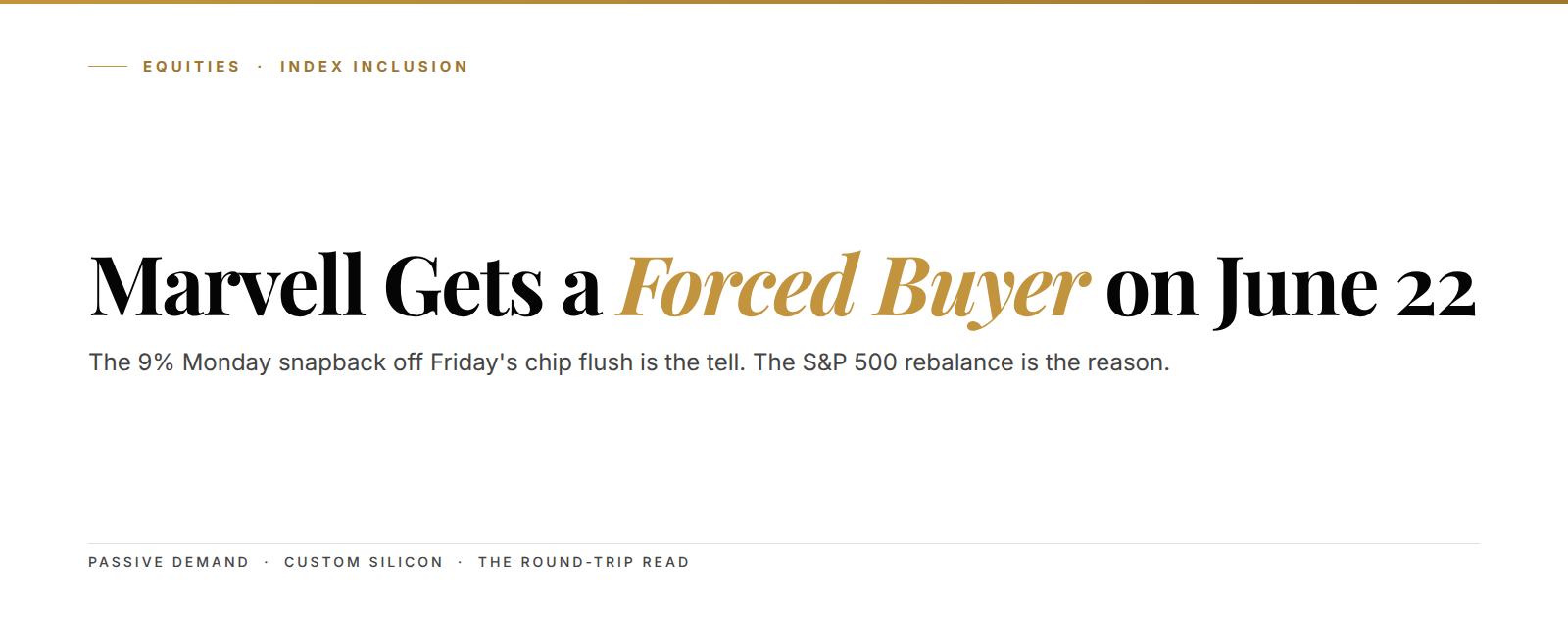
Marvell Technology ripped almost 9% on Monday, June 8, 2026, two sessions after the chip rout buried it. MRVL closed near the top of the semiconductor tape, leading the snapback that Friday's sellers swore would never come. Here is what the crowd missed. On June 5, S&P Dow Jones Indices confirmed that Marvell joins the S&P 500 on June 22, which means every index fund on the planet now has to buy the stock. Friday's flush handed that forced buyer a discount. That is the whole setup.
---
The setup in 3 lines:
- Marvell joins the S&P 500 on June 22, confirmed June 5 by S&P Dow Jones Indices.
- Index funds have to buy at the rebalance, and we peg the mechanical demand above $10 billion.
- The 9% Monday snapback off Friday's flush shows that forced bid already front-running the date.
By mid-morning Monday in New York, the desks that shadow the index were already lifting offers in size. Micron rose 7%, Nvidia added 2.3% on its new SK Hynix memory deal, and Marvell led the entire group higher. The tape said one thing on Friday. The flow said the opposite by Monday. You only had to read the second one to see where this was heading.
Friday's $1 trillion chip flush dumped Marvell 8% on a guide that was not even its own
Broadcom set the fire on June 3 when it beat on the quarter but guided next-quarter AI revenue below the most aggressive forecasts, and that one soft number was all the tape needed. We broke that reaction down in our Broadcom guide-day fade, where the sell-the-news move ran far past what the print deserved. The spillover did the rest.
By Friday, June 5, the Nasdaq had lost 4% for its worst session since the tariff shock of early 2025, and the broad chip group shed close to $1 trillion in market value across two days. Micron fell 13%. AMD dropped near 12%. Intel gave up 9%. The selling was not surgical. It hit everything with a fab attached to the AI story. No name was spared.
Marvell fell about 8% that Friday even though nothing at all had changed at the company. The selling was guilt by association, plain and simple. Marvell's custom-ASIC programs, which are application-specific chips built to one customer's exact spec, serve the same hyperscale buyers that Broadcom serves, so a fear about one custom-silicon vendor gets sold across the whole shelf at once.
Translation: the market dumped Marvell over a guidance number that Marvell never reported.
$1 trillion. That is what the chip group lost on a guide from a company Marvell does not even share a balance sheet with.
S&P Dow Jones Indices handed Marvell a forced buyer on June 22
On the same Friday the tape was puking, the index committee quietly acted. S&P Dow Jones Indices said that Marvell replaces Pool Corp in the S&P 500 before the open on June 22, with Flex joining the same day in Campbell's old seat. Two AI-infrastructure names go in. Two slower-growth names come out. The benchmark keeps tilting toward the same trade.
Index inclusion is not a popularity vote, it is a hard rule that fund managers cannot opt out of. Every fund that tracks the S&P 500 has to hold each member at its index weight, so the moment a stock joins, those funds are obligated to buy it. They do not get to wait around for a cheaper entry. The mandate is to match the index, never to time it.

Think of a shopper handed a grocery list they are not allowed to edit. The list says buy Marvell, so they buy Marvell, and the price on the shelf is simply not part of the decision. Ownership is the only thing a passive fund cares about. Price is noise to them.
The buying clusters tightly at the rebalance instead of spreading out over weeks. Funds work the trade near the June 19 close, the Friday before the June 22 effective date, and much of it goes through as market-on-close orders, which are trades filled at the official closing print. That design jams a lot of demand into one short window. We mapped the same passive-flow mechanic for digital assets in our ETF flow study.
More than $10 trillion tracks the S&P 500, so Marvell's weight is now everyone's order
Here is the back-of-envelope we ran. More than $10 trillion sits in funds benchmarked to the S&P 500, and Marvell's market cap runs north of $180 billion after the stock roughly tripled in 2026. That math puts its float-adjusted index weight near 0.3%, which is simply the slice of the whole index that Marvell now represents.
Apply that weight to the tracked money and the mechanical demand lands somewhere above $10 billion across the inclusion window. Not every dollar arrives on a single day, but a heavy slug of it does, and it shows up whether the stock looks cheap or not. That is the part discretionary sellers tend to forget when they hit the bid on a Friday afternoon.
Wait. We should back up and be honest about the inputs here. We do not know the precise passive total, and a chunk of that $10 trillion is closet-indexed rather than strictly mechanical. So treat the dollar figure as a range, not a clean point estimate. The direction does not change at all. A large forced buyer is coming, and Friday already set his price for him. The size is fuzzy. The buyer is not.
Translation: a buyer who must own the stock just walked in, and the seller marked it down before he arrived.
0.3% of the index. On more than $10 trillion of tracked money, that is a buy order no seller ever gets to negotiate.
This is the same concentration story we flagged in the S&P 500's hidden breadth problem, where every new AI name bolted onto the top of the index makes the whole thing heavier in one crowded trade. The rotation out of those names on Friday and back into them on Monday is the live version of that risk, and we walked through that exact pattern in the Caterpillar backlog piece.
Marvell's $1.8 billion data-center quarter is why the index bid has something worth buying
The index does not care about fundamentals, but you should, because a forced bid into a broken company fades almost immediately. A forced bid into a real grower compounds instead of fading away. The two stories rarely point the same direction at the same time. In Marvell's case, right now, they do. That is the edge here.
Marvell's most recent quarter, the first of fiscal 2027, printed record revenue of $2.418 billion, up 28% from a year earlier according to the company's own results. Data-center sales alone hit $1.833 billion, which works out to 76% of the entire business. Management guided the next quarter to roughly $2.7 billion, so the growth is still building into the inclusion date rather than rolling over.
Translation: the growth story and the index story are pulling the same direction, which almost never happens.
In March 2026, Nvidia put $2 billion straight into Marvell, in a deal covering custom XPUs, which are accelerator chips built to a customer's exact spec, plus NVLink-compatible scale-up networking. In February, Marvell closed its purchase of Celestial AI to fold in optical-fabric technology for moving data between chips faster. The wider AI-backlog theme is the same one we tracked in Dell's post-earnings drift.
Then came the loud part of the story. On June 2, Nvidia chief Jensen Huang called Marvell a possible next trillion-dollar company, and the stock jumped 32% in a single session on the comment alone. It added more than $50 billion in market value that day before Friday clawed a good chunk of it back. That round trip, from the Huang pop to the rout to Monday's snapback, is the entire tell.

The 9% snapback is the read: stocks with their own forced buyer lead the rebound
Here is the rule we actually trade around events like this. In a sector flush, everything sells together because correlation runs to one and nobody reads the fine print. The rebound, though, is never even across the group. Names carrying their own bid lead the bounce, while names carrying only beta lag behind. Beta is just the market's broad pull on a stock, nothing more.
Marvell carried its own bid into Monday in the form of the June 22 inclusion, so it led the tape higher. Micron and Nvidia bounced on a calmer Middle East headline and the SK Hynix memory deal, which was real but shared across the group. Marvell bounced on all of that plus a buyer who is obligated to show up in two weeks. That is not luck or sentiment. That is mechanics, not a mood, and the same edge runs through our post-earnings drift work. Flow beats narrative here.
As of June 8, the round trip is only half complete. Marvell gave back Friday's flush and then took most of it straight back on Monday, which leaves the forced bid sitting underneath the stock into the date. The risk is a broad-market leg lower that simply swamps the inclusion flow. The reward is a rebalance squeeze playing out on a thin pre-event float, where there are fewer willing sellers than the index actually needs.
Watch three things into June 22:
- Marvell outperforms the chip group on the next red day before the date.
- Volume builds into the June 19 close rather than after it.
- The stock holds above Friday's flush low on any retest.
Get those three and the forced bid is doing its job. Lose the third one and the broad tape has taken back control. That is the entire game.
See the full Marvell index-inclusion setup
The 9% snapback and the June 22 date are only the surface signal. The Kunkel Capital research adds the sized entry, the invalidation level under Friday's flush low, our full passive-demand range with the float math behind it, and the wave-map into the rebalance window. €19.99 first month, then €34.99. Cancel anytime.
Frequently asked questions
When exactly does Marvell join the S&P 500? It enters before the open on June 22, 2026, after S&P Dow Jones Indices confirmed the change on June 5. Marvell replaces Pool Corp, and Flex joins the same day in place of Campbell's.
Why did Marvell fall on Friday if its own news was good? It got caught in the broad chip rout. Broadcom's soft June 3 AI guide hit the whole custom-silicon group, and Marvell fell about 8% on association rather than on anything in its own numbers.
How much buying does index inclusion actually force? We estimate above $10 billion across the inclusion window. More than $10 trillion tracks the S&P 500, and Marvell's weight sits near 0.3%. Treat that as a range, not a fixed figure, since some tracking money is only loosely benchmarked.
Is the Monday move just a short-term pop? The forced bid is short-dated, but the growth case is not. Marvell booked record revenue of $2.418 billion last quarter, up 28%, with 76% from data center. Those are two separate reasons to own the stock.
Last updated: 2026-06-09