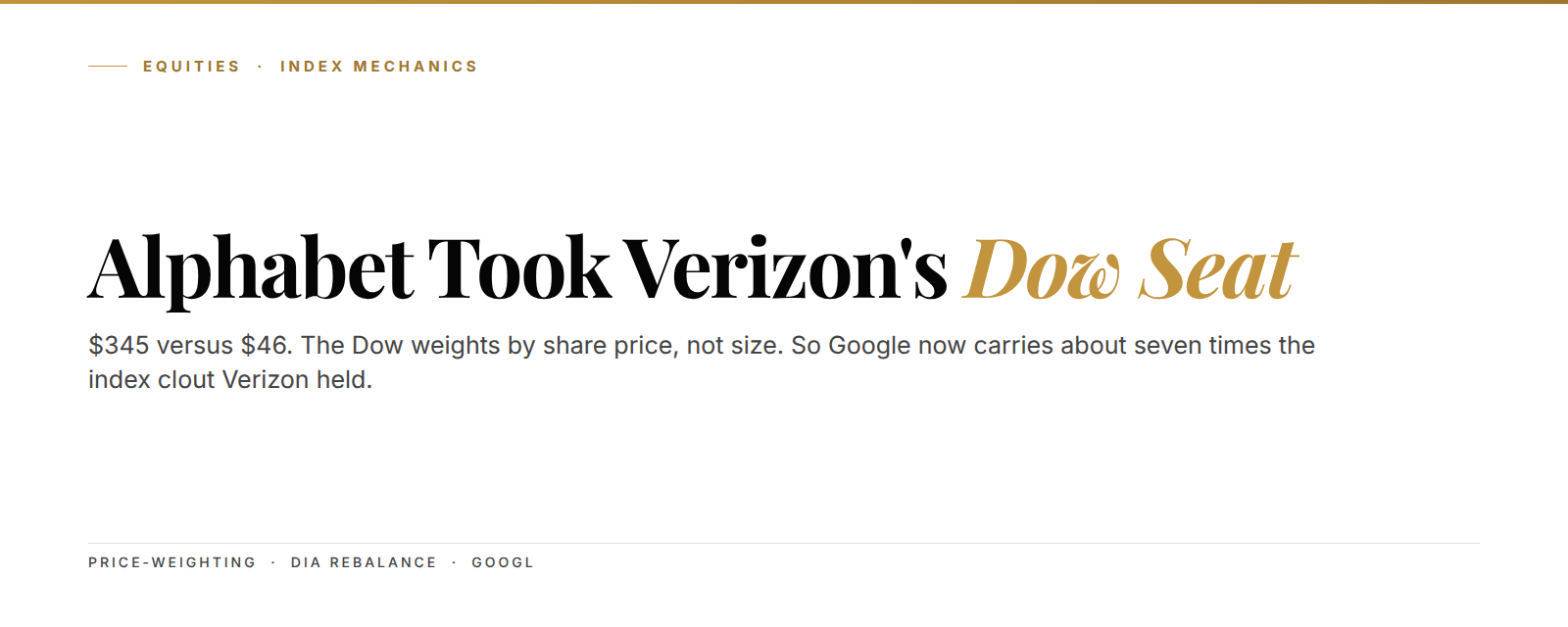
Alphabet jumped about 3.7% on Monday, June 29, the day Google's parent took Verizon's seat in the Dow Jones Industrial Average. The headlines called it a milestone. Most of them missed the mechanics. At a $345 share price, GOOGL now carries roughly seven times the daily index pull that Verizon held at $46. The Dow weights by share price, not by company size. So one Alphabet tick now swings the world's most-quoted index more than Microsoft does. That isn't a fundamentals story. It's a 19th-century quirk finally showing its teeth.
---
The setup in 3 lines:
- Alphabet replaced Verizon in the Dow on June 29 at a ~$345 share price, landing near 4% of the index by weight, while Goldman Sachs and Caterpillar each carry more than 10%.
- Because the Dow weights by price, GOOGL drives about 4% of every Dow move versus Verizon's old 0.5%, roughly seven times the clout.
- The forced rebalance was tiny (about $1.7B against $20T tracking the S&P 500), so the 3.7% pop is sentiment, not flow. Watch what fades next.
On June 23, the committee at S&P Dow Jones Indices made the call official. Verizon was out after 22 years. Alphabet was in. The reason they gave is the tell: Verizon had shrunk to just 0.5% of the price-weighted index, almost invisible. A stock can lose its seat at the most famous table in finance not because the business broke, but because its share price stayed low. Read that twice. That's the whole flaw in one sentence.
Verizon's 0.5% weight got it dropped, not its $46 billion in revenue
Verizon didn't get cut for missing numbers. It got cut for its share price. The stock sat near $46. In a price-weighted index, that low handle made it a rounding error. Alphabet, at $345, instantly outranks it by a factor of seven. Same index, same 30 names, wildly different influence, decided by nothing more than where each stock happens to trade.
Here's the part that trips people up. The Dow has been price-weighted since Charles Dow built it in 1896. Back then, summing share prices and dividing was the only math you could do by hand. It stuck. Market-cap weighting, which the S&P 500 uses, didn't become standard until decades later. So the Dow still treats a $345 stock as seven times more important than a $46 stock, even when the $46 company books more revenue.

7x. That's how much more daily influence Alphabet carries in the Dow than Verizon did, purely because GOOGL trades at $345 and VZ traded at $46.
Think of it like a voting system where your vote counts based on your height, not your citizenship. Tall people get more say. It tells you nothing about who should be leading. The Dow runs on the same logic. The price tag is the height.
Translation: Alphabet now matters more to the Dow than almost any other member, and the only reason is its sticker price.
The forced buying was $1.7B against the $20 trillion that already owned GOOGL
Most of the milestone coverage implied a wave of buying would lift the stock. It didn't, and it couldn't. Only about $115 billion tracks the Dow directly. State Street's DIA, the one big ETF pinned to the index, holds roughly $45 billion. Its desk had to buy Alphabet and dump Verizon before Monday's open. The flow analysts modeled landed near $1.7 billion.
That sounds large, but it isn't. Alphabet has been an S&P 500 heavyweight for years, and about $20 trillion tracks that index. So the funds that needed GOOGL already owned mountains of it. The Dow add changed the share count at the margin. Nothing more.

So where did the 3.7% come from? Sentiment, mostly. The news gave a green light to buyers who already liked the AI and cloud story. The index headline was the excuse, not the engine.
Translation: the pop was traders feeling good about Google, not robots forced to buy it.
This matters for what comes next. When a move is built on flow, it tends to hold, because the buying is mechanical and repeats. When it's built on sentiment, it can fade as fast as it came. You're not looking at a structural bid. You're looking at a mood.
The index-addition pop has faded as a tradable edge since 2015
There used to be a clean trade here. Get added to a major index, and forced buyers would lift you for weeks. Researchers named it the "index effect." It worked through the 1990s and into the 2000s. The average S&P 500 addition popped several percent on the announcement.
That edge has decayed. As more money moved into broad, cheap funds and front-runners learned to buy ahead of the rebalance, the post-inclusion drift shrank. Recent studies put the lasting premium near zero. The pop still happens, but the follow-through mostly doesn't.
The reason is crowding. Everyone now knows the rebalance date in advance. Traders buy the name days early and sell into the forced flow. By the time the index funds actually buy, the easy gain is gone. The edge got arbitraged away. What's left is a one-day blip and a press release.
Which is why the smart read on Alphabet isn't "it joined the Dow, so it goes up." The Dow membership is a label. It changes how the index behaves far more than it changes how the stock trades. The committee at S&P Dow Jones Indices didn't hand GOOGL a tailwind. They handed the Dow a tech problem.
$1.7 billion. That's the entire forced Dow rebalance into Alphabet. The S&P 500 already routes about $20 trillion, and GOOGL has been a top holding there for years.
Wait, one honest caveat. A label still carries soft value. Dow membership raises a name's profile with retail buyers and some mandates that screen for "blue chip" status. It's not zero. But it's a slow drip, not the engine behind a 3.7% day. We'd size any position on the business, not the badge.
The Dow now tilts toward tech, and Alphabet makes the distortion worse
Step back from GOOGL and look at the index itself. The swap pushed the Dow further into technology and communication services, the exact sectors already driving the S&P 500. The same day, Honeywell spun off its aerospace arm and stayed in the Dow under a new name. The 30-name benchmark keeps reshaping itself around the megacaps.
The trouble is the math. Because Alphabet lands near 4% of the index by weight, well above the 30-name average, a sharp GOOGL move can drag the whole Dow even on a day the other 29 names go nowhere. A single earnings miss could tug the index harder than a stumble at a far larger company that trades at a lower price. The Dow becomes a worse mirror of the broad economy and a better mirror of a few expensive stocks.
That's a benchmark problem, not a Google problem. But it shapes how you should read the Dow from here. When you see "the Dow fell 300 points," check whether Alphabet did the heavy lifting before you read it as a market-wide signal.
~4%. That's Alphabet's share of the Dow on day one, set by its $345 price, not its size. Goldman Sachs and Caterpillar each carry more than double that.
It also raises the odds of more swaps. UnitedHealth and a few other low-priced names now look exposed the same way Verizon did. The committee has shown it will cut a stock whose price has fallen behind, even a household name. So the Dow keeps drifting toward the same megacaps that already run the S&P 500. The two indexes look more alike every year. That's not diversification. That's concentration wearing two costumes.
You can see the same tech-rotation pull in how the tape has treated other megacap names this quarter. We mapped the AI-driven leg in our Broadcom AI-guide note and the industrial side of the rotation in the Caterpillar backlog read.
Five things the index noise is hiding about Alphabet
Strip out the Dow headline and the real questions are simple. Here's the checklist we're working from.
- Cloud growth: is Google Cloud still compounding above 25% year over year, or cooling?
- AI monetization: are Gemini and search-ad integrations adding revenue, or just cost?
- Ad core: is the base search-ad business holding share against new AI-answer rivals?
- Margins: is the heavy AI capex bill compressing operating margin this year?
- Buyback pace: is the repurchase program still shrinking the share count fast enough to matter?
None of those got answered on June 29. The Dow add told you nothing about any of them. That's the gap between the headline and the trade. The label moved, yet the fundamentals didn't.
Translation: the index news is loud and empty. The earnings print is quiet and everything.
The positional read: treat the Dow pop as noise, anchor to the Q2 print
So how do you trade it? Patiently. The June 29 spike is sentiment riding an index headline, and sentiment moves fade. We'd rather see how GOOGL behaves once the milestone buyers are done and the next earnings print sets the real tone. The structural story, Google's cloud and AI economics, plays out over quarters, not over one rebalance day.
The level to respect is where the stock sat before the Dow noise, not the post-news high. If price holds that pre-event base on a pullback, the buyers who showed up for the business, not the badge, are still there. If it slices back through, the 3.7% was hot air. We track those reclaim-or-fail spots the same way across setups, the method we laid out in our bear-trap reversal framework and our anchored-VWAP entries piece.
You don't need to chase the Dow headline. You need to know which of those five questions the next print answers. That's the entire game.
For the wider context on why share-count mechanics keep mispricing megacaps, our buyback-yield study and our consumer-sentiment-versus-Fed read round out the picture.
Frequently asked questions
Why did Alphabet join the Dow Jones Industrial Average?
S&P Dow Jones Indices added Alphabet on June 29, 2026, replacing Verizon. Verizon's low share price had shrunk its index weight to about 0.5%, near invisible. Alphabet, at roughly $345, better represents the communication-services sector in a price-weighted index.
Does joining the Dow make Alphabet stock go up?
Not in a lasting way. The forced rebalance was only about $1.7 billion, tiny next to the roughly $20 trillion tracking the S&P 500 that already owned GOOGL. The 3.7% pop on June 29 was sentiment, not mechanical buying.
Why does Alphabet have so much weight in the Dow?
The Dow weights members by share price, not company size. At $345, Alphabet carries about seven times the daily influence Verizon held at $46, regardless of which company earns more revenue.
Is the Dow a good benchmark after this change?
It's a flawed one. Price-weighting lets a few high-priced stocks dominate the index. After the Alphabet add, a single GOOGL swing can move the Dow more than a stumble at a far larger company trading at a lower price.
What should investors watch next for GOOGL?
The next earnings print, not the index label. Cloud growth, AI monetization, ad-core share, margin under AI capex, and buyback pace decide the trade. The Dow membership decides almost nothing.
See the full Alphabet Dow-debut setup
The 3.7% June 29 pop and the price-weighting flaw are the surface signals any reader can see. The Kunkel Capital research adds the GOOGL wave-map, the exact pre-event reclaim level we're watching on a pullback, a sized entry zone, and the five-question Q2 earnings scorecard tied to a multi-quarter target. €19.99 first month, then €34.99. Cancel anytime.
Last updated: 2026-06-30