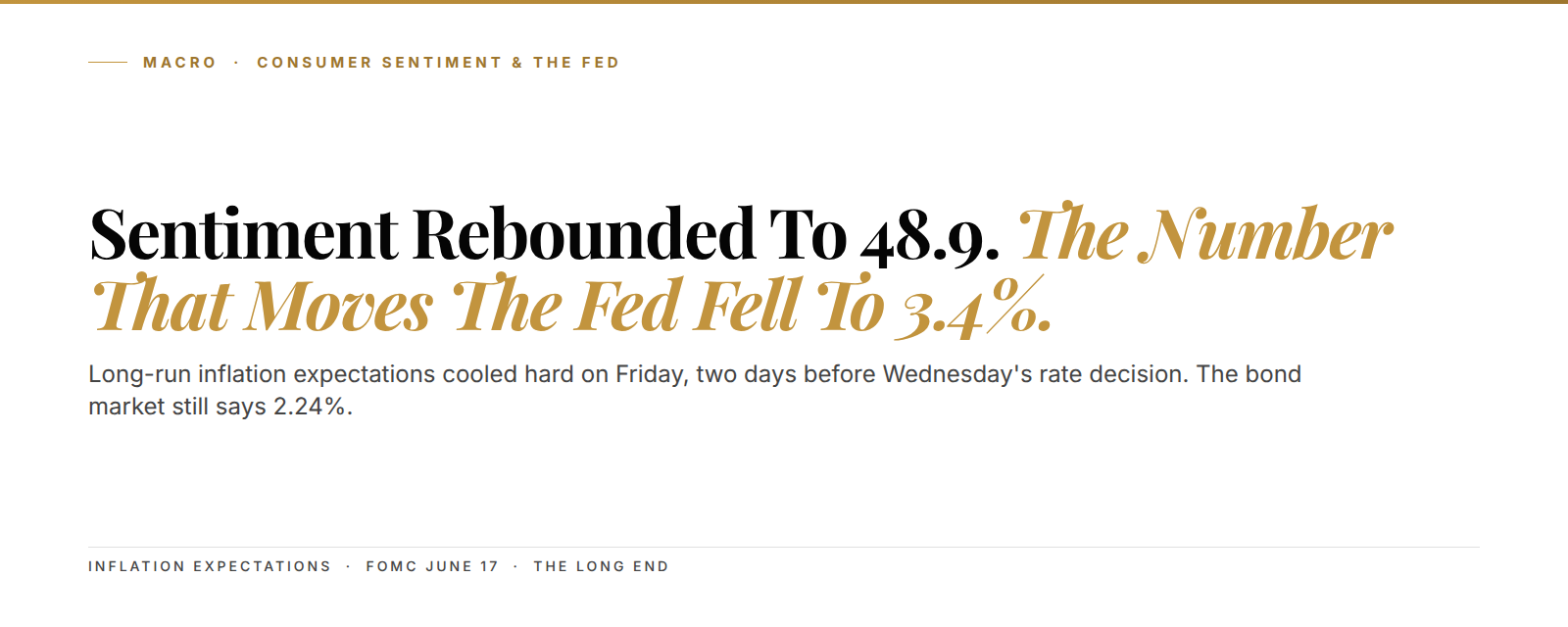
Consumer sentiment jumped to 48.9 on Friday, the first monthly gain since January and a clean beat of the 46 reading traders had penciled in. The crowd called it relief, but the number that actually moves the Fed sat three lines further down the page. Long-run inflation expectations fell to 3.4% from 3.9%, the steepest one-month cooling in more than a year. Two days before Wednesday's rate decision, that single line handed the FOMC room it didn't have a week ago.
---
The setup in 3 lines:
- Long-run inflation expectations dropped to 3.4% from 3.9%, the sharpest monthly fall since early 2025.
- Survey households still see inflation far above the 2.24% the bond market prices into the 5-year, 5-year forward.
- The FOMC meets Wednesday, and the gap between those two readings, not the 48.9 headline, decides whether the hawkish bias holds.
Here's the part the headline buried. Surveys of Consumers director Joanne Hsu pinned the bounce on cheaper gas, not on any new faith in the Fed. Pump prices eased in early June, and sentiment ticked up 9% almost overnight. Strip the gasoline relief out, though, and the read on the broader economy stayed, in her own word, dour. That single admission reframes the whole report, because a mood built on a cheaper fill-up unwinds the moment crude turns higher.
Friday's 48.9 print snapped a four-month slide in confidence
Consumer mood had fallen for four straight months into May's 44.8, the lowest reading in the survey's history. Friday broke the streak. The index landed at 48.9, up roughly four points, or about 9% on the month, with every group improving from young to old.
Context matters here, because 48.9 is still a grim number by any standard. It sits 19% below a year ago and 13% under January, when the series already looked weak. Back in 2024, this gauge ran in the 70s. A bounce off a record low isn't a recovery. It's a less severe collapse, and the survey's own framing keeps the tone cautious.
The June interviews ran from May 19 through June 8, so the read is genuinely fresh. Almost all of the lift traced back to one place. Gasoline got cheaper at the start of the month, and households felt it within days.
Translation: people didn't suddenly turn optimistic. Their gas bill just got smaller.
The 3.4% long-run inflation read is the line the Fed circles first
Set the headline aside for a second. The number the FOMC studies hardest is long-run inflation expectations, meaning what households think prices will do over the next five to ten years. That figure fell to 3.4% in June from 3.9% in May. It's the biggest one-month drop in more than a year. Households rarely shift their decade-ahead view this much in thirty days, which is why the move caught desks off guard.

Why does a survey of households move policy? Because expectations feed on themselves. Workers who expect 4% inflation ask for 4% raises, and firms lift prices to cover the higher wage bill. The expectation becomes the outcome.
Year-ahead expectations cooled too, sliding to 4.6% from 4.8%. Both numbers moved the right way. Neither one is comfortable yet. De-anchoring is the real fear here, the moment the public stops believing the Fed will ever get back to 2%.
3.4% versus 2.8%. That's the distance between where households see long-run inflation now and where they saw it through most of 2024.
So the read is mixed. Expectations fell hard, which is exactly what the Fed wants to see. Yet 3.4% still sits a full point above the 2.8% to 3.2% band that held all through 2024. The public hasn't re-anchored. It's just less un-anchored than it was in May, the same slow grind behind the return of term premium.
Survey says 3.4%, the bond market says 2.24%, and that spread is the trade
Here's the tension that actually matters. Households tell the survey they expect 3.4% inflation over the long run. The bond market, where real money changes hands, says something very different. One read comes from a phone call, the other from billions of dollars wagered on where prices actually land.
The 5-year, 5-year forward breakeven rate is the market's read on inflation over the back half of the coming decade. It sat at 2.24% in June, and on June 11 it printed 2.18%. That's within a hair of the Fed's 2% target. Two readings of the same future, more than a full point apart.

Translation: ordinary people are scared inflation stays hot. The traders betting billions are not.
Think of it like two forecasts for the same week. One comes from a neighbor who got soaked yesterday and now expects rain forever. The other comes from a meteorologist reading the pressure charts. The Fed listens to both, but it trusts the instruments over the mood. The same split shows up in how the two-year yield trades each jobs print.
Why the Fed weights the 2.24% market read over the 3.4% survey
What the FOMC actually ranks, in order:
- Market-based measures like the 5-year, 5-year forward and breakevens, because traders have skin in the game.
- The core inflation trend, stripping out food and energy noise.
- Wage growth and how much slack is left in the labor market.
- Survey expectations from Michigan and the New York Fed, used as a cross-check.
- Financial conditions and the long end, where the 30-year carries the term premium.
The order tells you the story. A trader who buys inflation protection loses money when the bet is wrong, while a household answering a phone survey loses nothing. So the Fed leans on the price that costs something to be wrong.
This is why one hot survey rarely forces the committee's hand. Policymakers have watched the Michigan number swing on gas prices for decades. They cross-check it against the net liquidity cycle and the live price of inflation protection. A single print gets logged, not acted on.
We'll be straight about one thing, though. Survey expectations get dismissed too easily. The Michigan series caught the 2021 inflation scare months before most of the pros did. So 3.4% isn't just noise, it's a warning the committee can't fully wave away. The honest answer is that nobody knows yet which read is right.
Gas at the pump did the lifting, and that's the soft spot
Joanne Hsu was blunt about the driver on Friday. The bounce came from cheaper gasoline, she said, not from any real shift in how people see the economy. That makes the base shaky.
Gasoline is the most visible price in American life. It sits on a lit sign at every corner. When it drops, mood lifts inside a week. When it climbs back, the bounce reverses just as fast. Households read the pump the way drivers read a stoplight, on instinct and within seconds.
The underlying inflation picture is still hot. May CPI, released June 10, ran 4.2% over the year, with prices up 0.5% on the month. Core inflation held at 2.9%, so the squeeze households actually feel didn't ease at all.
Translation: the thing crushing budgets didn't get better. The gas sign just got cheaper for a few weeks.
What turns the 3.4% from a one-month blip into a trend
One print doesn't make a trend, and the Fed knows it. For Friday's cooling to mean anything, it has to hold across the next two readings. A single month can flip back on nothing more than a move at the pump.
Three things decide whether it sticks. Gasoline comes first, since it drives the short-run number almost on its own. If prices keep sliding through June, the 4.6% year-ahead read falls again. If crude bounces, the move unwinds in days.
The June CPI report lands second, due July 14. It shows whether the 4.2% headline is finally rolling over or digging in. Then comes the labor market, where wage growth feeds straight back into how households price the future, the loop that makes real yields a cleaner read than the survey.
So treat Friday as one data point with a wide error band. It shifted the odds, not the outcome. The committee will read it the same way. One soft survey buys patience, not a victory lap.
That's the entire game right now.
The 30-year at 4.97% is where Wednesday's hold gets priced
The FOMC almost certainly holds on Wednesday. Markets put the odds of no move at 99.5%, with the funds rate parked at 3.5% to 3.75%. The decision isn't the event. The bias is.
Recent minutes show the committee dropping its old easing lean and leaving the door open to a hike later in 2026 if prices misbehave. Friday's cooling in expectations buys it cover to stay patient. One soft survey won't flip the stance, but it does stop the hawks from forcing a hike this week. A patient hold with a hawkish tilt is the most likely script, and the long end has already started to price it.
Watch the long end, not the front. The 30-year yield closed Friday at 4.97%, knocking on the 5% door. That level reflects term premium, the extra yield investors demand for holding long bonds through an uncertain decade. If expectations keep cooling, the premium eases and the long end can rally. If gas reverses, 5% gives way fast, the same pressure that drives global money when long yields reprice.
Our read: the asymmetry favors the long end into and just after Wednesday, as long as the 5-year, 5-year forward holds near 2.2%. The dollar is the cleaner play on a Fed that stays patient and refuses to cut, a setup tied to the dollar's funding stress. The trade was never the headline number. It's the gap sitting underneath it.
See the full inflation-expectations setup
The 3.4% survey read against the 2.24% market read is only the surface signal. The Kunkel Capital research maps the full divergence. It plots the term-premium zones on the 30-year, the 5-year, 5-year forward levels that flip the long-end trade, and the dollar entries that pay if the Fed stays patient. You also get the watchlist for Wednesday's statement. €19.99 first month, then €34.99. Cancel anytime.
Frequently asked questions
When was the June 2026 consumer sentiment report released?
The University of Michigan published its preliminary June reading on Friday, June 12, 2026. The final June report follows later in the month.
What were the key inflation expectation numbers?
Year-ahead expectations fell to 4.6% from 4.8%. Long-run expectations, covering five to ten years out, dropped to 3.4% from 3.9%. Both still sit above the 2.8% to 3.2% range that held through 2024.
Why do inflation expectations matter so much to the Fed?
Expectations can be self-fulfilling. When households and firms expect high inflation, they set wages and prices to match, which makes the inflation real. The Fed watches them as an early read on that risk.
What is the FOMC expected to do on June 17?
Markets price a 99.5% chance of no change, holding the funds rate at 3.5% to 3.75%. The real question is whether the committee keeps its hawkish bias or softens it after Friday's data.
Which inflation read should you trust, the survey or the market?
The Fed leans on market-based measures because traders lose money when wrong. Still, the Michigan survey flagged the 2021 inflation spike early, so neither read deserves to be ignored.
Last updated: 2026-06-15
Kunkel Capital Research. Educational content, not individual investment advice.