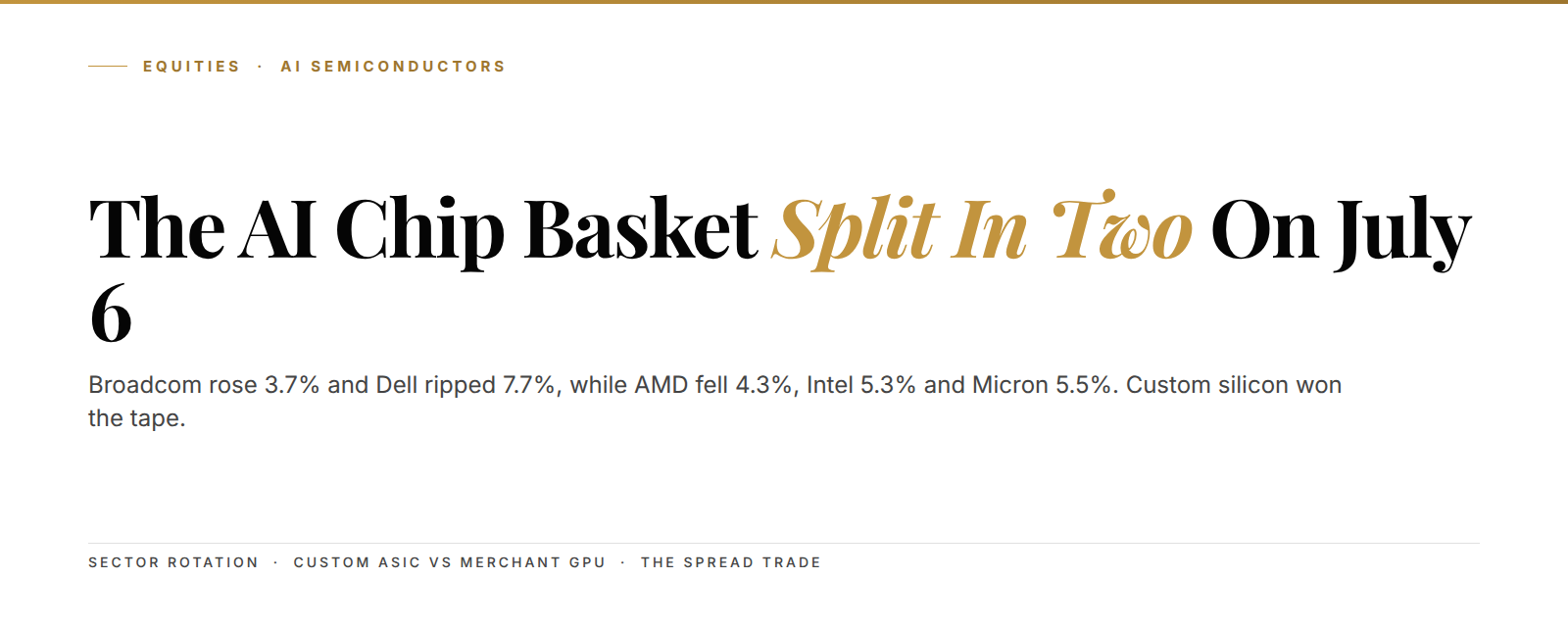
AMD fell 4.3% on Monday, July 6, while Broadcom closed up 3.7% in the same session. For two years the tape treated "AI chips" as one basket. Buy the theme, buy every ticker. That trade broke on Monday. Intel dropped 5.3%, and Micron dropped 5.5%. Yet Broadcom rose, Dell ripped 7.7%, and the Dow closed at a record above 53,000. Same sector. Opposite tape. The split is not noise. It is the first clean read on which side of the AI chip war the money now wants to own.
The setup in 3 lines:
- On July 6 the AI-chip complex split: Broadcom +3.7% and Dell +7.7%, against AMD -4.3%, Intel -5.3% and Micron -5.5%.
- The mechanism is custom silicon replacing off-the-shelf GPUs. TrendForce puts custom ASIC shipment growth at 44.6% this year versus 16.1% for merchant GPUs.
- Watch the spread, not the sector: the two-basket split is a multi-quarter trade, and Broadcom's Apple deal through 2031 is the tell.
The trigger was a single filing-grade headline. Before the open on Monday, July 6, Apple and Broadcom said they had extended their custom-chip supply deal through 2031. Bloomberg reported it first. Broadcom will build a range of custom ASIC parts (application-specific chips, meaning silicon designed for one buyer's workload rather than sold to everyone) across several Apple product generations. It reaches into Apple's own AI server chip, codenamed Baltra. That one line repriced the whole complex in a session.
AMD fell 4.3% while Broadcom rose 3.7% in the very same session
Start with the raw tape. On July 6, three names got sold hard. AMD gave up 4.3%, Intel gave up 5.3%, and Micron gave up 5.5%. On the other side, Broadcom added 3.7% and Dell added 7.7%. The broad market did not flinch. The S&P 500 rose 0.7%, the Nasdaq jumped 1.1%, and the Dow set a fresh record close above 53,000.
Look at what got bought and what got dumped. The buyers wanted custom silicon and the systems that ship it, while the sellers dumped merchant GPUs and commodity memory.

That is a rotation inside a single sector, not a risk-off day.
Translation: the crowd stopped buying "chips" and started buying a specific kind of chip.
This matters because dispersion like this rarely reverses in a day. When one basket leads and another lags on a clean structural driver, the spread tends to run for quarters. We saw the same pattern when the Dow reshuffled its weights and one name carried the index. You can read that setup in our note on Alphabet's Dow debut and the price-weighting quirk.
Broadcom's Apple deal runs to 2031 and locks in a fifth of its revenue
The Apple headline did the heavy lifting. Apple accounts for roughly 20% of Broadcom's annual revenue. A 2031 extension takes the single biggest question mark off the model. It removes the fear that Apple designs Broadcom out.
On the same tape, CEO Hock Tan kept the pressure on. He said Broadcom now has six core custom-chip customers. The named ones: Google, Meta, Anthropic, and OpenAI. He reiterated guidance for AI semiconductor revenue above $100 billion for the full fiscal year. Broadcom exited its second fiscal quarter with an AI backlog above $30 billion. Only $10.8 billion of it had shipped.
$30 billion. Broadcom's AI backlog, with just $10.8 billion delivered. The rest is contracted demand the market can already see.
Think of it like a homebuilder with a signed order book stretching three years out. The revenue isn't a forecast. It's a queue. That is why one deal headline moved the stock more than any price target could. Traders were not buying a quarter. They were buying a locked pipeline. For the contrast with a name that faded its own AI guide, see our post on Broadcom's $107B AI guide and the fade that followed.
Custom ASIC shipments grow 44.6% this year against 16.1% for merchant GPUs
Now the structural half. This is where the one-day move turns into a multi-quarter thesis. TrendForce projects custom ASIC shipments growing 44.6% in 2026. Merchant GPUs grow 16.1% over the same window. That gap is almost three to one.

The share math tells the same story. TrendForce expects ASIC-based AI servers to reach 27.8% of shipments in 2026, the highest reading since 2023. GPUs still hold 69.7%. Total AI server shipments grow more than 28% year over year. So GPUs keep the crown. But the marginal dollar is moving.
Translation: the pie is growing, and the custom slice is growing fastest.
Here is the mechanism in plain terms. Google, Amazon, Microsoft, and Meta are all Nvidia's largest customers. They are also building their own chips. Every workload they move to an in-house ASIC is a workload that stops paying Nvidia and AMD. TrendForce and industry trackers peg the total-cost advantage at 40% to 65% on specific internal jobs like recommendation ranking and inference.
Think of it like a delivery company that used to rent every truck. Renting is fast and flexible. But once the routes are fixed and the volume is huge, you buy your own fleet. The hyperscalers just crossed that line. Broadcom and Marvell are the fleet builders. AMD is the rental desk.
44.6% versus 16.1%. Custom silicon is growing almost three times faster than the merchant GPUs it is designed to replace. That is the whole trade in two numbers.
Micron fell 5.5% for a reason that is not the same as AMD's
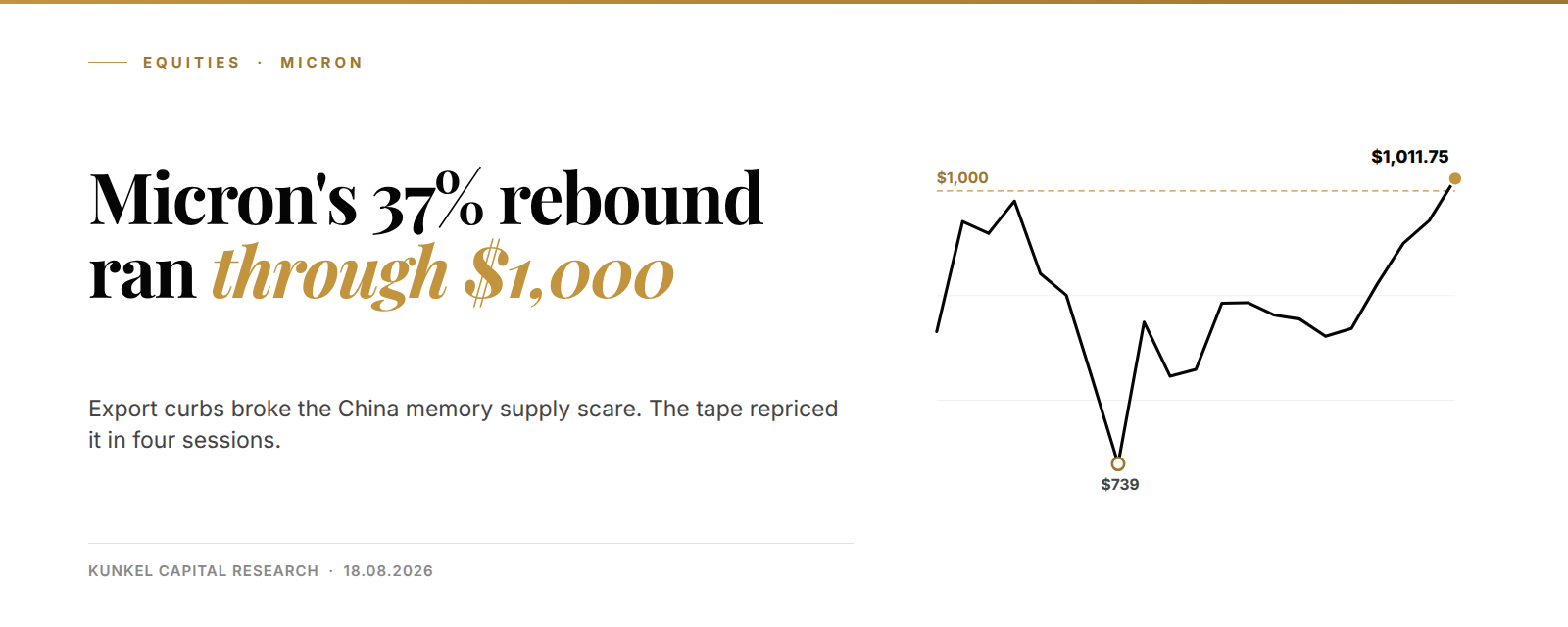
Wait. Before we tie a neat bow on this, one name in the losing basket does not fit the story. Micron is memory, not a merchant GPU. Its high-bandwidth memory sells into Broadcom's ASICs and Nvidia's GPUs alike. So why did it drop 5.5% on July 6, closing at $984.75?
Three reasons, and only one is the ASIC story. First, plain rotation: the momentum factor averages roughly -5% in July, and Micron had run hot. Second, profit-taking after a historic run. Micron had already shed 11% on July 1, wiping out about $138 billion of market value in a single Q3 session. Third, a US class-action complaint naming Micron, Samsung, and SK Hynix over DRAM output. That is a legal overhang, not a demand problem.
We flag this because honest dispersion analysis names the exceptions. Micron sits in the red basket for reasons that have little to do with custom silicon. If you trade the split, treat memory as its own book.
Translation: not every red ticker is red for the same reason. Sort by cause, not by color.
Dell ripped 7.7% because systems sell the buildout, not the wafer
Dell was the loudest tape on Monday, up 7.7%. The proximate spark was political theater. President Trump promoted Dell's computers at a White House bell-ringing event with the NYSE and Nasdaq. That is a one-day sugar rush.
The structural read is bigger. Dell does not fab silicon, it integrates it. It ships the racks, the cooling, and the servers that turn a chip order into a running cluster. When custom ASICs and GPUs both ship in record volume, the systems vendor gets paid on every unit either way. It sits above the chip war, not inside it.
That is the quiet lesson of July 6. You could have owned the argument about ASIC versus GPU. Or you could have owned the box that ships both. We walked through the same layer logic in our note on Dell's earnings gap and the AI backlog drift, and in the industrial version of the trade in Caterpillar's $63B backlog and the AI rotation.
Five things the July 6 split told you about the next two quarters
The tape handed traders a clean signal. Here is what it said, in order.
- The AI-chip basket is now two baskets: custom silicon and systems on one side, merchant GPUs and commodity memory on the other.
- Broadcom's Apple deal through 2031 removed the single biggest bear case and repriced the leader.
- Custom ASIC growth (44.6%) is lapping merchant GPU growth (16.1%), so the spread has a structural tailwind.
- Micron's drop is a memory-and-legal story, not an ASIC story, so it trades on its own clock.
- Dell shows the safest expression of the buildout may be the systems layer, which gets paid on both sides.
The move that follows a clean structural print usually drifts in the same direction for weeks. That is the post-earnings-drift effect at a sector level. We audited that behavior in why the market keeps ignoring the beat.
The two-basket split is a positional trade, not a one-day headline
Here is our read as of July 7, 2026. The July 6 session was not a rotation out of AI. It was a rotation inside it. The money is sorting winners from the losers of the custom-silicon shift, and it is doing so with real numbers behind it.
The positional zone is the spread itself. Long the custom-silicon and systems basket. Fade the merchant-GPU names into strength, with memory treated as a separate book because of the legal overhang. The tell to watch is Broadcom's backlog conversion: $10.8 billion shipped against a $30 billion book. As that ratio climbs, the thesis is working. If it stalls, the split narrows.
You do not need to catch the low. You need to be on the right side of the spread. That is the entire game.
For the bottoming version of this playbook, where insiders step in before the tape turns, see our work on insider cluster buys at equity bottoms. And for the counter-case, where a strong data-center print still got sold, read Nvidia's $75B data-center quarter and the sell-the-news drop.
Frequently asked questions
Why did AMD and Broadcom move in opposite directions on July 6, 2026?
Broadcom rose 3.7% on the Apple deal extension through 2031, which locked in roughly 20% of its revenue. AMD fell 4.3% as the same tape rewarded custom silicon over merchant GPUs. The market split the AI-chip basket in two.
Is the custom-ASIC shift actually bigger than the GPU market?
No, not yet. GPUs still hold 69.7% of AI server shipments in 2026 per TrendForce. But custom ASIC shipment growth (44.6%) is nearly three times the merchant-GPU rate (16.1%), so the marginal dollar is shifting fast.
Why did Micron fall if it makes memory the AI buildout needs?
Micron dropped 5.5% on July 6 mostly on rotation and profit-taking after an 11% slide on July 1, plus a US DRAM class-action overhang. Its move is a memory-and-legal story, not a sign that high-bandwidth memory demand is fading.
Was Dell's 7.7% jump just a Trump headline?
The spark was a White House promotion, which fades fast. The durable reason is structural: Dell ships the servers and racks that both ASICs and GPUs run inside, so it gets paid on the buildout regardless of which chip wins.
How do you trade a two-basket split like this?
Own the spread, not the sector. Long custom silicon and systems, fade merchant GPUs into strength, and keep memory as a separate book. Watch Broadcom's backlog conversion as the confirming signal.
Last updated: 2026-07-07
See the full custom-silicon rotation setup
The July 6 split is the surface signal. The Kunkel Capital research adds the sized entry on the spread, the Broadcom backlog-conversion tracker, the memory-book carve-out, and the multi-quarter target zones for each basket. €19.99 first month, then €34.99. Cancel anytime.