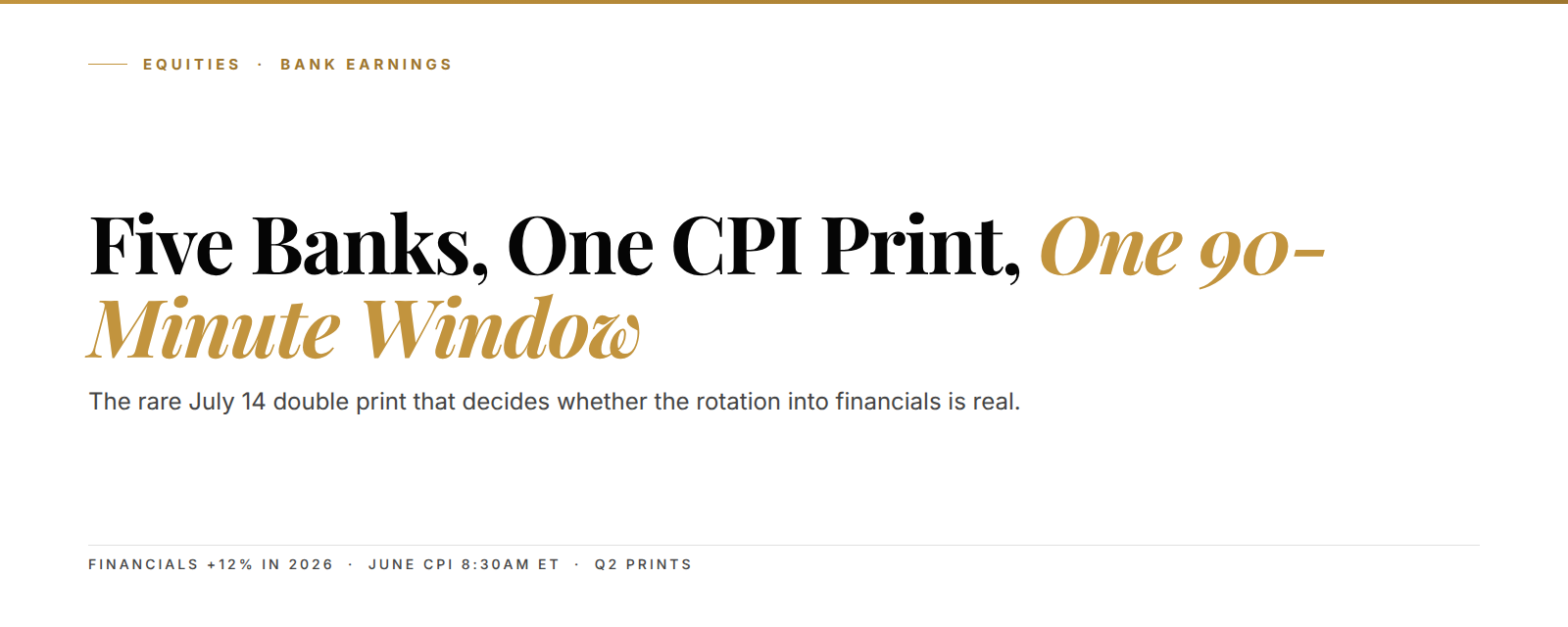
Financials are up 12% in 2026, and Tuesday morning decides whether that lead is real. Five of the biggest US banks report second-quarter results before the bell on July 14: JPMorgan, Goldman Sachs, Bank of America, Citigroup, and Wells Fargo. The June inflation print lands in the same window, at 8:30 a.m. ET. Two market-moving events. One 90-minute box. Consensus says the banks beat and inflation cools. If both land soft, the rotation out of chips and into financials gets its proof. If either misses, the trade that carried the Dow to a record can unwind fast.
The setup in 3 lines:
- Five big banks report Q2 pre-market on July 14 while the June Consumer Price Index drops at 8:30 a.m. ET, a rare double print.
- JPMorgan's consensus is $5.80 in earnings per share, up 15% from last year. Goldman's options price a 6% swing, the widest single-name bet on the board.
- Watch the KBE bank ETF's 2026 high and whether core inflation stays pinned near 2.9%. That pairing sets the tone into Q4.
Here's the part the desk doesn't say out loud. The Dow's record close of 52,900 was built on money that fled semiconductors, not fresh cash. The SMH chip ETF dropped 4.5% in the same stretch, with Teradyne off 13.6% and KLA down 11.5%. Same dollars. Different room. Bank earnings are the test of whether they stay.
Five banks and one inflation print share a 90-minute window Tuesday
At 8:29 a.m. ET Tuesday, a macro desk trader at Citadel is watching two screens at once. One holds the bank tape. The other holds the June inflation release. Both fire inside the same 90 minutes. That overlap is rare, and it matters, because the two stories pull the same lever: rates.
The banks report first. JPMorgan, Bank of America, Citigroup, and Wells Fargo all print before the open, with Goldman Sachs in the mix. Then the Bureau of Labor Statistics drops June inflation at 8:30.
Translation: you get the health of the lender and the health of the borrower in one shot.
The market can't hedge both cleanly. A soft inflation number lifts rate-cut odds, which helps stocks broadly. A strong bank quarter confirms the rotation. But a hot core reading and a bank miss would hit the exact trade that's leading 2026. That's why the implied move (the swing options traders are paying up for) is wide across the group.
$50.5 billion. That's the revenue JPMorgan is expected to clear in a single quarter, and the number the whole rotation leans on.
JPMorgan's $5.80 consensus caps a 15% jump the rotation is leaning on
JPMorgan sets the tone every quarter, and this one is no different. Consensus calls for $5.80 in earnings per share, up 15% from the $4.96 it printed a year ago. Revenue is pegged near $50.5 billion. Analysts have raised targets into the print, with the average around $353.57, roughly 5% above where the stock trades now.
The number under the number is net interest income: the gap between what a bank earns on loans and pays on deposits. Higher-for-longer rates have kept that spread fat. So banks have earned more simply by holding the same loans.
Think of it like a landlord who locked in rent while his mortgage stayed cheap. He didn't do anything new. The spread just widened in his favor. That's been the bank trade for two years.
Translation: the banks got paid to sit still, and the market wants to know if that lasts.
But the easy part may be ending. If Tuesday's inflation cools and rate-cut odds climb, that fat spread starts to narrow. So a good inflation number for the broad market is a mixed number for the lenders. You can see why the tape is nervous.
Goldman's 6% implied move is the widest single-name bet on the board
Goldman Sachs carries the widest expected swing of the group. Options are pricing a 6% move in either direction on the print, versus 4.4% for JPMorgan. The Zacks consensus puts Goldman's revenue near $16.49 billion, up 13.1% from a year ago, on the back of a capital-markets boom (trading and deal-making fees).
Here's the split that defines the quarter. Lenders like Wells Fargo live on the loan spread. Dealers like Goldman live on activity: mergers, IPOs, trading desks running hot. In 2026, activity has been strong. One read pegged sector earnings growth near 25% on the capital-markets surge.
That's the bull case in one line. Deals are back, desks are busy, and the fee machine is running.
The bear case is just as simple. Capital-markets revenue is lumpy. One quiet quarter and the beat vanishes. So Goldman's 6% implied move isn't drama. It's an honest read on how binary this print is.

June inflation's drop to 3.9% hides a core rate stuck near 2.9%
The headline inflation number will look friendly, and that's the trap. Consensus sees June CPI falling 0.1% on the month, pulling the annual rate from 4.2% in May down to about 3.9%. The reason is narrow: US gasoline fell roughly 10% in June after the Strait of Hormuz reopened and crude backed off.
Strip out food and energy and the picture changes. Core inflation is expected to hold near 2.9% year over year, with a 0.2% monthly gain. That's the number the Federal Reserve actually watches. Sticky. Not falling.
Translation: the headline looks like progress, but the part that drives Fed policy hasn't moved.
This is why a clean headline won't settle anything. If core stays pinned at 2.9%, the case for fast rate cuts weakens, and the bank spread stays wide a while longer. That's quietly good for the lenders and bad for the growth names that need cheaper money. The rotation feeds on exactly this gap.
2.9%. Core inflation hasn't moved. That single sticky number is the whole reason the rotation into financials has legs.
Wells Fargo and Citigroup carry the read on the consumer, not the deal desk
Not every bank prints the same story on Tuesday. JPMorgan and Goldman ride the capital-markets boom, but Wells Fargo and Citigroup tell you how the everyday borrower is actually holding up right now. Credit-card balances, loan losses, and deposit costs are the lines that show whether the American household is starting to crack under higher prices. That read has stayed steady through the first half of 2026, and it's half the reason the KBE bank ETF is up 12% on the year.
Watch the loan-loss provision line closely: the cash a bank sets aside now for loans it expects to go bad later. A sharp jump there signals the bank sees real trouble building in household budgets over the next few quarters. A flat line says the consumer is fine and the rotation into financials rests on solid footing.
Translation: the deal banks show you the boom, and the consumer banks show you the floor underneath it.
There's a wrinkle worth naming out loud. We're leaning on consensus estimates here, and consensus has been too gloomy on US bank credit for four straight quarters now. So the risk cuts both ways into this print. A clean provision line would stretch the trade further, but we'd rather see the actual number land than assume a four-quarter streak simply repeats itself again.
The Dow's record 52,900 was built on the same cash that left chips down 4.5%
The rotation is not a rumor. It's in the tape. The Dow closed at a record 52,900.07 this month, up 594.83 points in one session, while the Nasdaq lagged and the chip complex bled. The SMH semiconductor ETF fell 4.5%, led by a 13.6% drop in Teradyne and an 11.5% slide in KLA. Even Nvidia gave back 1.4%, and Micron lost 5.5%.

Think of the rotation like a crowd moving between two rooms. The tech room got too full and too hot. The money didn't leave the building. It walked next door into financials, industrials, and healthcare. Bank earnings are the doorway.
Translation: this isn't selling. It's reshuffling. And the banks decide if the door stays open.
Monday complicated the picture. Stocks slipped after the Hormuz shipping blockade came back, oil jumped, and the S&P 500 closed at 7,515.34. So Tuesday's banks report into a jumpier tape than they'd like. That raises the stakes on every line of guidance.
What the double print decides for financials into Q4
Two levels frame the read. First, the KBE bank ETF's 2026 high. A clean break and hold above it on strong prints tells you the leadership is real and the rotation has another leg. A rejection there says the good news was already in the price.
Second, core inflation at 2.9%. Hold or hotter keeps the rate-cut clock slow and the bank spread wide into Q4. A surprise cool below it flips the story toward the growth names that got sold, and the rotation stalls.
Five things that decide the tape Tuesday:
- Core inflation near 2.9% or hotter, which keeps rate cuts slow and the bank spread wide into Q4
- JPMorgan's net interest income guide, where a raise confirms the spread trade still has room to run
- Goldman's capital-markets revenue near $16.49 billion, since a soft print there breaks the whole boom story
- Wells Fargo's loan-loss provisions, the line that jumps first when household budgets begin to crack
- The KBE bank ETF's 2026 high, where a clean hold above it means the rotation has another leg
We think the structural setup still favors the lenders and dealers into the fourth quarter. Capital-markets activity is running, buybacks are heavy, and the yield curve is working in favor of net interest income across the group. But we'll say the honest part. This is the one print where a single bad guidance line can break a two-quarter trend in a morning. Wait for the reaction, not the headline.
That's the entire game on Tuesday.
The surface signal is clear enough. Five banks, one inflation print, one 90-minute window. The read underneath, the levels, the sizing, the follow-through, is where the work lives.
See the full bank-earnings rotation setup
The double print and the KBE level are the surface signal. The Kunkel Capital research adds the full rotation map: the exact bank-ETF zones to watch, the core-inflation scenarios scored against rate-cut odds, and the multi-quarter target for financials leadership into Q4. €19.99 first month, then €34.99. Cancel anytime.
Frequently asked questions
Why is July 14 called a double print?
Five big US banks report second-quarter earnings before the open, and the June inflation report lands at 8:30 a.m. ET the same morning. Two market-moving events in one window is rare.
Which banks report on July 14, 2026?
JPMorgan, Goldman Sachs, Bank of America, Citigroup, and Wells Fargo all report before the bell. BlackRock and Morgan Stanley follow on Wednesday.
What is the sector rotation into financials?
Investors have shifted money out of high-flying semiconductor and AI names into financials, industrials, and healthcare. The Dow hit a record while the SMH chip ETF fell 4.5%.
Why does core inflation matter more than the headline?
Core inflation strips out food and energy, so it shows the sticky part of price growth. The Fed uses it to set rates, and near 2.9% it keeps rate cuts slow.
Is this investment advice?
No. This is market research and education from Kunkel Capital, not personalized investment advice. Do your own work and manage your own risk.
Last updated: 2026-07-14