
Bitcoin closed July at $63,038.65, up about 7.5% on the month. It did that while absorbing the most hawkish Fed hold of this cycle, a $38 million wallet exploit and the weakest month of ETF inflows on record. On July 29 we published a call: the $60,000 floor holds through the Fed. The consensus that week said a coin-flip meeting would break the range. It's now resolved, so here's the audit, including the half of our reasoning that was wrong.
The setup in 3 lines:
- Bitcoin ended July at $63,038.65 for a 7.5% monthly gain, after entering the month near $59,500.
- The Fed held at 3.50-3.75% on July 29 with three members dissenting for a hike, and the 10-year yield pushed to 4.62%.
- Price held because the forced sellers were already gone, not because fresh money arrived: July ETF inflows came to just $205 million.
The stress test arrived late on Thursday. At 9:56 pm ET on July 31, an attacker finished a 25-minute sweep of some 500 wallets, all of them secured by Coldcard hardware devices. He took roughly 594 bitcoin, about $38.3 million. Block's bitcoin engineering team traced it to a firmware build error that had quietly bypassed the device's own hardware random-number generator since March 2021. Bitcoin fell less than 1% on the news. That reaction, more than any chart, is what the whole month came down to.
The July 29 call said the $60,000 floor holds, and the Fed tested it a day later
Our post that Tuesday was written into real fear. Bitcoin had slid 2.5% to $63,300, and rate-hike odds on the CME FedWatch tool had jumped to 35.8% from 25.7% a week earlier. We argued the range was intact and that the selling was late money leaving, not structure breaking. Then we named the condition that would prove us wrong: a weekly close back under the $58,000 shelf.
The meeting itself came in more hawkish than priced. The FOMC voted 9-3 to hold the funds rate at 3.50-3.75%, with three dissents in favor of a hike, citing tariff pass-through and energy costs from the Iran conflict. Bond markets took it straight. The 10-year Treasury yield moved to 4.62%, near its high for the year, and the 2-year added about three basis points to 4.30%. By Friday the 30-year was trading at levels last seen twenty years ago.
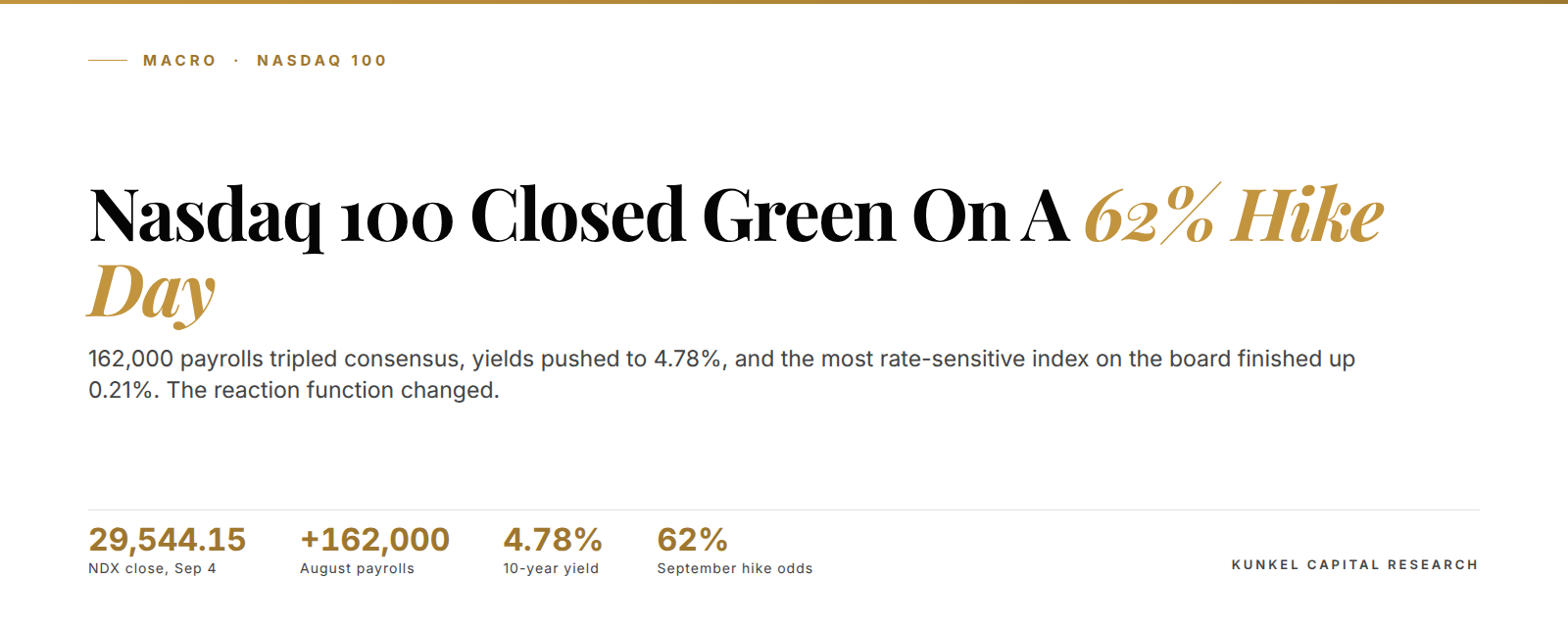
That is the setup you'd expect to break a levered risk asset, and it didn't. Bitcoin drifted rather than cracked, and the $60,000 area never came into play. The same rate scare hit equities harder, which we tracked in the Nasdaq 100 rate-hike read. So the call scored a clean pass on direction.
Bitcoin's real month low sat under $58,000 on July 1, weeks before we named the floor
Here's where we owe the reader a correction. The level that did the actual work in July wasn't the $60,000 round number we kept pointing at. June had been brutal, down roughly 19%, and the month closed near $60,000. On July 1 bitcoin traded below $58,000 intraday, which means the shelf underneath the floor got tagged before the floor was ever a story.
From there the market built higher lows for four weeks. By the time we published on July 29, the repair was already done, so the call was a continuation read on an established range, not a bottom call. That distinction matters if you're scoring us honestly. The harder trade was July 1, and we didn't put our name on it that day.
$58,000 to $63,038.65. The move that made July was already in the tape three weeks before we wrote about the floor.
We'd still make the same July 29 argument, because a range that survives a war, $100 oil and an outflow week usually survives a meeting too. But the credit belongs to the structure, not the timing.

594 stolen bitcoin and a 25-minute sweep moved price by less than one percent
The Coldcard story deserves a closer look, because it's the cleanest sentiment test the month produced. Coinkite is the Canadian firm behind the device. Since March 2021 it had shipped firmware in which a preprocessor guard checked only whether a setting was defined, never its value. The result: seed generation fell back to a software random number source instead of the secure hardware one.
In practice that left Mk3 seeds with roughly 40 bits of effective entropy instead of the intended 128, and Mk4, Q and Mk5 seeds around 72 bits. Entropy, in plain terms, is how many guesses an attacker needs before he finds your key. Cutting 128 bits to 40 turns an impossible search into a weekend project for anyone with rented compute. Wallets made on that firmware stayed guessable for five years.
Self-custody is the ideological core of this asset, so an exploit hitting the most trusted hardware brand should have produced a real flush. It produced a 1% wobble and a debate on whether some holders now shift toward ETFs. Bitcoin absorbed a five-year-old key-generation flaw and a three-dissent Fed inside 72 hours without giving back the month.
Daily liquidations ran below the $400 million norm, and that's the actual mechanism
So why did none of it stick? The answer isn't sentiment, it's positioning. Liquidations, meaning the forced closing of borrowed-money positions when an exchange pulls the plug on a margin account, ran well under the typical $400 million to $500 million daily range. That was true through the whole back half of July. In other words, almost nobody was left to force out.
Think of a hillside that burned in June. The fire comes through again in July and there's nothing left to catch, so it moves past without doing damage. June's 19% decline was that first fire, and it consumed the levered longs. When the Fed dissents landed on July 29, the sellers who would normally amplify the move had already been carried out a month earlier.
Translation: the market didn't rally on good news, it simply ran out of people who had to sell. Bitfinex analysts made the same point on Friday. They framed crypto's smaller drawdown against levered equity themes as a fuel problem, not a conviction one. That reading also explains why the AI-complex selloff, which cost chip names more than $100 billion each, barely touched crypto that week.
July's $205 million of ETF inflows was the weakest month on record while price gained 7.5%
Now for the number that breaks the standard model. Spot bitcoin ETFs took in $205 million across all of July, their weakest month since launch, against $2.43 billion of outflows in May and $4.51 billion in June. Total net assets across the complex sat at $77.46 billion on July 29, down from a peak above $150 billion in September 2025. Bloomberg had already reported the seven-session inflow streak snapping on July 27.
For two years the working assumption has been simple: ETF flows set the price. That relationship just produced its cleanest counterexample. Price gained 7.5% in the month the ETF bid nearly vanished. So the marginal buyer in July was somebody else, most likely spot accumulation that never touches a fund wrapper. We covered the flow-driven version of this thesis in ETF flows and price discovery, and July is the month that put an asterisk on it.
Bitcoin is one of the assets on the Kunkel Capital rotation: members get the full structure map with entry, exit and invalidation refreshed on a fixed cycle, with alerts when levels hit.
Friday's $1,414 slide into the New York open was expiry mechanics, not a regime change
The last session of the month looked ugly for 45 minutes and meant almost nothing. Bitcoin printed an intraday high of $63,758 at 09:25 EDT on July 31, then lost $1,414 by 10:10 EDT as New York opened, bottoming at $62,344. Monthly options expiry and month-end rebalancing were both in the window, and market makers were adjusting hedges as contracts rolled off.
By late trading it had recovered above $63,000, and through Saturday morning it held a tight $62,800 to $63,160 band. If you only saw the 10:10 candle you'd have called it a breakdown. If you saw the close you'd have called it a nothing day, and the close was right.
That's the practical use of knowing where levels actually sit. A flush into a known monthly expiry is noise; the same move on expanding liquidations while the shelf gives way is signal. The two look identical for the first half hour.
Scoring the call: the floor held, but the reason we published was only half of it
Here's the audit in full, point by point:
- Direction: correct. We said the $60,000 floor holds through the Fed, and bitcoin never traded within $2,000 of it after publication.
- Invalidation: never triggered. We named a weekly close under the $58,000 shelf, and July's only visit below that level came on July 1, four weeks before the call.
- Timing: mediocre. The structural repair happened in the first week of July, so we scored a continuation, not a turn.
- Reasoning: half right. We framed ETF outflows as the risk to watch, and July delivered record-weak flows anyway while price rose.
- Missed variable: liquidation exhaustion. Sub-$400 million daily forced selling was the load-bearing fact, and it wasn't in our July 29 post.

The regime read going forward follows from point five rather than from the flow data. A market this de-levered is hard to break with headlines, because headlines only move price when somebody is forced to act on them. That's why a hawkish Fed, a hardware exploit and an AI unwind all landed in the same week and produced a 7.5% monthly gain anyway.
Where the thesis breaks is a specific pair of conditions, not a scary print. If daily liquidations climb back toward the $400 million to $500 million norm while bitcoin gives up the $58,000 shelf on a weekly closing basis, the de-levered read is dead. The range would then be a distribution top instead. The next real test is the coming US jobs data, since a hot number puts the September hike back on the table. Until one of those two things happens, the burned-hillside condition holds.
Frequently asked questions
Did bitcoin go up or down in July 2026?
Bitcoin rose about 7.5% in July 2026, closing the month at $63,038.65 after entering it near $59,500. That gain came despite a hawkish Fed hold, rising Treasury yields and an AI-driven equity selloff.
Why didn't the hawkish Fed decision crash bitcoin?
Because the forced sellers were already gone. June's 19% decline flushed the levered positions, and daily liquidations ran well below the usual $400 million to $500 million range. So the decision had no borrowed money to knock over.
How much did the Coldcard exploit steal?
Roughly 594 bitcoin, about $38.3 million, from around 500 wallets in a 25-minute sweep that ended at 9:56 pm ET on July 31. The cause was a firmware build error that bypassed the hardware random-number generator from March 2021 onward.
Were bitcoin ETF flows positive in July 2026?
Yes, but barely. Spot bitcoin ETFs took in $205 million for the month, the weakest on record, after $2.43 billion of outflows in May and $4.51 billion in June.
What would break the current bitcoin structure?
A weekly close back under the $58,000 shelf while daily liquidations expand toward the $400 million to $500 million norm. That combination would show forced sellers returning to a market that spent July without them.
Know your entry, your exit, and where you are wrong on Bitcoin
A floor that survives a three-dissent Fed and a $38 million exploit is the surface signal. Bitcoin is on the Kunkel Capital watchlist: the full research maps the current wave count to a defined entry zone, an exit target and the exact invalidation level, refreshed on a fixed rotation, with alerts when levels hit. €19.99 first month, then €34.99. Cancel anytime.
Related Kunkel Capital research:
- The original pre-Fed floor call we're auditing here.
- How the same rate scare hit the Nasdaq 100.
- Perpetual funding at capitulation lows.
- Realized price and the cycle bottom.
- Stablecoin mints that front-run bitcoin demand.
- The Mag 7 flush that confirmed our July 10 top call.
This is Kunkel Capital Research, daily market structure with Elliott Wave and Fibonacci, and none of it is investment advice.
Sources: FOMC statement (July 29, 2026), US Treasury yield data, Bloomberg spot bitcoin ETF flow reporting (July 27, 2026), CME FedWatch tool, Coinkite firmware disclosure.
Last updated: 2026-08-02