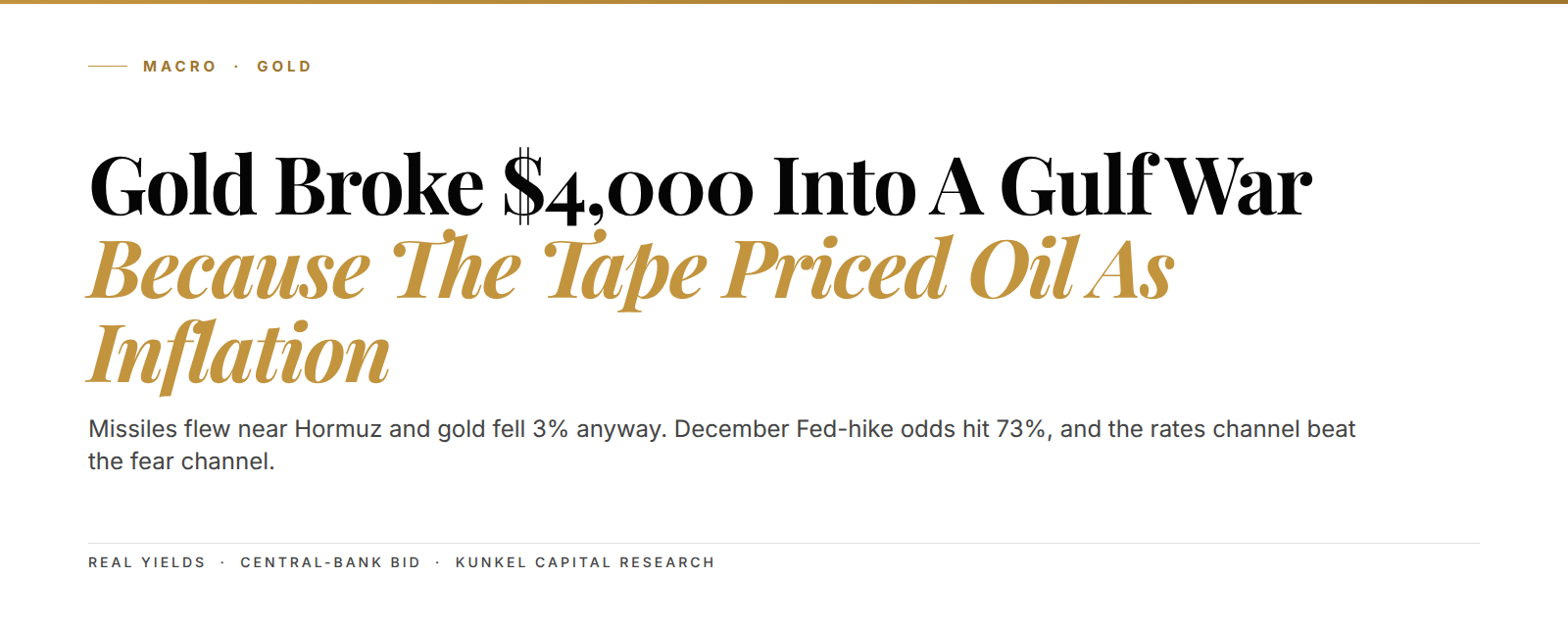
Gold fell below $4,000 on Friday, July 17, capping its worst week in six months. The strange part is when it happened: during an active shooting war in the Persian Gulf. Missiles were flying near the Strait of Hormuz, crude ripped to a one-month high, and the one asset built to catch a fear bid got sold instead, down roughly 3% on the week. The old playbook says gold rips when the shooting starts, so a selloff into a Gulf war looks broken. It isn't. Traders read the Iran oil shock as an inflation event, not a fear event, and that one reframe is why gold cracked instead of climbing.
The setup in 3 lines:
- Gold lost about 3% into Friday, July 17, and closed the week under $4,000 for the first time since winter.
- The Hormuz oil shock pushed December Fed-hike odds to 73%, so the tape priced the war as inflation, not as a safe-haven trade.
- Central banks bought 337 tonnes in Q1, the strongest first quarter on record, and that bid still sits under the correction.
On Thursday, Dallas Fed President Lorie Logan said out loud what the futures market had been whispering all week. With oil feeding straight into headline prices, she argued, the Fed should stay ready to hike, not cut. Vice Chair Philip Jefferson left the same door open a day earlier. Under Chair Kevin Warsh, that language isn't background noise. It's a stance, and gold desks repriced within hours. By Friday the metal had given back a level it defended for months.
Gold lost 3% during a shooting war, and that inversion is the whole story
Start with what should have happened this week. A shooting war near the world's most important oil chokepoint is a textbook fear trade. Money runs to gold, the dollar, and Treasuries, and it runs fast. That's how the January panic played, when gold spiked to a record above $5,500 on the first Iran strike headlines. So the script for this was already written. This week the market tore it up.
Gold didn't rally into the Hormuz headlines. It fell. And it fell hardest on the days crude rose most, which is the tell that matters. When the safe-haven asset drops on the exact news that should lift it, the market is telling you it changed the question. It stopped asking "how scary is this" and started asking "what does this do to inflation." Those two questions point gold in opposite directions.

Here is the mechanism in one line. Higher oil means higher headline inflation, higher inflation means a more hawkish Fed, and a more hawkish Fed means higher real rates that punish an asset paying no yield. So the war really did move gold. It just moved it through the rates channel, not the fear channel, and the rates channel points down.
Translation: the war made oil expensive, expensive oil makes the Fed meaner, and a mean Fed is gold's worst enemy. The bombs were bearish this time, not bullish.
December hike odds hit 73% because the tape priced oil as inflation
The number driving all of it sits in the rates market. By Friday, traders priced a 73% chance the Fed hikes by December, up sharply on the week. That's the lever under the gold price, and it moved a long way in five sessions.
Back up a step to see why. In June, headline CPI actually fell 0.4% on the month, dragging the annual rate down to 3.5% from 4.2% in May. That was the first monthly price drop in six years, and for a few days it killed the hike talk cold. Then Hormuz happened. Crude jumped, the disinflation story wobbled, and the same traders who had written off a July move started pricing one for the autumn instead.
This is the regime most investors still haven't internalized. For two years the reflex was simple: bad news means the Fed cuts, so buy the dip. Warsh's Fed quietly broke that old reflex. When the bad news is an oil-driven inflation scare, this Fed leans toward tightening, and the whole "bad news is good news" trade flips upside down. We walked through the same repricing after the last jobs print in our read on the two-year yield's hike pivot.
So gold got caught on the wrong side of a policy reflex, not a fear reflex. That's a very different setup, and it changes where the floor is.

Real rates set the gold price when the Fed answers inflation with hikes
Gold pays you nothing: no coupon, no dividend, and no rent. So the price you'll pay for it depends heavily on what you give up by holding it, and that opportunity cost is the real yield: the interest rate after inflation. When real yields climb, cash and short Treasuries start to look better, and gold has to compete against a rising hurdle.
That's the pipe the war traveled through this week. Hike odds rose, real yields firmed, and gold's relative appeal slipped even with a live conflict on the tape. It's counterintuitive until you see the plumbing, and then it's obvious.
73% December hike odds. That's the number that sold gold this week, not the missiles over Hormuz.
Think of it like a landlord choosing between two buildings. One pays rent that rises with rates. The other pays nothing but might appreciate. When the first building's rent jumps, the empty one has to promise a much bigger future gain to stay worth owning. In that picture, gold is the empty building. Rising real rates just raised the rent on everything else.
We've made this argument before, because it keeps mattering. Our earlier piece on why real yields stopped predicting gold cleanly covers the nuance: the link isn't mechanical week to week, but it dominates at turning points like this one. And this week was a turning point, driven by the same real-yield squeeze under Warsh we flagged earlier in the correction.
Central banks bought 337 tonnes in Q1, the record bid under the correction
Now the other side, because a price-driven selloff and a structural top are not the same thing. While speculators dumped paper gold this week, the buyers who move slowly kept buying. Central banks purchased a net 337 tonnes in the first quarter of 2026, the strongest Q1 on record, per the World Gold Council. Total demand hit 1,234 tonnes, the best first quarter since 2011.
These buyers don't chase the daily tape. Poland's central bank added 31 tonnes in Q1 alone, part of a multi-year plan to keep stacking reserves. The buyer list even got longer this year, with Guatemala, Indonesia, and Malaysia showing up on it for the first time. The Council still pencils in 700 to 900 tonnes for the full year. That's the slow bid sitting under every rate-driven flush.
Here's why that matters for the read:
- Central-bank demand is price-insensitive, so a hawkish Fed doesn't scare it off.
- The 337-tonne Q1 was the strongest on record, not a one-off spike.
- New sovereign buyers keep joining, which widens the structural floor.
- Reserve diversification away from the dollar is a multi-year plan, not a trade.
- That bid is why gold's corrections have kept finding footing far above old ranges.
Gold is one of the assets on the Kunkel Capital rotation, and members get the full structure map with the entry zone, the exit target, and the invalidation level refreshed on a fixed cycle. The point for right now is simpler than that. The people buying tonnes aren't the people who sold this week, and they don't move for a hike scare.
The $4,000 round number is where this read gets tested
Put the two forces together and the picture resolves. Short term, gold is a hostage to the rates market, and the rates market is leaning hawkish into the July 28-29 Fed meeting. So the path of least resistance stays lower while hike odds hold near 73%. That's the correction we flagged when the metal first cracked its prior shelf, echoed in our note on the Warsh flush and the central-bank floor.
Longer term, the structural bid hasn't blinked. Gold ran to a record above $5,500 in late January and crossed $4,400 as recently as April, so this week's break of $4,000 is a deep correction inside a bull market, not the end of one. The central-bank tape says the floor is real. The rates tape says the floor is lower than bulls hoped. Both can be true at once, and right now they are.
So where exactly does this thesis break? Watch the round number and the buyers together. A weekly close back below $4,000 that holds, paired with signs the central-bank bid is stalling, would tell you the correction has turned into something worse. That is exactly where we would be wrong. As long as $4,000 keeps getting defended on a closing basis and the sovereign buyers keep filing purchases, the hawkish-Fed selloff stays a dip inside a longer uptrend, not a trend change.
That's the honest read as of 2026-07-20. The war didn't lift gold because the market repriced it as inflation. The Fed, not the missiles, holds the near-term whip. And the slow money underneath hasn't moved. You now know what's happening and why. The next question, where the levels actually sit, is the one the research answers.
Frequently asked questions
Why did gold fall when there's a war near the Strait of Hormuz?
Because the market read the conflict as an inflation event, not a fear event. Higher oil feeds headline inflation, which pushes the Fed toward hikes and lifts real yields. Gold pays no yield, so rising real rates hurt it. The rates channel overpowered the safe-haven channel this week.
What are the odds of a Fed rate hike now?
By Friday, July 17, the market priced roughly a 73% chance of a hike by December. The next Fed meeting is July 28-29. June CPI had actually fallen 0.4% on the month, but the Hormuz oil shock revived the inflation worry that drives hike bets.
Is the gold bull market over?
Not on the structural data. Central banks bought a record 337 tonnes in Q1 2026 and the full-year forecast is 700 to 900 tonnes. Gold set a record above $5,500 in January. This week's drop below $4,000 reads as a deep correction inside that trend, driven by rates, not by the buyers leaving.
What would confirm the selloff is getting worse?
A weekly close that holds below the $4,000 round number, paired with signs the central-bank bid is fading. That combination would flip the read from "dip inside an uptrend" to "trend change." Until then, defended closes above $4,000 keep the structural case intact.
Last updated: 2026-07-20
Know your entry, your exit, and where you are wrong on Gold
The market reading a Gulf war as inflation instead of fear is the surface signal. Gold is on the Kunkel Capital watchlist: the full research maps the current wave count to a defined entry zone, an exit target, and the exact invalidation level, refreshed on a fixed rotation, with alerts when levels hit. €19.99 first month, then €34.99. Cancel anytime.