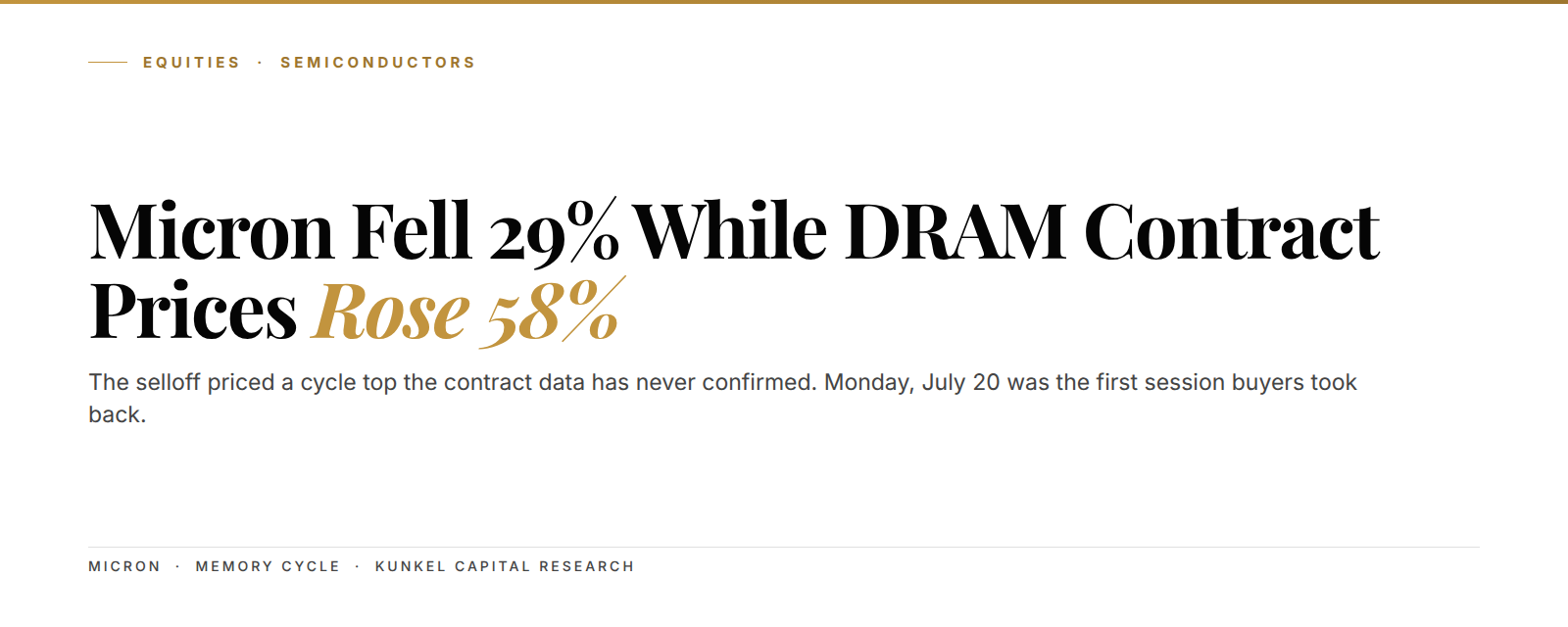
Micron closed at $865.46 on Monday, July 20, after gaining 5% in the first session that went the buyers' way in three weeks. That price sits 29% below the $1,213.37 close the stock printed on June 25. Most of the tape read the slide as the AI memory trade finally cracking. But conventional DRAM contract prices rose 58% to 63% quarter-on-quarter in the same window, and not one month of falling prices has shown up in the data yet.
The setup in 3 lines:
- Micron fell 29% from its June 25 record close while DRAM contract prices rose 58-63% quarter-on-quarter.
- The selloff priced in a cycle top that the contract-price data has never once confirmed.
- The confirming signal would be two straight months of falling DDR5 contract prices, and so far there are zero.
A memory upcycle is the stretch where chip prices climb quarter after quarter because buyers need more chips than the factories can physically build. That is the condition the contract data still describes. The share price stopped describing it on June 25.
Monday morning gave the divergence a public test. Before the open, JPMorgan strategist Mislav Matejka told clients the semis were oversold and flagged that no meaningful new supply arrives before 2028. Memory names caught a bid within minutes. Micron added 5%, SanDisk 6%, Western Digital 4%, and SK Hynix roughly 5%. One session proves nothing on its own. But it is the first time since late June that the group stopped going down on no news.
Micron's 29% drawdown happened while its product got 58% more expensive
Here is the gap in plain numbers. Micron peaked at a $1,213.37 close on June 25. By Monday it traded at $865.46, so nearly a third of the equity value came off in under four weeks. Over that same stretch, TrendForce reported conventional DRAM contract prices rising another 58% to 63% quarter-on-quarter, following a 93% to 98% jump in the first quarter.
That combination is unusual and worth sitting with. The thing Micron sells got dramatically more expensive. The claim on Micron's future earnings got dramatically cheaper. Both cannot be describing the same cycle.

Translation: the factory is charging more for every part it ships, and the stock market is paying less for the factory.
The usual explanation is that markets look forward and contract prices look backward. That is a fair point, and it is the strongest version of the bear case. Contract prices are negotiated in arrears, so they tell you what buyers agreed to weeks ago. A stock that fell 29% may simply be pricing the quarter after next, when the shortage eases. So the honest question is not whether the market can lead the data, because it obviously can. The real question is whether anything in the supply picture actually changed between June 25 and July 20.
$3.3 trillion. That is the global semiconductor market value erased in the slide off the June high, according to index data, with zero months of falling DRAM contract prices to justify it.
The SOX lost 20% from its June record without a single supply headline
The broader chip index tells the same story at a wider angle. The PHLX Semiconductor Index peaked at 14,655 in late June and closed near 11,674 on Friday, July 17. That is a drop of just over 20%, which puts the index formally in a bear market. Global semiconductor market value fell by roughly $3.3 trillion across that move.
Now look at what did not happen during those four weeks. No major producer announced new fab capacity coming online early. No hyperscaler cancelled a memory order publicly. Samsung's own quarter, reported in early July, came in ahead of expectations at roughly $59 billion in operating profit on about $113 billion in sales. The company printed monster numbers and the group sold off anyway.
That last detail is the one that matters, because it separates two very different kinds of decline. When a cycle genuinely tops, the bad news comes first and the price follows. Here the price moved first and the news never arrived. What changed was positioning, not supply.
To see why positioning alone can do this much damage, remember where the group started. Memory names had put on roughly 60% median gains since late March. A move that size attracts fast money, and fast money leaves faster than it arrives. So the first real drawdown found very few holders willing to sit through it.
Sold-out capacity is a contract, not a forecast, and that distinction carries the thesis
The supply side of this is more concrete than most cycle arguments get. Micron's high-bandwidth memory capacity is sold out through 2027. Kioxia confirmed back in January that its entire 2026 NAND output was already committed, with some hyperscale customers asking for supply agreements running into 2027 and 2028. SK Hynix's chairman has gone further and warned that global memory supply likely stays around 20% below demand through 2030.
Think of it like a wheat farmer who has already sold next year's harvest at a fixed price before planting. He is not forecasting anything, because he signed papers. If wheat prices fall next spring, his revenue does not move, since the buyer is contractually on the hook. Sold-out memory capacity works the same way, which is why booked capacity behaves very differently from guidance.
That is the part the drawdown treats as optional. A stock falling 29% is pricing a demand problem, and a demand problem should show up first as order cancellations or as softening contract prices. Neither of those has appeared yet. Until one does, the selloff is a story about who owns the shares, not about who wants the chips.
Micron is one of the assets on the Kunkel Capital rotation: members get the full structure map with entry, exit and invalidation refreshed on a fixed cycle.
We flagged this same supply-versus-price gap five weeks ago, when the memory complex beat the index eight to one on June 15 and the tape credited an Iran truce for it. That read is in our note on the sold-out memory cycle behind Western Digital's move. The cycle thesis has since taken a 29% drawdown, and saying so plainly matters more than defending the call. Drawdowns inside an intact trend are normal. Drawdowns that break the trend are not, and the data below is how you tell them apart.
Five conditions separate a shakeout from a genuine cycle top
Here is the checklist we run on the memory complex, in the order the evidence would actually arrive:
- DDR5 contract prices. Two consecutive monthly declines is the historical warning. Right now the count is zero.
- Order cancellations. A named hyperscaler walking back a committed 2027 order would change the supply math immediately.
- New fab announcements. Capacity pulled forward from 2028 into 2027 would compress the shortage window.
- Inventory days at the module makers. Rising inventory while prices still climb is the classic late-cycle tell.
- Price behavior at the prior breakout area. Whether the June range floor holds on a weekly closing basis, not intraday.
Notice that four of the five are physical, not technical. That is deliberate, because in a supply-constrained cycle the chart usually moves last. The chart tells you about positioning, while the contract data tells you about the actual shortage.

Zero. The number of consecutive months of falling DDR5 contract prices recorded so far, against a 29% drawdown in Micron.
The structural read: this is a positioning flush inside an intact supply shortage
So where does that leave the actual thesis? The weight of evidence says the June-to-July decline was a positioning event, not a cycle top. The physical shortage that drove the move is still on the books, still contracted, and still visible in TrendForce's pricing series. What broke was the crowd that arrived late, after 60% median gains, with no intention of holding through a drawdown.
That view has a direction attached to it. Memory equities dislocated below where the contract data says the earnings power sits, and Monday's 5% session was the first sign that buyers noticed. The regime here is a supply-constrained upcycle in its middle innings, not its final one, and shortages that are contractually locked through 2027 do not resolve because a stock fell for four weeks.
Now the part that matters most, because a thesis without a break point is just an opinion. Here is where this read is wrong. If TrendForce prints two consecutive months of falling DDR5 contract prices while Micron closes a weekly candle back inside the pre-breakout range it left in the spring, the shortage thesis is finished and this becomes a genuine cycle top. That is the invalidation, and it is behavioral rather than a line on a chart. You would not need our work to see it. You would need TrendForce's monthly release and a weekly close.
One honest caveat belongs here, and it cuts against the read. We do not know how much of the AI memory demand is genuine end-use versus hyperscalers building buffer inventory against future shortage. If a meaningful share turns out to be buffer, the 2027 order book is softer than it reads, and the shortage ends sooner than the contracts suggest. That risk is real and it is not resolvable from the outside right now.
What Monday actually settled, and what it did not
Monday settled one narrow thing, and only that. The group can go up without a peace headline, an earnings beat, or a policy change, which had not been true since June 25. In other words, sellers ran out before buyers did. That is how flushes usually end, though a single session is thin evidence and the week ahead carries real event risk with Alphabet, Tesla and AMD all reporting.
What Monday did not settle is the timing. A shortage that lasts through 2027 tells you the direction. It tells you very little about which week the low prints. That gap between a correct thesis and a tradeable one is where most people lose money on cycles they read correctly.
For now the read stays straightforward enough to hold in one line. The chips got scarcer and the shares got cheaper, and only one of those two facts can survive contact with 2027.
Frequently asked questions
Why did Micron fall 29% if memory prices are rising? Because positioning changed, not supply. Memory names had gained roughly 60% median since late March, and that late-arriving money sold quickly on the first real drawdown. No order cancellations or falling contract prices accompanied the decline.
What happened to Micron on July 20, 2026? Micron rose about 5% to close at $865.46, part of a broad memory rebound that also lifted SanDisk 6%, Western Digital 4% and SK Hynix roughly 5%. It was the group's first up session on no fresh news since late June.
How much did DRAM contract prices actually rise in 2026? TrendForce reported conventional DRAM contract prices up 93-98% quarter-on-quarter in the first quarter of 2026, with a further 58-63% rise in the second quarter. Industry revenue reached $97 billion in Q1, up 81% quarter-on-quarter.
What would prove the memory cycle has topped? Two consecutive months of declining DDR5 contract prices is the historical signal, and it has preceded 40-60% drawdowns in memory equities. That count currently stands at zero.
Is the semiconductor sector in a bear market? Yes, by the standard definition. The PHLX Semiconductor Index fell from 14,655 in late June to about 11,674 on July 17, a decline of just over 20%.
Know your entry, your exit, and where you are wrong on Micron
A 29% drawdown against 58% contract-price gains is the surface signal, and this post gave you the full read on why the two diverged. Micron is on the Kunkel Capital watchlist: the research maps the current wave count to a defined entry zone, an exit target and the exact invalidation level, refreshed on a fixed rotation, with alerts when levels hit. €19.99 first month, then €34.99. Cancel anytime.
Related Kunkel Capital research:
- ASML's guide against the chip rout.
- TSMC's record print and the wave 4 pullback.
- NVIDIA's data-center number as a sell-the-news event.
- How wave 4 pullbacks alternate.
- The AMD and Broadcom custom-silicon split.
- Wave 3 extensions most traders miss.
Sources: TrendForce DRAM contract pricing series (June 1, 2026), Nasdaq PHLX Semiconductor Index data, company filings.
Last updated: 2026-07-21