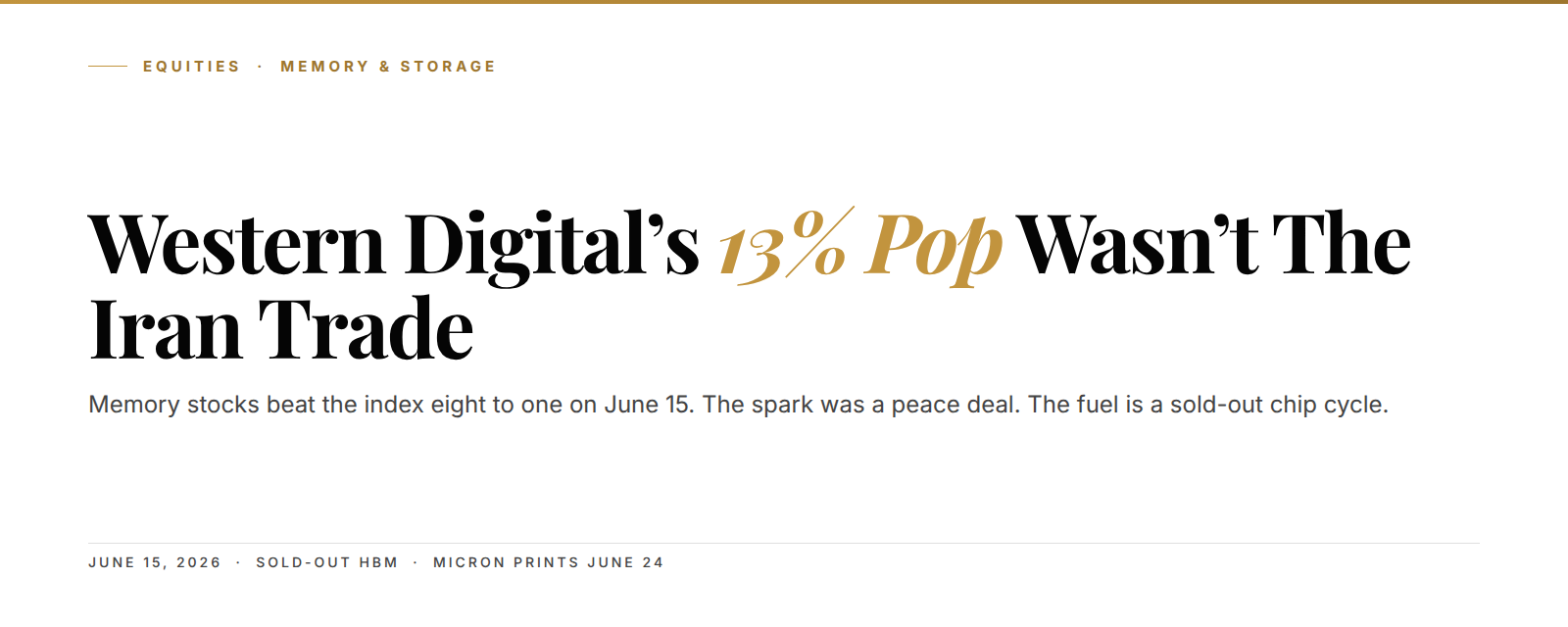
Western Digital ripped 13% Monday, June 15, to $638. The tape called it an Iran-truce bounce. Stocks jumped, oil fell, and a peace headline got the credit. Here's the problem with that story. Western Digital doesn't make oil. It makes memory and storage chips. And it didn't move alone. Micron rose 9%, Seagate and SanDisk added 6% each, and AXT jumped almost 15%. The whole memory group moved together, and it moved far more than the 1.5% the S&P managed.
That gap is the tell, and most people read it backward.
Here's the one-line version. A memory upcycle is a stretch where chip prices climb quarter after quarter because buyers need more than the factories can build.
The setup in 3 lines:
- Memory and storage stocks jumped 6% to 15% on June 15 while the S&P added just 1.5%.
- The Iran truce was the spark. The fuel was a chip shortage that's been building for a year.
- The hard date is June 24, when Micron reports with its fastest memory already sold out.
---
Here's what consensus skipped. When Micron's CEO closed the company's fiscal second-quarter call in late March, he didn't lead with the revenue line. He said demand was running "substantially higher than the ability to supply." That sentence, not the Iran headline, is why these stocks gapped. Monday just handed the crowd a reason to finally buy what the supply data flagged months ago.
The memory names beat the index 8 to 1, and that ratio is the whole story
Western Digital gained 13% on a day the S&P added 1.5%. Do the math: that's more than eight times the index move, in one name, in one session. Seagate, Micron, and SanDisk all cleared 6% on the same day. When a whole group beats the tape by that much, it isn't beta. It's a sector move wearing a market costume.
Translation: a risk-on bounce lifts everything a little. This lifted memory a lot. That difference is the signal.
The Iran truce did reopen risk appetite. Reuters reported the framework Sunday night, with a formal signing set for June 19 in Switzerland. Oil fell near 5% to about $83. So money rotated back into risk assets. But risk-on alone can't explain why storage stocks tripled the index move while defense names like Lockheed actually fell 1% to 2%.
Wait, actually that split is the proof. Peace sold the war trade and bought the growth trade. Memory is the growth trade with the tightest supply. So it caught the most bid. It's the same forced-demand mechanic we tracked when index buyers had to lift Marvell into the S&P, mapped in our note on Marvell's S&P inclusion and the forced bid.
The chart below stacks Monday's moves side by side. Memory and storage on one axis, the S&P on the other.

13% versus 1.5%. That's Western Digital against the index on June 15. The gap is the story, not the headline.
Micron's fastest memory is already sold out, and that's the fuse Iran lit
Micron's high-bandwidth memory is sold out for 2026. High-bandwidth memory, or HBM, is the stacked chip that feeds AI accelerators the data they need. Every AI server Nvidia ships needs it, and Micron just can't make enough.
Here's the mechanic that matters. HBM eats roughly three times the factory space per bit of regular memory. So every wafer Micron shifts to HBM pulls supply out of the normal DRAM market. DRAM is the everyday memory inside phones, laptops, and servers.
Translation: the AI chips are stealing the factory lines that used to make ordinary memory. That makes ordinary memory scarce too. Two shortages, one cause.
Think of it like a bakery that lands a giant wedding-cake order. Every oven goes to the cake. The shelves run dry of bread. Now bread costs more, even though nothing changed for the bread buyer. HBM is the wedding cake, and DRAM is the bread, and right now the whole town is short on both.
DRAM prices jumped 20% in a quarter while the screen looked away
DRAM prices climbed about 20% in a single quarter and roughly 30% over the year. Micron's fiscal second-quarter filing put average selling prices up double digits across both memory lines. NAND, the memory inside storage drives, added mid-teens. Those aren't recovery numbers, they're shortage numbers from a market that can't keep up.
The proof shows up in the margins. Micron's gross margin hit 74.9% last quarter, and the Street models near 81% for the print. Revenue ran up 196% from a year ago. You don't post numbers like that in a glut.
Translation: when a company sells out and still raises prices, the buyer has no room to push back. That's a seller's market. It's lasted longer than almost anyone modeled.
This is why the storage names matter as much as the chipmakers. Western Digital's own CFO has called the storage boom early-stage, not late. The drives that hold AI training data are scarce for the same reason the chips are. We laid out how forward order books re-rate these stocks in our work on Broadcom's AI guide and the order book that moves it.
20% in one quarter. That's how fast DRAM prices climbed while the tape still treated memory as a cyclical loser.
June 24 is the hard date: Micron's print decides the memory trade
Micron reports after the close on June 24. That's the real event, not the Iran headline. The whole complex, Western Digital included, trades off what Micron's guide says about pricing into the back half of the year.
Consensus wants about $34.8 billion in revenue and near $19.82 in earnings. But the number that moves the group is the forward guide on HBM and DRAM pricing. Guide prices higher again and the shortage thesis holds. Hedge it, and the June 15 pop looks like a one-day trade.
We've seen both outcomes this spring. Dell ripped 33% on a raised guide, broken down in our Dell earnings-gap note. Nvidia beat and faded on an in-line one, covered in our Nvidia sell-the-news read. The forward number is always the tell, never the backward one. And after a clean beat-and-raise, the drift keeps paying for weeks, the base pattern we mapped in why earnings drift pays the traders who ignore the beat.
There's a read-through for the whole group here. If Micron's guide holds, Western Digital, Seagate, and SanDisk all re-rate on the same pricing data. They sell into the same shortage. So the June 24 print isn't only a Micron event. It's the tape's verdict on every memory name at once. That's why we watch one print to frame six positions.
Translation: don't trade Monday's pop, trade what Micron actually says on June 24.
June 24. That's the date the memory trade gets settled. Not the Iran headline.
Five tells separate a one-day bounce from a real breakout
We run every news-driven gap through a short filter. It sorts a headline bounce from the start of a real trend. Here they are, scored against June 15.
- Dispersion: did the group beat the index by a wide margin? Memory cleared 6% to 15% against 1.5%, which scores green, because a real move shows up as alpha rather than beta.
- The price curve: are the underlying prices still rising? DRAM is up 20% on the quarter, another green, because tight supply confirms the stock move.
- The calendar: is there a hard fundamental date ahead? Micron prints June 24, a third green, since a bounce with a near-term proof point can extend.
- Positioning: how stretched are the stocks already? Western Digital has roughly doubled in 2026, so this one flags yellow, with a lot of good news already priced in.
- Breadth: is the rest of the tape risk-on? The S&P just rallied on the truce, green for now, though peace rallies tend to fade on a lag.
Most gaps pass one or two of these. June 15 passed four cleanly, with one yellow flag on positioning. That's a high score, which is why we treat this as more than a one-day bounce.
The first three tells matter most, and the scorecard below runs them against Monday's move.

The breadth caution is real, though. Leadership this year has been narrow, the same thin tape we flagged in our note on the equal-weight S&P 500 and the breadth nobody talks about. Narrow markets punish latecomers when the leaders wobble.
The positional read: Western Digital's $638 line is what matters
Western Digital closed near $638 on Monday. That level is the line to watch. Hold above it into Micron's print and the breakout has legs. Lose it on a soft Micron guide and the Iran pop round-trips fast.
We don't chase the gap, because buying after a 13% up day is how you end up offside. The setup we like is the hold, not the spike. Let the stock prove the level above $638, then use the prior shelf as the line. We map those volume-weighted entries and the Fibonacci targets in the full research, not here. A peace-driven spike that fades is the classic sell-the-news trap, and we'd rather wait for the hold than guess the open.
The structural picture is simple enough to frame here. Western Digital has roughly doubled this year, so the trend is up and stretched at the same time. A hold above the breakout shelf keeps the uptrend intact. A daily close back below it is the first crack, and the spot where we'd step aside and wait.
One honest uncertainty. We're writing before June 24. If Micron guides soft, every tell above flips, and the whole complex sells the news. We're not calling Micron's number. We're handing you the read, so you trade the print instead of the headline.
You watch June 24, not June 15. That's the tell.
Frequently asked questions
Why did memory stocks like Western Digital jump on June 15, 2026?
The spark was a U.S.-Iran peace framework that reopened risk appetite across global markets. Reuters reported the deal Sunday night, with a signing set for June 19. But memory stocks rose far more than the index because the group sits on a real shortage. DRAM and HBM prices have climbed for months, and Micron's fastest memory is sold out for the year.
What is HBM and why does it matter for the memory cycle?
HBM, or high-bandwidth memory, is the stacked chip that feeds AI accelerators their data. It uses about three times the factory space per bit of regular memory. So every HBM wafer pulls supply out of the normal DRAM market, tightening both at once. That double squeeze is what powers the current upcycle.
When does Micron report earnings?
Micron reports after the close on June 24, 2026. Consensus calls for roughly $34.8 billion in revenue and about $19.82 in earnings, with gross margin near 81%. The number that moves the group is the forward guide on memory pricing, not the headline beat.
Is the Western Digital move a bounce or a breakout?
It scores as more than a bounce on our framework. The memory group beat the index by a wide margin, underlying prices are still rising, and a hard fundamental date sits days away. The one caution is positioning. Western Digital has roughly doubled in 2026, so a lot of good news is already in.
How high have DRAM and NAND prices risen?
DRAM average selling prices rose roughly 20% in a single quarter and about 30% over the year, based on Micron's fiscal second-quarter filing. NAND, the memory inside storage drives, added mid-teens. Those gains reflect demand running ahead of what factories can supply.
See the full memory-cycle setup
The June 15 pop and the sold-out HBM line are the surface signal. The Kunkel Capital research adds the Elliott Wave count on Western Digital and Micron, the Fibonacci zones we'd buy into the June 24 print, and the watchlist of memory names most levered to the pricing curve. €19.99 first month, then €34.99. Cancel anytime.
Last updated: 2026-06-16. Kunkel Capital Research. Not investment advice.