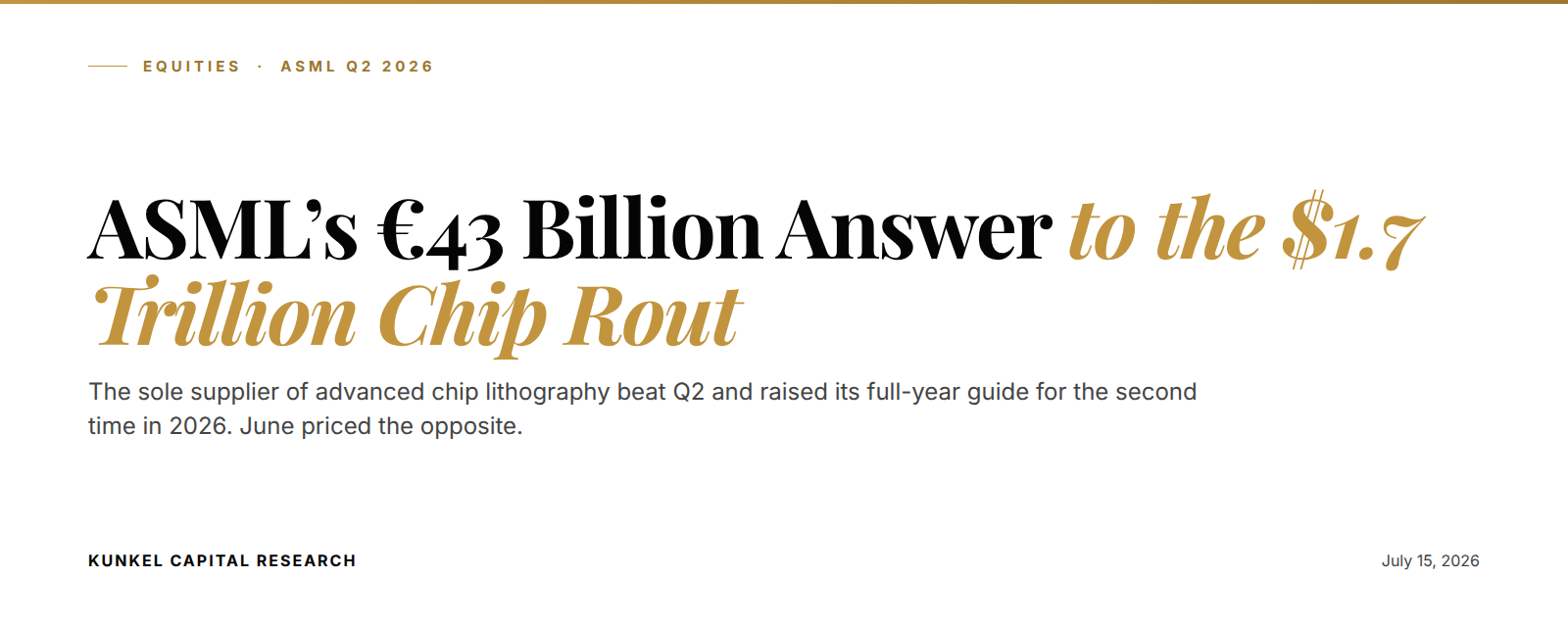
ASML raised its full-year guidance to €43 billion to €45 billion on Wednesday morning, six weeks after a $1.7 trillion chip rout told everyone the AI build-out was cooling. The machine layer just disagreed with the screen. ASML is the Dutch company that builds the lithography machines every advanced chip depends on, and no other company on earth makes them. The whole semiconductor complex just sold off on slowdown fear. Then the sole supplier of the critical machines raised its outlook for the second time in one year. One of those two signals is wrong.
The setup in 3 lines:
- ASML printed €9.3 billion in Q2 sales at a 54.0% gross margin and lifted 2026 guidance to €43-45 billion, its second raise this year.
- The Q3 guide calls for €11.0 to €12.0 billion, an 18% to 29% step up over the quarter it just beat on.
- June's $1.7 trillion chip rout priced a slowdown that the one company selling the machines says it cannot see.
At 07:00 Central European Time on Wednesday, July 15, CEO Christophe Fouquet signed off on a release in Veldhoven. It carried one number the June sellers never modeled. ASML shipped 86 new lithography systems in a single quarter, up from 67 in Q1, and it still could not keep up. The company is now adding 30% to its most advanced machine capacity for 2027. You don't build factory slots two years out for demand you doubt.
The stock gapped up more than 7% at the Amsterdam open and held near +4.4% into early afternoon.
June's $1.7 trillion rout priced a slowdown ASML says it cannot see
Rewind six weeks. Around June 23, the semiconductor complex broke hard. ASML and TSMC both dropped between 5% and 7.5% in days, NVIDIA fell with them, and Bloomberg tallied the damage across the sector at $1.7 trillion in lost market value. The story behind the selling was simple: AI capital spending had to peak sometime, and the tape decided the time was now.
That story had a problem. Nobody selling the machines agreed with it.
Fouquet's release used a phrase you rarely get from a Dutch engineering company that measures everything twice: order intake in the first half was "extremely strong." Customers aren't trimming. They're accelerating, and they're committing to machine slots that won't even be delivered until 2027 and 2028.
Translation: the people who write nine-figure checks for chip equipment just voted against the June selloff with their own money.
€11.0 to €12.0 billion. That's the Q3 guide. At the low end it's an 18% jump over a quarter that already beat.
The 86 machines and the €2.8 billion service line did the beating
The Q2 print itself was clean across every line that matters. Sales of €9.33 billion against €8.77 billion in Q1. Gross margin at 54.0%, up a full point from Q1's 53.0%. Net income of €2.9 billion, or €7.59 per share. And the quiet one: Installed Base Management revenue hit €2.76 billion. That line is ASML's service and upgrade income on machines already running inside chip factories. The company itself credited it for the beat.
That service line deserves a second look. Machines this complex don't get bought and forgotten. Every system ASML has ever shipped becomes a recurring customer for upgrades, spare parts and software. The bigger the installed fleet grows, the higher the revenue floor gets, in any demand weather.
If you're skimming, here are the six numbers from the July 15 release that carry the read:
- €9.33 billion Q2 total net sales, above the company's own guidance.
- 54.0% gross margin, up from 53.0% in Q1.
- 86 new systems shipped, up from 67 in Q1.
- €2.76 billion in service and upgrade revenue, the stated driver of the beat.
- €11.0-12.0 billion guided for Q3, with margin guided to 55-57%.
- €43-45 billion now expected for full-year 2026, the second raise this year.
Six numbers. Not one of them fits a slowdown.

A 30% capacity add for 2027 is money where the mouth is
Guidance is a promise. Capacity is a purchase. This release had both, and the capacity part is the piece the market will still be digesting next week.
ASML plans to add 30% to its 2026 low NA EUV capacity, roughly 65 machines of its top production line today. EUV means extreme ultraviolet lithography, the technology that prints the smallest chip features. It's investigating another 30% on top of that for 2028. Same shape for the DUV immersion line, the workhorse machines: around 130 units of capacity today, plus 30% planned for 2027, plus another 30% under study for 2028.
Think of it like airports and airlines. Chipmakers are the airlines. ASML is the only company on the planet that builds runways. Runways take two years to pour and airlines book the slots long before the concrete sets. When the runway builder doubles its construction plan, it isn't guessing about future passenger demand. It's reading signed contracts.
30% more EUV capacity for 2027. Machine slots are sold years ahead. Nobody pours that concrete on a hunch.

Wait, one correction to our own first read. Our instinct this morning was to call the fade from +7% to +4.4% distribution, sellers using the good print to get out. Look at the June tape first, though. After a $1.7 trillion sector drawdown, a stock that gaps 7% and still holds most of it hours later is showing absorption, not exit. The sellers had six weeks to leave. The ones left needed this print to be bad. It wasn't.
The missing bookings number is the honest tension in this print
Here's what the bulls have to sit with: the July 15 release doesn't print a net bookings figure. For years, that single number was the street's favorite forward gauge on ASML. This quarter you get a qualitative "extremely strong" plus capacity plans instead of a euro amount you can model.
We can't fully verify order quality from the outside, and we won't pretend otherwise. The capacity commitments are the best available proxy, and they're a strong one, because they cost real money and get board sign-off. But a printed backlog number would be better, and we don't have it. That's the acknowledged gap in this read.
There's a second wrinkle. NVIDIA spent the same week tightening its authorized-buyer list for high-end AI chips across Singapore, Malaysia and Japan. Export rules keep shifting, and ASML sells into that same geography. In plain terms: the demand signal is loud and real, but the map of who's allowed to buy what keeps getting redrawn. That can move quarterly numbers around even when the cycle itself is intact.
TSMC's 68% June and Thursday's print decide if the fade was right
ASML never moves alone. Its largest customer reports Q2 on Thursday, July 16. TSMC walked into that print with its June sales report already public: NT$442.7 billion for the month, up 68% from a year earlier. First-half revenue ran 35.6% ahead of last year, and the company has guided full-year growth above 30% in dollar terms.
So the sequence this week is unusually clean. The machine supplier beat and raised on Wednesday. The chip manufacturer, the single biggest buyer of those machines, shows its hand on Thursday. If TSMC confirms with capex intact or higher, the June rout starts to look like what we suspect it was: a positioning flush inside a structure that never broke. It is the same shape we walked through in our bear-trap reversal framework and saw resolve in the NVIDIA sell-the-news episode.
And if TSMC guides capex down? Then Wednesday's gap was the last good exit, and the fade crowd was right. Thursday isn't a detail. It's the other half of this print.
ASML is one of the assets on the Kunkel Capital rotation: members get the full structure map with entry, exit and invalidation refreshed on a fixed cycle.
The structural read: the June low is now the line that matters
Step back to the weekly chart and the June episode reads as a sharp corrective leg inside a larger advance that started well before this year. That's the wave shape we care about: a fast, emotional flush that breaks nothing structural, followed by the first piece of hard evidence that the underlying cycle is intact. Wednesday's release is that evidence. The pattern rhymes with the post-flush behavior we documented on Broadcom's AI guide and in our wave 3 extension study.
The levels that matter here are the ones everyone can see. Below, the June 23 selloff low: that's the flush point, and it's the floor the whole recovery case stands on. Above, the pre-rout June high: reclaim that on a weekly close and the correction is formally over. Between those two market-visible marks sits today's gap, and gaps born from guidance raises tend to get defended by the buyers who created them.
So the thesis, in one sentence: the machine layer says the AI build-out is accelerating into 2027, and June priced the opposite.
And the thesis breaks under conditions you can watch without any model. Two consecutive daily closes below the June 23 low, or a TSMC print on Thursday that guides capital spending flat to down, and this read is wrong. We'd say it plainly: that combination would mean the order commentary was the lagging signal and the June sellers saw the turn first. That's where we are wrong, and we'd rather you know it before the trade than after.
What we're not giving you here is the execution layer. That means the precise zone where the risk-reward flips positive, the structural marks derived from our wave count, and the exact price where the setup is invalid rather than just stretched. That's the difference between reading the story and trading it. The full Fibonacci confluence method behind those zones is documented for members, and the Q1 audit of our closed calls shows how the framework performed when it was wrong, too.
Know your entry, your exit, and where you are wrong on ASML
This post gave you the what and the why: a guidance raise the June rout never priced, and the conditions that would kill the read. The Kunkel Capital research adds the where and the when. ASML is on the watchlist. Members see the current wave count mapped to a defined entry zone, an exit zone and the exact invalidation level, refreshed on a fixed rotation, with alerts when the levels trade. €19.99 first month, then €34.99. Cancel anytime.
Frequently asked questions
Why did ASML stock jump on July 15, 2026?
ASML reported Q2 2026 sales of €9.3 billion with a 54.0% gross margin, both above its own guidance. It also raised full-year 2026 guidance to €43-45 billion for the second time this year. The stock gapped up more than 7% at the open and held near +4.4% into early afternoon.
What guidance did ASML give for 2026 and Q3?
ASML now expects 2026 total net sales between €43 billion and €45 billion with a gross margin between 54% and 56%. For Q3 2026 it guided sales of €11.0 to €12.0 billion with a 55-57% gross margin, an 18% to 29% step up from Q2.
What did ASML say about AI demand?
CEO Christophe Fouquet said AI-related investment keeps driving demand for advanced logic and memory chips. He called first-half order intake "extremely strong" and said customers are accelerating capacity plans. ASML will add 30% to its 2027 EUV and DUV machine capacity, with another 30% under study for 2028.
Did ASML publish a bookings number this quarter?
No. The July 15 release contains no net bookings figure. The company pointed to "extremely strong" first-half order intake and its 2027-2028 capacity plans instead, which makes the capacity commitments the best available forward gauge this quarter.
What should traders watch after ASML's Q2 print?
TSMC reports on Thursday, July 16, and its capital-spending commentary either confirms or contradicts ASML's demand signal. On the chart, the June 23 selloff low is the floor of the recovery case, and a weekly close above the pre-rout June high would formally end the correction.
Sources: ASML Q2 2026 press release (SEC filing, July 15, 2026), Bloomberg, TSMC monthly revenue report (June 2026).
Last updated: 2026-07-15