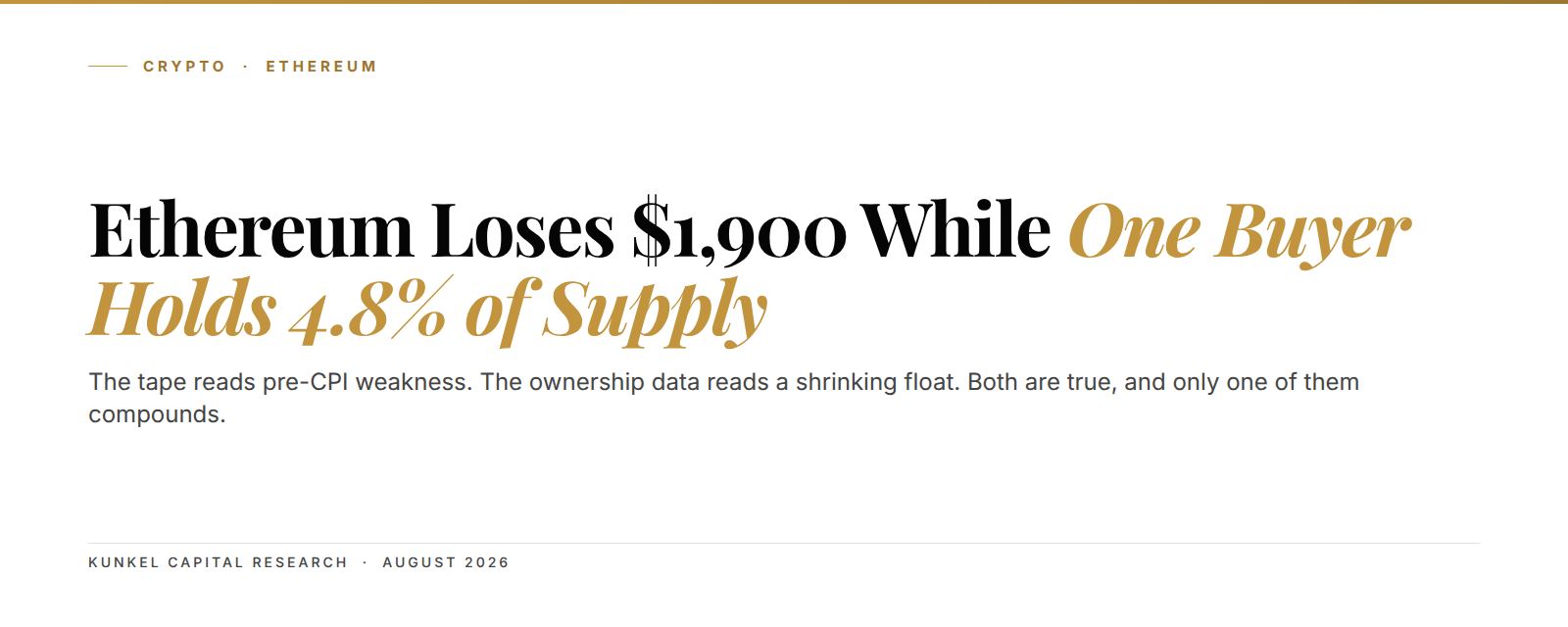
Ethereum closed Monday at $1,871, its first daily close under the $1,900 handle in a week, and the consensus read is simple pre-CPI de-risking. The same afternoon, BitMine disclosed a treasury of 5.81 million ETH, roughly 4.8% of every coin in existence. So the tape says nobody wants Ethereum into today's inflation print. The ownership data says one buyer wants nearly all of it, every single week, at any price.
The setup in 3 lines:
- BitMine's August 10 release puts its stack at 5,805,238 ETH, worth about $11.2 billion at the reference price in the filing.
- 87% of that stack sits in staking contracts, which removes it from the tradeable float entirely.
- Price keeps stalling at $1,900 on thin conviction, so the real fight is a shrinking float against a nervous tape.
---
Start with the scene. On Monday, August 10, BitMine chairman Tom Lee signed off on the company's weekly treasury update. Another 7,391 ETH went on the books. The buying run hasn't skipped a week since June 30, 2025. His macro line in the release was direct: easing financial conditions, in his words, should be "a tailwind for crypto". Hours later the spot market delivered the opposite. The handle gave way into the close.
That's the tension this piece resolves. Because both of those things are true at once, and they aren't pointing in different directions by accident.
BitMine's 5.81 million ETH print landed the same Monday the handle gave way
The release itself reads like a routine weekly update, which is exactly what makes it strange. BitMine now reports 5,805,238 ETH against a total supply of 120.7 million, plus a small pile of cash and side positions. At the reference price in the filing, the crypto stack alone is worth about $11.2 billion. And the company frames all of it as progress toward one stated goal: owning five percent of Ethereum, a project it calls the "alchemy of 5%," now 96% complete after fourteen months.
Monday's market barely blinked at any of that. ETH spent the session heavy, closed at $1,871, and Tuesday stayed pinned under $1,900 while traders squared up ahead of today's CPI report. The contrast is the story: the most aggressive accumulation program in the asset's history hit a new milestone on the exact day the price lost its round number.

You could hardly script a cleaner contrast.
You'd normally expect those two facts to live in different regimes, since accumulation stories usually come with rising prices attached. But treasury buyers don't behave like traders, and that difference is the mechanism the rest of this read hangs on.
One balance sheet holds 4.8% of the supply, and 87% of it is staked
Scale first, because the number is genuinely without precedent. BitMine's stack is about 4.8% of the 120.7 million total supply, which makes it the largest single corporate holder of Ethereum by a wide margin. And of that stack, 5,067,309 ETH sits in staking contracts, earning a running yield in the mid-two-percent range.
The staking share matters more than the headline number here. In plain terms, staked ETH is locked into validator duty: it secures the network, collects its yield, and does not sit on an exchange order book waiting for a bid. So 87% of the largest holder's position isn't just off the market in spirit. It's off the market in fact.
5,805,238 ETH. One company's stack, 96% of the way to its stated five percent goal.
Think of it like a landlord who keeps buying apartments in the same building and never lists a single one. The posted price of the building gets set by the few units still changing hands. Each purchase makes the visible market thinner, and a thinner market swings harder in both directions on the same amount of money.

Ethereum's tradeable float shrinks while the tape reads it as weakness
Now stack the other supply sinks on top of that. The spot ETH funds hold their own inventory, network staking beyond BitMine locks up a large share of the remaining supply, and long-dormant coins rarely move at all. Monday's fund flows were mildly negative too, with the spot ETH products giving back $14.59 million in a single session. The Bitcoin funds shed $144.67 million and broke a five-day inflow streak. It's the same nervous rotation we tracked around Bitcoin's $62,542 floor retest.
Put simply, the marginal seller this week is a fund allocator trimming risk before an inflation print. The marginal buyer is a corporate treasury that has bought every week for fourteen months and stakes most of what it buys. Those two run on completely different clocks, which is why the tape looks weaker than the underlying ownership shift really is.
The float math in six lines:
- Total supply stands near 120.7 million ETH, with net issuance roughly flat after fees.
- BitMine alone now holds 5.81 million coins, or 4.8% of everything.
- About 5.07 million of those are staked and out of the order book.
- Spot funds, other treasuries and network-wide staking lock up millions more.
- What actually trades day to day is the thin remainder, and it keeps shrinking.
- A thin float cuts both ways: sharper drops on outflows, sharper squeezes on real demand.
Translation: the sellers set the price this week, but the buyers are removing the inventory that the next rally will have to be bought from. That's the whole float argument in one line.
BlackRock's August 4 launch put a $311 billion fund range on Ethereum rails
The demand side isn't only treasuries, and this is where the month's quieter news matters. On August 4, BlackRock launched twelve tokenized share classes across six European money market funds, with JPMorgan's Kinexys platform minting the tokens on Ethereum, a launch Bloomberg covered the same day. The six funds hold $311 billion between them, and to be fair, that figure covers the full fund range receiving the new share class, not assets moving on-chain today.
Even so, the direction is what counts here. The largest asset manager in the world picked Ethereum as the settlement layer for regulated European cash funds, with round-the-clock transfers between approved investor wallets. That isn't a price call on ETH. And nobody should read it as one. It's a statement about which rails institutional plumbing is being welded to, and welded plumbing rarely gets ripped out over one soft quarter.
The same week brought a smaller plumbing change on the Bitcoin side. BlackRock's digital assets head Robert Mitchnick said the firm cut the minimum for in-kind creations on its spot fund from $25 million to $1 million. Small detail, but it points the same way: the institutional rails keep getting cheaper to use.
Which brings the two halves of the story together. A shrinking tradeable float is meeting a lengthening list of institutional uses for the network underneath it. And the tape chops sideways as if neither existed. Ethereum is one of the assets on the Kunkel Capital rotation: members get the full structure map with entry, exit and invalidation refreshed on a fixed cycle.
Concentration cuts both ways, and the $104 million cash line is the honest risk
Now the uncomfortable part, because it cuts against our own framing. A single holder at 4.8% of supply is also a single point of failure, and the filing shows $104 million in cash and marketable securities behind an $11.6 billion crypto balance sheet. That's a thin cushion for a company whose weekly buying is funded largely by issuing its own shares into the market. The pipeline works until it doesn't.
If that share machine ever stalls, the weekly bid disappears with it. And if the company were ever forced to unwind, the same thin float that amplifies squeezes would amplify the damage on the way down. We flagged the same shape around Bitcoin's first spot ETF closure earlier this month: concentration reads as strength right up until the concentrated party changes direction.
$104 million. The cash line behind an $11.6 billion crypto balance sheet.
So the honest statement is conditional, not triumphant. The float story is real and the staking lock is real, but the funding model behind the largest buyer is an open question we can't settle from the outside. What we can do is define what the structure has to keep doing for the constructive read to stay alive.
Absorption above the August floor is the structural read until the floor gives
Step back to the chart. Ethereum bottomed at $1,507 on June 6, recovered roughly 24% into early August, and has spent two weeks chopping between the August 1 low near $1,821 and the low-$1,930s. Every push into $1,900 since August 5 has been sold, and yet every dip toward the floor has been bought back within a session or two. So far, that's absorption behavior, not breakdown behavior. If you're watching the range, that's the whole pattern.
Sideways chop on falling conviction while locked supply keeps growing is what absorption looks like from the outside. The April high at $2,465 is the obvious overhead marker every free chart shows, and it stays irrelevant until this range resolves. For now the read is that the June recovery is consolidating rather than failing. Today's CPI is the event risk that decides which side of the range gets tested first. And the macro backdrop is still digesting the first negative payrolls print of the hike cycle, which is what put a September Fed decision back in play at all.
And here is where we are wrong: the thesis breaks on a weekly close back below the August 1 swing low while the treasury bid stalls or fund outflows accelerate. That combination would mean the float stopped absorbing real selling, and the June low conversation reopens, the same failure test we ran on Bitcoin's $60,000 floor through the hawkish Fed. Until that happens, weakness into the $1,800s is the market handing inventory to buyers who don't intend to give it back.
Frequently asked questions
Why is Ethereum down this week?
ETH lost the $1,900 handle on Monday, August 10, closing at $1,871 as traders cut risk ahead of today's US CPI report. Fund flows turned mildly negative the same day, with the spot ETH products giving back $14.59 million in one session. Nothing about the ownership structure changed that day.
How much Ethereum does BitMine own?
BitMine's August 10 release reports 5,805,238 ETH, about 4.8% of the 120.7 million total supply, worth roughly $11.2 billion at the filing's reference price. About 87% of that position is deployed in staking.
Does BitMine's buying support the ETH price?
Not on any given day, and Monday proved it: a weekly buyer can't cancel a pre-CPI dip. Structurally it removes coins from the tradeable float week after week. Most of those coins go into staking, so the effect compounds.
Is one company owning 4.8% of Ethereum a risk?
Yes, and we say so in the piece: a holder this size is structural support on the way up and a structural overhang if its funding model ever breaks. BitMine reports only $104 million in cash against an $11.6 billion crypto balance sheet, so the share-issuance machine is the thing to watch, not the coins.
What would flip the constructive read on Ethereum?
A weekly close below the August 1 swing low, combined with the treasury bid stalling or fund outflows turning persistent. That's the condition where we are wrong, and when you see those two together, the absorption case is finished. The exact levels our members trade against are part of the full research, not this post.
Know your entry, your exit, and where you are wrong on Ethereum
The Monday supply print is the surface signal. Ethereum is on the Kunkel Capital watchlist. The full research maps the current wave count to a defined entry zone, an exit target and the exact invalidation level. Levels get refreshed on a fixed rotation, with alerts when they hit. €19.99 first month, then €34.99. Cancel anytime.
Last updated: 2026-08-12