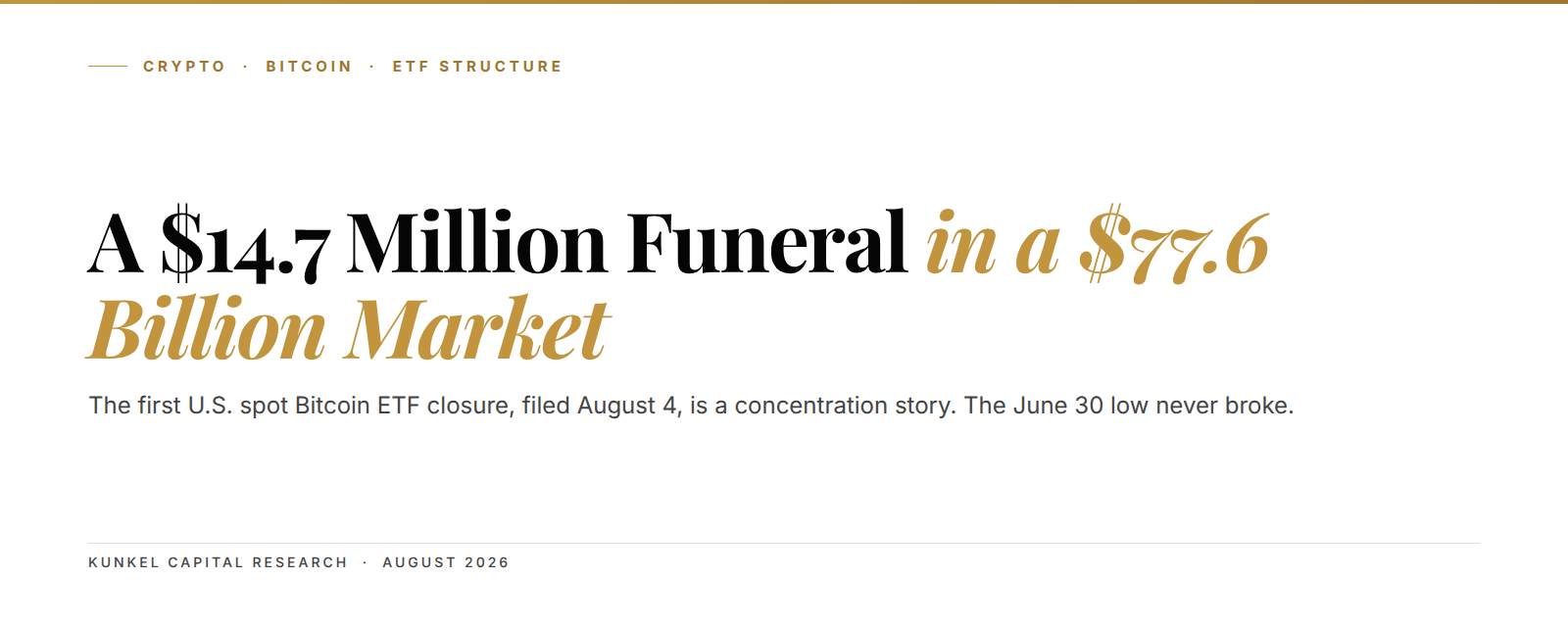
Bitcoin's ETF era buried its first fund this week. Hashdex filed on Tuesday, August 4, to close its U.S. spot Bitcoin ETF, ticker DEFI, and the final trading day is set for August 17. The obituaries wrote themselves: three straight months of net outflows from the spot funds, a crypto complex down roughly 36% from its spring highs, and now the first spot product shutting its doors. So the bearish read hardened overnight: institutional demand for Bitcoin is dying. But the fund that died held $14.7 million. The category it leaves behind still holds $77.6 billion. That gap, not the closure, is the real story.
The setup in 3 lines:
- Hashdex closes the first U.S. spot Bitcoin ETF on August 17: a $14.7 million fund inside a $77.6 billion category.
- Three months of net outflows never broke the price structure. The June 30 low at $58,559 still holds, and Bitcoin trades near $64,100 today.
- The seller is an AI rotation, not lost conviction. The read flips if outflows re-accelerate while the June low gives way.
Vetle Lunde, head of research at K33, put a timestamp on the mechanism this week. "Much of the market views the opportunity cost of holding BTC as too high while anything AI-related soars," he wrote. That one sentence explains more of the 2026 crypto tape than any flow table, because it names the actual seller. And opportunity-cost selling carries a known expiry date: it stops the moment the alternative trade stops sprinting.
The closing fund held 0.019% of a $77.6 billion category
Start with the corpse, because the details matter. Hashdex's DEFI came to market alongside the other spot products and never found a distribution edge. The firm's filing cites the usual suspects: assets under management, liquidity, operating costs and investor interest. In plain terms, a $14.7 million fund can't cover its own running costs, so it closes.
Now set that against the category around it. The U.S. spot Bitcoin complex still holds $77.6 billion in assets, and it has kept $51.5 billion of cumulative net inflows since launch. BlackRock's IBIT alone sits at $47.08 billion, which works out to about 61 cents of every spot-ETF dollar. So the money didn't leave the wrapper class. It concentrated inside it, and the sub-scale funds got starved.
Closures aren't new to crypto wrappers, either. Bitcoin futures ETFs folded in past cycles, including VanEck's XBTF back in 2024, and nobody read those as verdicts on the asset itself. A fund closing because it failed to gather assets is a business event. It only becomes a market event when the big wrappers start bleeding badly, and IBIT's share tells you they're consolidating instead.

Three months of outflows never broke the June 30 floor
Here's the tension the obituaries skip. The spot funds have posted three consecutive months of net outflows, and July ended the run with a $265 million single-day withdrawal on July 31. IBIT led that final day with $122.66 million out. If flows were the whole story, price should have printed a new low somewhere in that stretch.
It didn't. Bitcoin topped at $82,139 on May 10, slid for seven weeks into the June 30 low at $58,559, and hasn't traded below that print since.

The reclaim of $60,000 came within days, and we mapped that defense in real time when Bitcoin held the $60,000 floor through a hawkish Fed. Since then the follow-through has been quiet but consistent: July settled at $62,814, and the tape sits near $64,100 as of August 5. On top of that, every dip has found a higher shelf than the pre-Fed slide into the $60,000 zone did in June.
Five weeks, zero new lows. Three months of ETF outflows have not produced a single close beneath the June 30 print at $58,559.
That divergence has a name: absorption. Somebody is buying the coins the ETF sellers surrender, at prices the June capitulation already cleared. And you don't need to guess who. Spot desks, corporate treasuries and non-U.S. venues never show up in the U.S. flow tables, which just means the visible seller isn't the whole market.
BlackRock's 39% AI fund is where the marginal dollar went
Follow the money that left. BlackRock's iShares Future AI and Tech ETF is up 39% through July and has swollen to $3.6 billion, while the broad crypto complex sits about 36% below its high. Same asset manager, same client base, opposite tape. The rotation isn't a mystery; it shows up on a single client statement.
Think of it like a marina with one shared fuel dock. Every boat can sail, but they all fill up from the same pump, and this year the queue forms behind the AI boats. Bitcoin isn't leaking fuel. It's waiting in line, and that distinction changes how the selling ends: opportunity-cost flows reverse on the alternative's first stumble, not on Bitcoin's own news.
We've watched the same pool of money chase the concentration trade in equities all year. It's the mirror image of what we flagged in NVIDIA's $250 billion circular-financing loop and in the semiconductor unwind behind the S&P 500's July loss. When one trade absorbs every marginal dollar at the desk, everything else gets sold to fund it, and that selling says nothing about the things being sold.
And August's first sessions hinted at the turn. The spot funds took in $170 million on Monday, seven funds positive and none negative, their broadest inflow day since spring. One day isn't a trend. But inflows returning while the AI trade wobbles is exactly the sequence the divergence predicted, and it rhymes with how the Nasdaq 100's rate-hike scare resolved once forced sellers finished.
Product capitulation clusters near the end of declines, not the start
There's a reason fund closures feel bearish and tend to resolve bullish. Product decisions run on committee time, so a closure filed in August reflects pain accumulated since spring. By the time the wrapper dies, the selling that killed it is mostly behind you. The futures-fund closures of past cycles followed the same script, announced deep into drawdowns rather than anywhere near the tops.
The numbers around this closure, stacked in one place:
- $14.7 million: assets in Hashdex's DEFI, the fund that stops trading on August 17.
- $77.6 billion: assets across U.S. spot Bitcoin ETFs after three months of outflows.
- $51.5 billion: cumulative net inflows the category has kept since launch.
- $47.08 billion: BlackRock's IBIT alone, roughly 61% of all category assets.
- $27.47 billion: lifetime outflows from Grayscale's GBTC, absorbed without breaking the category.
- $58,559: the June 30 low that three months of outflows never retested.
- 39%: the July gain in BlackRock's AI fund, the trade the marginal dollar left for.
The shape of the decline matters as much as the flows. The leg from $82,139 into $58,559 unfolded as an overlapping grind, with momentum fading into the final push, and the two months since have built a base above the old round-number battleground at $60,000. That's the anatomy of a correction completing, not a trend accelerating. We'd add one honest caveat, because the wave count allows it: corrective structures can stretch into one more probe of the lows before finishing, and we told members the same thing in early July. The base doesn't have to be finished to be real.
Bitcoin is one of the always-on assets in the Kunkel Capital rotation: members get the full structure map with defined entry, exit and invalidation levels refreshed on a fixed cycle.
$27.47 billion. That's the lifetime bleed from Grayscale's GBTC alone, and the category still kept $51.5 billion of net inflows around it.
Where the thesis breaks, and what would confirm the turn
So here's the full read, stated plainly. The first spot ETF closure is a concentration marker inside a category that kept $51.5 billion of net money through a 36% asset drawdown. The persistent outflows are opportunity-cost selling into an AI trade, and that selling has failed for five weeks to push price below the floor the June capitulation established. Structure says the decline from May is complete or close to it, with the base above $60,000 doing the heavy work. Consensus treats the closure as the beginning of the end; the tape has been treating it as the end of the selling.
Every read needs its kill switch, so here is where the thesis breaks: a weekly close beneath the June 30 low while daily ETF outflows re-accelerate would tell us the absorption failed and the correction has another leg down. Short of that specific pairing, dips into the low $60,000s are the base doing normal work, not a warning.
On the other side, confirmation needs two things you can watch for free. First, a string of broad inflow days like Monday's, because breadth across seven funds is harder to fake than one headline number. Second, a weekly close back above July's best close near $65,300, which would put the tape above everything printed since the June capitulation. Until one side triggers, the two-month base holds the benefit of the doubt, the same way our Nasdaq 100 top-call audit showed structure leading the flow data at the equity highs, just in the opposite direction.
The wrapper shakeout will keep going either way, and the next sub-scale fund to fold will produce the same scary headlines. When it does, check the category assets before checking your conviction. In August 2026, the funeral was for a $14.7 million wrapper, and the asset barely noticed.
Know your entry, your exit, and where you are wrong on Bitcoin
The ETF closure headline is the surface signal. Bitcoin is on the Kunkel Capital watchlist: the full research maps the current wave count to a defined entry zone, an exit objective and the exact invalidation level, refreshed on a fixed rotation, with alerts when levels hit. €19.99 first month, then €34.99. Cancel anytime.
Frequently asked questions
Which Bitcoin ETF is closing, and when?
Hashdex's U.S. spot Bitcoin ETF, ticker DEFI, filed to close on August 4, 2026. Its final trading day is August 17, and it held about $14.7 million at the announcement, making it the smallest casualty possible in the category.
Does the closure mean the spot Bitcoin ETF era failed?
No. The category still holds $77.6 billion in assets and has kept $51.5 billion of cumulative net inflows through three straight months of outflows. One sub-scale wrapper folding while IBIT holds roughly 61% of category assets is consolidation, not failure.
Why is Bitcoin down in 2026 if institutions still hold the ETFs?
The dominant seller has been rotation rather than conviction. K33's research desk frames it as opportunity cost: money chased AI-linked funds up 39% while crypto fell about 36%. Bitcoin dropped from $82,139 in May to $58,559 on June 30 and has based above that low since.
What would change the constructive structural read?
A weekly close beneath the June 30 low with ETF outflows re-accelerating at the same time. That pairing would mean the two-month base failed and the correction from May has another leg. The full research names the exact levels for members before the fact, not after.
Sources: SEC filings, K33 Research, issuer AUM and flow disclosures, exchange price data.
Last updated: 2026-08-05