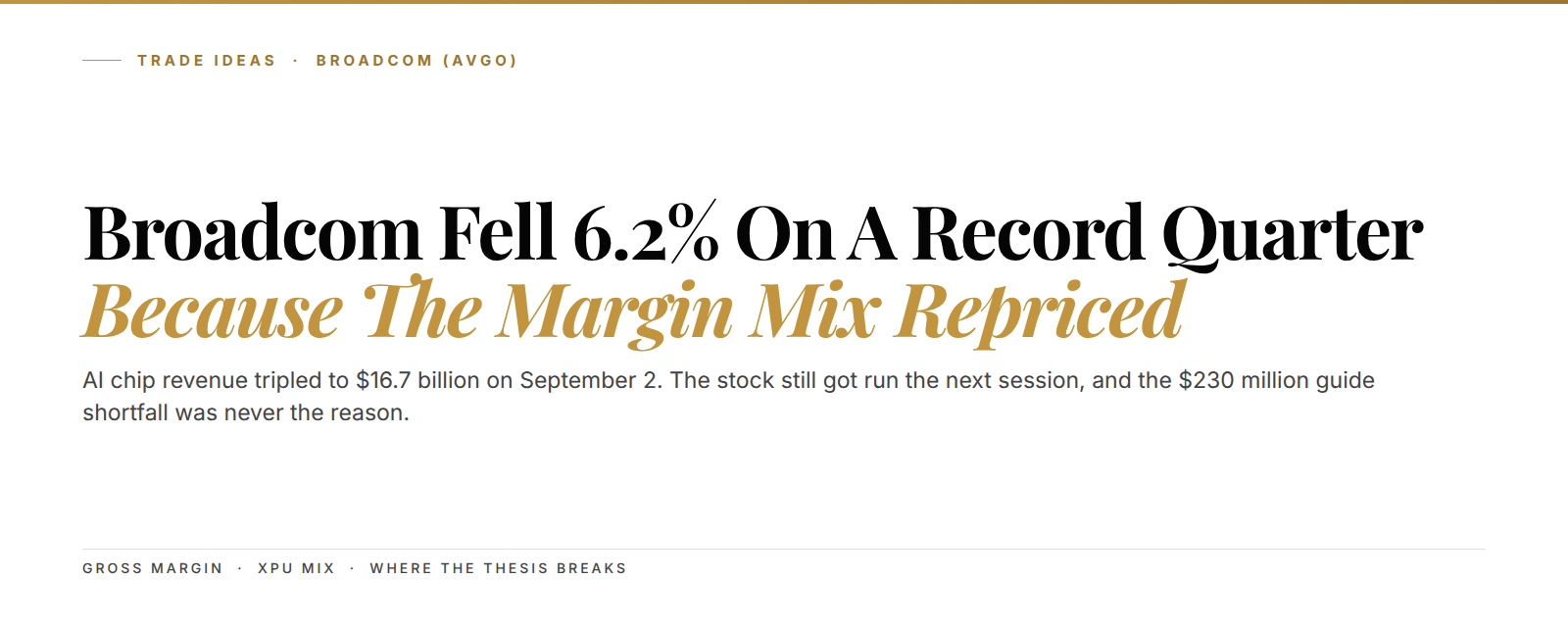
Broadcom fell 6.2% on Thursday, September 3, one day after printing the best quarter in company history. Revenue rose 86% to $29.59 billion, and AI chip revenue tripled to $16.7 billion. The stock got run anyway, and the reason everybody reached for was the fourth-quarter guide: about $34.8 billion against roughly $35.03 billion expected. That shortfall is $230 million on a $35 billion quarter, or seven tenths of one percent. Nobody de-rates a company six percent for that. What actually got sold sat two lines lower on the same release, and it was not demand.
The setup in 3 lines:
- Broadcom beat on revenue and on earnings, then fell 6.2% on September 3 while the Nasdaq Composite rose 1.4%.
- Gross margin is the line that got sold. It is guided near 73% for the fourth quarter, against 78% a year ago, because custom XPU chips carry expensive memory.
- Demand did not crack, so the live question is what multiple the tape pays for lower-margin revenue, not whether the revenue shows up.
Hock Tan spent Wednesday evening sounding like a man with a full order book. "Q3 demand was simply hot and we're just getting started," Broadcom's chief executive told analysts on the September 2 call. Then he put a figure on it. Broadcom will ship $350 billion of AI semiconductors to six customers over the next two years. Twelve hours later his stock opened 5.76% lower and changed hands near $344 by mid-morning. Both of those things happened on the same tape. Holding them in one hand is the whole job here.
A $230 million shortfall cannot explain a six percent session
Start with the arithmetic the headlines skipped. Broadcom guided fourth-quarter revenue to roughly $34.8 billion when the street had penciled in $35.03 billion. In percentage terms that is a rounding error, and it sits well inside the range any semiconductor company can move with two weeks of shipping schedule. So the guide is a story, not the story.
Compare it to what the same guidance page did to the profit line. Gross margin, meaning the share of revenue left after the cost of building the chips, is guided to about 73% for the fourth quarter. A year ago that figure was 78%. Five points of margin on $34.8 billion of revenue is roughly $1.7 billion of gross profit. That is more than seven times the revenue shortfall everybody wrote about.
$230 million versus $1.7 billion. The revenue miss got the headline. The margin step-down got the selling.
You can see why the tape moved before the commentary caught up. Desks that model semis do not read the revenue line first, they read the mix, because mix is what compounds into next year's earnings. The mix changed, and it changed in a direction the sell side had been slow to write down.
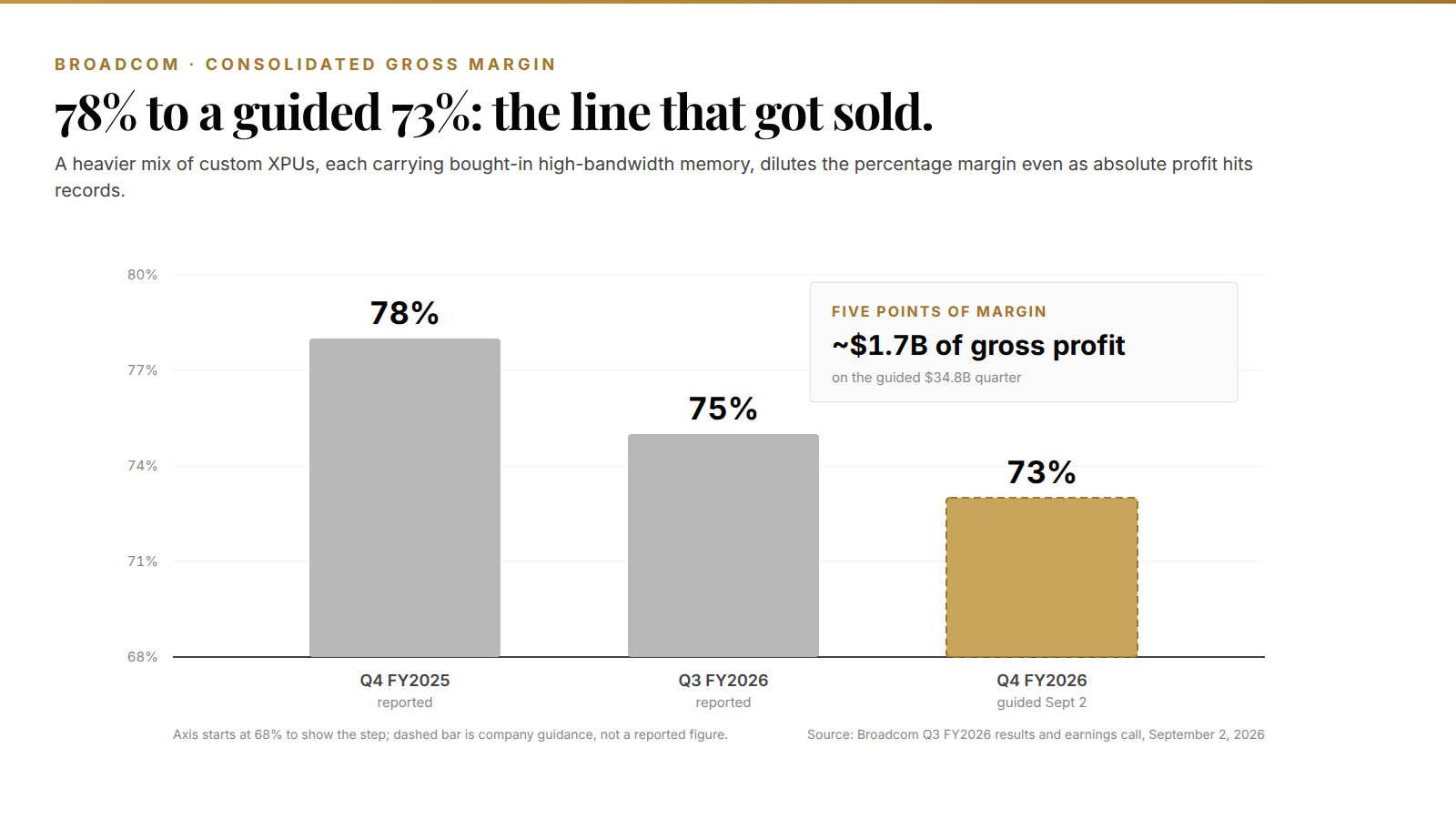
Gross margin is guided to 73% because memory rides inside the XPU price
Here is the mechanism, and it is simpler than it sounds. Broadcom's AI business used to be mostly networking silicon, which is high-margin merchant product sold off a catalog. It is now mostly XPUs, the custom accelerator chips Broadcom co-designs for a single customer. Each XPU ships with a large stack of high-bandwidth memory attached, and Broadcom buys that memory from someone else.
Think about a builder who used to sell finished shells and now sells the same house with the client's own kitchen fitted inside. The revenue line gets bigger, because the kitchen is inside the price. The profit on the kitchen still belongs to the kitchen maker. That is what rising memory content does to a percentage margin. Management said so plainly on the call. A heavier XPU mix, carrying more memory, is diluting consolidated gross margin.
Translation: the dollars are real and growing fast, but each new dollar of AI revenue arrives with a thinner slice of profit inside it than the dollar it replaced. That is not a demand problem at all. It is a valuation problem, because a lower-margin revenue stream historically earns a lower multiple, and Broadcom went into Wednesday priced near a record.
Notice what did not deteriorate in the quarter, though. Operating income rose 92% to $20.1 billion, operating margin hit a record 67.9%, and free cash flow came in at $13.7 billion, or 46% of revenue. The absolute profit engine is running hotter than ever, which is why we read Thursday as a repricing of quality rather than a break in the business. Anyone reading it as the top of the AI cycle is arguing with a cash flow statement.
Five numbers from the September 2 release that outrank the guide
- AI semiconductor revenue of $16.7 billion, up 221% year over year and 54% from the prior quarter.
- Full-year fiscal 2026 AI revenue guided up to $58 billion, with the fourth quarter alone near $21.7 billion.
- Gross margin guided to roughly 73%, against 78% in the same quarter last year.
- Six XPU customers producing 73% of AI revenue, a concentration that cuts both ways.
- Free cash flow of $13.7 billion, equal to 46% of revenue in the quarter.
Read those together and the shape is clear. Revenue quality is being traded for revenue scale, on purpose, at a speed most models had not caught up to. That trade can be the right one and still cost the stock six percent on the day it becomes explicit.
Six customers carry 73% of AI revenue, and their names are the moat
The concentration number deserves more attention than it got. Six XPU customers account for 73% of AI revenue, and management walked through the deployment schedule in unusual detail. Google is shipping Ironwood and starting production on its next TPU generation. Anthropic has a one-gigawatt deployment this year and roughly five gigawatts planned for 2027. OpenAI has 1.3 gigawatts landing in 2027, and Meta has a line of sight to three gigawatts through 2028.
Concentration usually reads as risk, and normally we would treat it that way. Here it works differently, because a custom accelerator is co-designed over two to three years and cannot be swapped for a competitor's part mid-program. Once a hyperscaler tapes out a chip with Broadcom, the switching cost is a multi-year redesign, not a purchase order. So the same six names that look like concentration risk on a spreadsheet are also the reason the fiscal 2028 revenue ambition of $230 billion is not pure imagination.
Where we would be careful is the frontier labs. Google and Meta fund silicon out of operating cash flow, and their commitments are as close to money-good as this industry gets. Anthropic and OpenAI are a different credit, and that difference showed up in the release in a way almost nobody discussed.
The $35 billion Apollo and Blackstone tranche moved the buildout onto private credit
Broadcom closed the first $35 billion tranche of a financing platform with Apollo and Blackstone to fund Anthropic's one-gigawatt deployment. Read that sentence again, because it changes the character of the order book. The chips are not being bought out of a customer's retained earnings, they are being bought with structured private credit arranged alongside the vendor.
That is not automatically bad, and vendor-adjacent financing has funded every large infrastructure cycle since the railroads. It does mean one thing for the risk, though. The durability of part of this backlog now depends on credit markets staying open. And August was spent pricing a possible Federal Reserve hike, not a cut. Ten-year yields only eased back to 4.74% on Thursday after Governor Christopher Waller's remarks softened the hike odds.
$35 billion, arranged with Apollo and Blackstone. The demand is real. The funding for part of it is now a credit-market variable, not a customer-cash variable.
We flagged the same structural question when Nvidia backstopped OpenAI, in the $250 billion circular-financing piece, and the pattern is repeating with a different balance sheet in the middle. It is the one thread in this print that could genuinely change the multi-year read, and it is worth watching more closely than any single quarter's guide.
Nasdaq up 1.4% while Broadcom fell 6.2% is single-stock supply, not macro
The session tells you what kind of selling this was. On Thursday the Dow rose 1.3%, the S&P 500 added 1%, and the Nasdaq Composite jumped about 1.4% as rate-hike fears eased. Broadcom lost 6.2% into that same rising tape. A stock that drops seven and a half points against its own index on a risk-on day is not being sold by macro allocators. It is being sold by holders of the name.
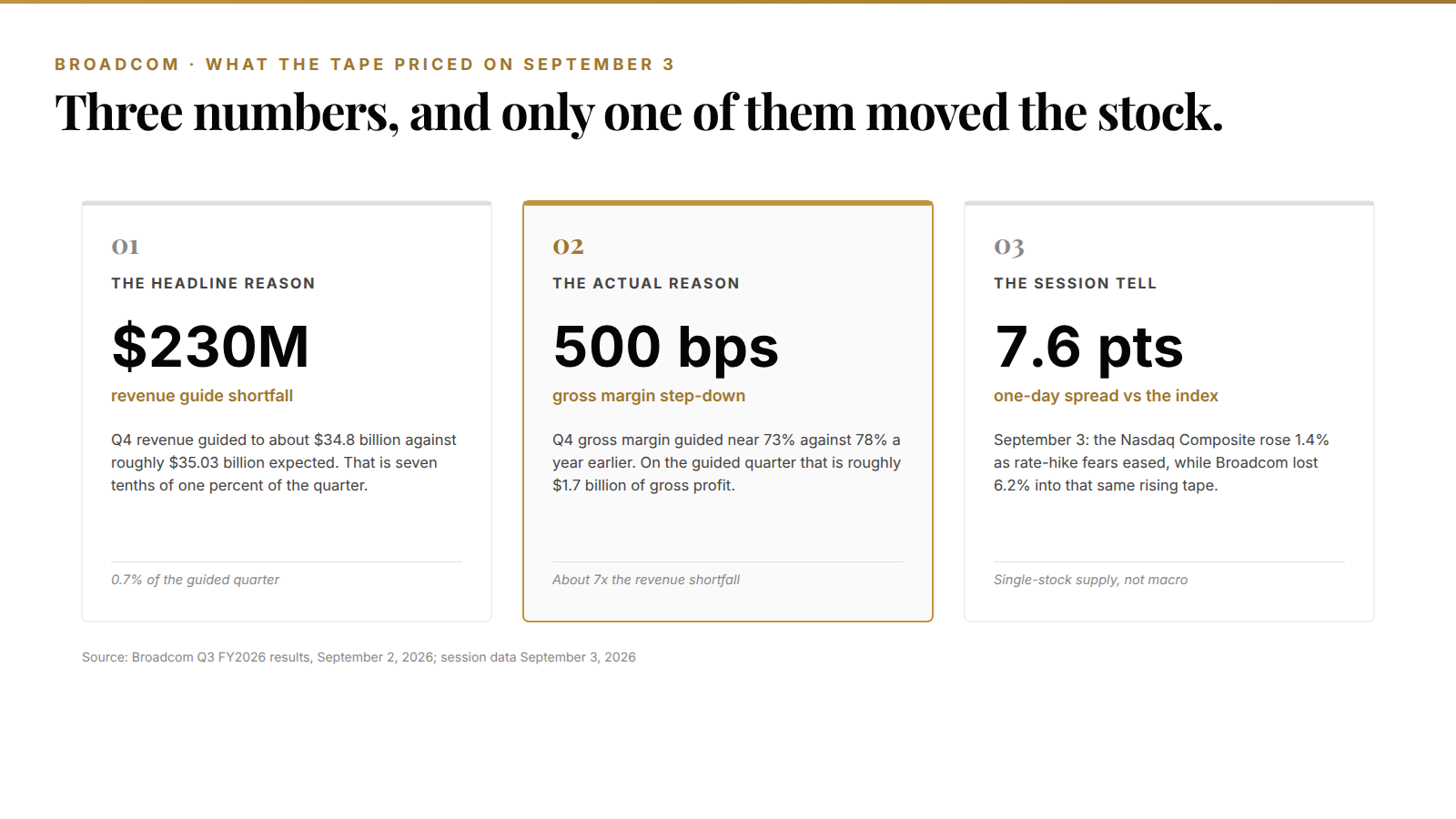
That distinction matters a lot for structure. Macro-driven declines tend to drag the whole complex down together and resolve when the macro input changes. Single-stock distribution after a record print behaves differently. It works through supply from holders who no longer like the risk-reward. That usually needs time to clear, not news. TSMC did the same thing in July, beating record earnings and falling 5% before the structure resolved higher, which we mapped in the wave-4 pullback read.
Broadcom is one of the assets on the Kunkel Capital rotation, and members get the full structure map with entry, exit and invalidation refreshed on a fixed cycle.
Our June 3 read said the guide would move this stock, not the beat
Three months ago we published a filter ahead of Broadcom's June print. The argument then was that the $10.7 billion AI guide everyone chased was already in the price. The move would come from the next-quarter guide and the custom-chip order book instead. That is precisely what happened on Wednesday night. The beat landed, the order book got bigger, and the stock still faded on forward numbers.
Wait, one correction to our own framing there. We wrote that piece expecting the swing factor to be the AI revenue guide, and the AI guide was actually raised, to $58 billion for the year. The forward line that moved the stock was gross margin, which we had not weighted heavily enough at the time. The structure of the lesson held, but the specific line item did not.
Custom silicon is now reshaping the income statement the same way it reshaped the competitive map in the AMD and Broadcom custom-silicon split. The memory pass-through echoes what contract pricing did to Micron's drawdown. Same cycle, three different income statements, one shared input.
Where this thesis breaks, and what would confirm it
Our read is that Thursday was a mix-driven repricing inside an intact advance, not the end of the AI capex cycle. The support for that is on the release itself. Full-year AI revenue got raised rather than trimmed, the fourth-quarter AI guide sits near $21.7 billion, and free cash flow covers the dividend many times over. When demand actually breaks in this industry, the forward revenue guide comes down first, and it did the opposite here.
So here is where we are wrong. Say Broadcom loses the base it built before the print and closes back inside the summer range. Say the next quarter then shows another step down in gross margin, alongside a flat or lower AI guide. At that point this stops being a mix story and becomes a demand story. That combination is the invalidation: price failure, a second margin step-down, and a stalled guide. Any one of the three on its own is noise. We would not act on it.
For now the honest summary is short. Broadcom sold off because each revenue dollar got less profitable, not because the dollars stopped coming. The business is changing shape faster than the models tracking it, and the tape needed a session to reprice that. The macro backdrop turned friendlier on the very same day. That is why the divergence is worth respecting rather than dismissing. If you trade this name, watch the margin guide next, not the revenue headline.
Frequently asked questions
Why did Broadcom stock fall after beating earnings? The fourth-quarter gross margin guide of roughly 73% landed about five points below the 78% of a year earlier. Broadcom fell 6.2% on September 3 on that line. The revenue shortfall of $230 million was too small to explain the move.
What is an XPU and why does it hurt margin? An XPU is a custom AI accelerator Broadcom co-designs for a single customer. It ships with a large stack of high-bandwidth memory that Broadcom buys in. That memory passes through the revenue line at low margin. So a heavier XPU mix lifts revenue while thinning the percentage margin.
How big is Broadcom's AI business now? AI semiconductor revenue reached $16.7 billion in the fiscal third quarter, up 221% year over year. Management raised the full-year fiscal 2026 AI figure to $58 billion. Fiscal 2027 is guided to roughly $115 billion.
Is the Broadcom order book credit-financed? Partly. Broadcom closed a first $35 billion tranche with Apollo and Blackstone for Anthropic's one-gigawatt deployment. So part of the backlog depends on private credit staying open, not on customer cash alone.
Does the drop change the longer-term structure? Not by itself. A single distribution session after a record print, into a rising index, reads as supply from existing holders rather than a change in the demand cycle.
Know your entry, your exit, and where you are wrong on Broadcom
The 73% margin guide is the surface signal, and it is the part any reader can verify. Broadcom is on the Kunkel Capital watchlist. The full research maps the current wave count to a defined entry zone, an exit target and the exact invalidation level, refreshed on a fixed rotation. Alerts fire when levels hit. €19.99 first month, then €34.99. Cancel anytime.
Sources: Broadcom Q3 fiscal 2026 results release and earnings call (September 2, 2026); Reuters and Bloomberg session coverage, September 3, 2026.
Last updated: 2026-09-05