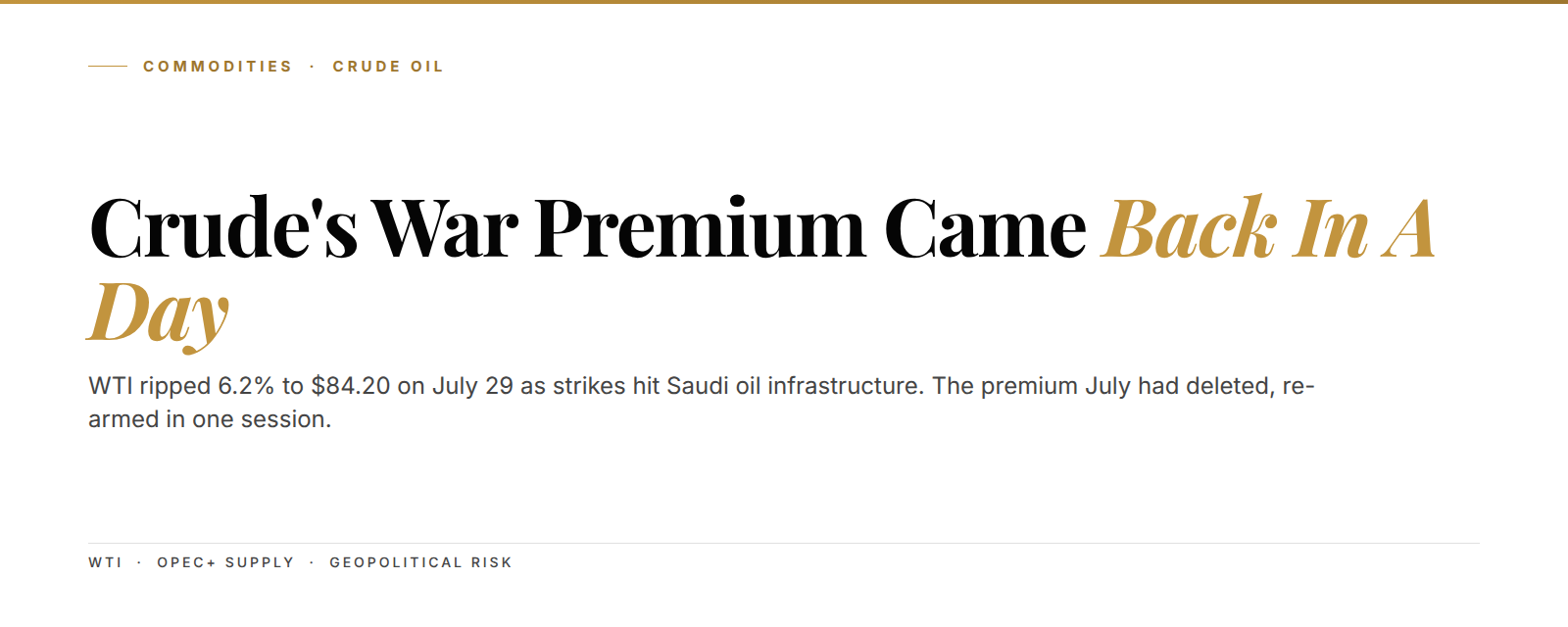
WTI crude ripped 6.2% to $84.20 on Wednesday, July 29, its biggest one-day jump in months. The tape spent all of July acting like the war was over. It wasn't. A fresh wave of drone and missile attacks on Saudi oil sites, plus a Houthi hit on a Saudi tanker on Tuesday, put the supply risk the market had written off right back on the screen. Crude gained $4.94 in a single session and snapped a three-day slide.
The setup in 3 lines:
- WTI jumped 6.2% to $84.20 on July 29 after strikes on Saudi oil infrastructure.
- The June 18 truce had bled the war premium out, dragging crude from above $110 down under $80.
- OPEC+ keeps adding barrels while the geopolitical risk climbs again, and the August 2 meeting is the next swing.
Last Tuesday, Yemen's Houthis put a missile into a Saudi oil tanker. By Wednesday predawn, US Central Command was hitting weapons and logistics sites across eastern Iraq. That is the moment the risk stopped being a memory and became a price again. If you traded oil in July, you watched the premium drain out for four straight weeks. This week it came back in one.
WTI ripped 6.2% to $84 Wednesday because the target list changed
The move started with hardware, not headlines. Saudi Arabia's energy ministry said it shot down several drones launched from Iraq at oil facilities in the country's east. Those were not the first. Those drones were not the first this month. US Central Command described the strikes as a response to more than 30 drone attacks on US and Saudi energy sites over the prior 72 hours. So this was not one scary headline. It was a pattern the tape had stopped pricing.
We almost filed Wednesday under "another spike that fades." Then we looked hard at what actually got hit. The attacks are aimed at the machinery that actually moves barrels: pumping stations, storage, loading terminals. That is the kind of target list that turns a risk story into a supply story, and the screen knows the difference. The tape finally saw the shift on Wednesday.
$4.94 in one session. That is the war premium the market spent a month deleting, re-added in a day.
Crude had been drifting lower into Wednesday, so the jump also ran a lot of short bets that were leaning the wrong way. Traders who sold the quiet got tagged. When a falling market gaps up 6%, the people offside have to buy back fast, and that buying is part of why the candle was so big.
The June 18 truce had bled the war premium out
To see why $84 matters, you have to rewind six weeks. Oil began 2026 near $61. Then the Strait of Hormuz closed in late February after the US-Iran conflict broke out, and the price went vertical. Nine days into the closure, WTI ran past $110. Brent finished the first quarter around $118. That is what a real supply scare looks like on a chart.
Then it reversed hard over the next three weeks. On June 18, the US and Iran signed a memorandum to end the fighting and reopen the Strait. Barrels started flowing again. By July 1, Brent had dropped back below $70, roughly where it traded before the war. WTI settled near $79.60 by the middle of July.

In plain terms: the market decided the crisis was finished and priced oil like nothing was moving. The crowd called the war over too early.
That round-trip from $120 down to $70 is the exact pattern we mapped in Brent's June Hormuz round-trip, and the 57-million-barrel blockade math that drove the spike still sits underneath this tape. The truce cooled the price in a hurry. It did not remove the fault line.
Here is the tension the market is missing. The truce closed the shooting war between the two governments. It did not close the proxy war around Saudi and US energy infrastructure. Those attacks kept coming through July, mostly ignored, until Wednesday made them impossible to ignore.
OPEC+ keeps handing barrels back while the risk climbs again
The supply side has been loosening the whole time, which is the other half of why July felt so calm. Seven OPEC+ nations agreed on July 5 to raise output by 188,000 barrels a day for August. That was the fourth quota hike since the Hormuz closure. The cartel has spent 2026 slowly handing back the barrels it held off the market for two years.
So you had two forces pulling in opposite directions. More physical supply coming online, month after month, pushing price down. A geopolitical risk that never actually resolved, coiling underneath. For most of July the supply side won, and crude leaked lower toward $79. So far the barrels keep winning that fight. Wednesday was the risk side reminding everyone it still had a vote.

Crude oil is one of the assets on the Kunkel Capital rotation, and members get the full structure map with the entry zone, the exit and the invalidation level refreshed on a fixed cycle. We covered the barrel-supply side of this in the phantom OPEC barrels read, and the geopolitical layer in Brent's $94 war premium and the second front.
The next real test is only days away. OPEC+ meets again on August 2, and the group is expected to wave through another increase near 188,000 barrels a day. Translation: the people with the actual spare barrels are about to add more, at the same moment the risk of losing some of those barrels just jumped. Those two facts sitting on top of each other are the whole story this week.
Wednesday's attacks hit infrastructure, not just sentiment
The named moment worth holding onto came before dawn on Wednesday. US and Saudi forces struck Iran-backed groups in eastern Iraq, blaming them for the drone attacks on Saudi oil facilities. It came hours after the US military said it had headed off a surprise Iranian attack on American troops in the region. This was a coordinated response, not a one-off.
Think of it like a house alarm. For a month, sensors kept tripping and nobody in the market got out of bed. Wednesday the front door actually got kicked, and everyone woke up at once. The price gap is that room full of people reaching for the same trade in the same minute.
What makes this different from a normal headline pop is where the strikes land. Missiles aimed at a tanker or a pumping station threaten barrels that are already sold and moving. That is why gold caught a bid too, rebounding toward $4,100 from a nine-month low near $3,975, which we broke down in the Iran oil-shock inflation read. When the same shock lifts oil and gold together, it is a supply-and-safety story, not a growth story.
Where the $84 reclaim sits on the map
Start with the levels every chart already shows. WTI lost the $80 handle in mid-July and spent three sessions grinding lower before Wednesday. The $84 reclaim puts price back inside the range it held before the late-July slide, and back above the mid-July shelf near $79 to $80 that the market kept defending. Below that shelf is the sub-$70 pre-war zone. Above sits the crisis territory that only comes back if the Strait itself is threatened again. The map here is simple enough to hold.
Five things actually changed this week, and the order matters.
- Attacks shifted from troops to energy infrastructure, which is a supply threat, not just a risk headline.
- WTI reclaimed the $84 handle it lost in mid-July, flipping the short-term tape.
- Gold rebounded with oil toward $4,100, confirming a supply-and-safety bid, not a growth bid.
- OPEC+ meets August 2 and is likely to add more barrels into rising risk.
- The June 18 truce is holding between governments but not on the ground.
Now the structural read, fully in the open. This is a re-arming of a risk premium the market had deleted, not the start of a fresh 2026-style supply crisis. The barrels are still flowing and the Strait is still open. So the base case is a higher, jumpier range while the infrastructure attacks continue, rather than a straight run back to triple digits. A genuine repeat of the $110 to $118 move needs the Strait of Hormuz to close again, and nothing this week says it has.
Here is where the thesis breaks, and it is a condition, not a price. The read fails if three things line up at once. The August 2 OPEC+ meeting confirms another hike, the strikes on Saudi energy sites go quiet, and WTI closes back below its mid-July shelf on a daily basis. If all three happen, this week was just a headline spike and the supply-loosening trend wins. That behavior, not a single tick, is where we would be wrong. We always tell you how you would know the read has failed. The product tells you the exact level where it does.
One honest uncertainty remains. We do not know whether Iran's leadership wants a controlled squeeze on Saudi exports or a real escalation, and that single question decides whether $84 is a ceiling or a floor for the next month. The tape will answer it before the analysts do.
The bottom line on crude this week
WTI's 6.2% jump to $84 is the market re-pricing a risk it spent July pretending was gone. The setup pits a loosening OPEC+ supply schedule against a hardening attack pattern on the exact infrastructure that moves those barrels. That tension, more than any single print, is what sets the range from here. The related real-yield read on gold and the silver-to-gold ratio move round out how this same shock is rippling across the metals.
Frequently asked questions
Why did WTI crude jump 6.2% on July 29, 2026?
Crude rose $4.94 to $84.20 after a fresh round of drone and missile attacks on Saudi oil infrastructure, plus a Houthi strike on a Saudi tanker on Tuesday. US and Saudi forces responded with strikes on Iran-backed groups in eastern Iraq. The market re-priced supply risk it had been ignoring since June.
Is the oil war premium back for good?
Not yet. The barrels are still flowing and the Strait of Hormuz is still open, so this reads as a re-arming of risk rather than a full supply crisis. A sustained premium needs the physical attacks to keep hitting export infrastructure.
What is OPEC+ doing about oil supply?
OPEC+ agreed on July 5 to raise output by 188,000 barrels a day in August, the fourth hike since the Hormuz closure. The group meets again on August 2 and is expected to approve another increase, adding supply into a market where geopolitical risk is climbing.
What would take crude back above $110?
A repeat of the early-2026 move needs the Strait of Hormuz to close again. This week's attacks threaten specific facilities, but they have not shut the waterway. Without that, the base case is a higher, choppier range rather than a run to triple digits.
How high did oil go earlier in 2026?
After starting the year near $61, WTI ran past $110 and Brent hit about $118 in the first quarter, following the late-February closure of the Strait of Hormuz. Prices fell back under $80 after the June 18 truce reopened the waterway.
Know your entry, your exit, and where you are wrong on Crude Oil
The $84 reclaim and the August 2 OPEC+ meeting are the surface signals. Crude Oil is on the Kunkel Capital watchlist: the full research maps the current wave count to a defined entry zone, an exit and the exact invalidation level, refreshed on a fixed rotation, with alerts when levels hit. €19.99 first month, then €34.99. Cancel anytime.
Last updated: 2026-07-30
Kunkel Capital Research · Daily market structure · Elliott Wave + Fibonacci · Not investment advice.