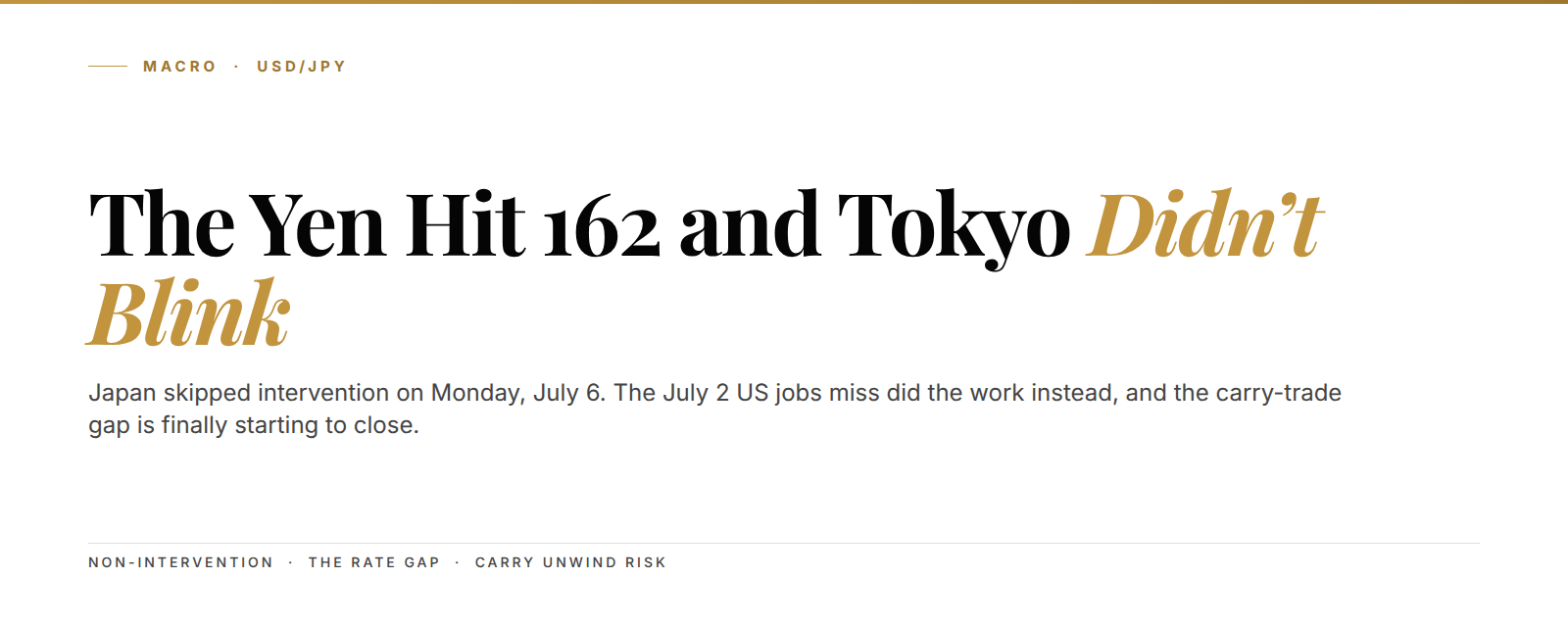
The yen slid toward 162 per dollar on Monday, July 6, and Tokyo did nothing. That's the story. Traders spent the weekend braced for intervention. Finance Minister Satsuki Katayama had warned, again, that Japan stood ready to step in at any time. The line held anyway. The pair gave back about half of its July 2 gains, the ones it made when a soft US jobs print knocked the dollar down. So the market got its answer. At 162, into thin holiday liquidity, the Ministry of Finance sat on its hands.
That silence tells you more than any speech.
The setup in 3 lines:
- USD/JPY pushed to 162 on Monday, July 6, and Japan skipped intervention despite fresh warnings.
- The real mover was the July 2 US jobs report: 57,000 payrolls against a 115,000 forecast, which cut September Fed-hike odds from 64% to near 50%.
- Watch the gap between the US two-year yield at 4.13% and the Bank of Japan's new 1.00% rate. That gap still drags the yen lower, and it's finally starting to close.
Here's the part nobody says out loud. The intervention that mattered last week wasn't Japan's. It was America's jobs report. On Thursday, July 2, the Bureau of Labor Statistics reported 57,000 new payrolls for June. The Dow Jones consensus was 115,000. May got revised down to 129,000, and April and May together lost 74,000 jobs on paper. The yen ripped higher on the news, and no Japanese official touched the market. The data did the work.
Tokyo let 162 print on Monday and stayed out of the market
Japan drew a line and then walked away from it. For weeks, 162 has been treated as the level. Foreign-exchange desks flagged it as the new intervention threshold, the point where the Ministry of Finance was supposed to show up. The 2026 defence budget, near 10 trillion yen, points to a ceiling around 160 to 162. On Monday the pair traded right into that zone. Katayama repeated the script: Japan and the US remain "in close contact" on currency policy, she said, and authorities can act "at any time."
They didn't act.
Part of that is tactics. Reports last month suggested Japan may stop announcing its intervention plans in advance. The idea is to catch short-yen traders off guard and force a messier unwind. Pre-committing to a level does the opposite. It hands speculators a free option. They can sell the yen toward the line, then buy it back the moment the Ministry shows up. Silence is cheaper than a defended number that everyone front-runs.
162. The level Tokyo drew a line at, then let print without a fight on Monday, July 6.
But there's a simpler read too. Maybe 162 just isn't the emergency it was in 2022. Back then the yen fell while every driver pointed the same way. The Fed was hiking hard, and the BoJ was pinned at zero. Now one of those drivers has flipped. That changes the math on whether you spend reserves to defend a round number.
The July 2 jobs miss did the intervention Japan didn't have to
One weak print moved the yen more than any warning had. Payrolls came in at 57,000, the smallest gain in four months. The unemployment rate held at 4.2%. Leisure and hospitality shed 61,000 jobs. The market read it fast: rate-hike odds for September fell from about 64% to near 50% in a single day. The two-year Treasury yield dropped to 4.13%. The dollar softened across the board, and the yen was the biggest winner.
Translation: the yen didn't rally because Japan got stronger, it rallied because the US looked weaker.
This matters for how you think about the whole trade. The yen's problem was never really about Japan. It was about the gap. When US short rates sit far above Japanese short rates, money borrows cheap in yen and parks in dollars. That's the carry trade, and it pays you the difference while pushing the yen down as a side effect. Weaken the US rate outlook, and you shrink the gap. Shrink the gap, and the whole trade gets less attractive.
Fed Chair Kevin Warsh gave the move a push. Speaking at the ECB Forum this week, he said inflation expectations had eased over the past month. No urgency to hike, in other words. For a market that had priced a real chance of a September move, that read as a green light to fade the dollar.
The BoJ's 1.00% rate is the first serious number since 1995
Japan finally has a policy rate that does something. On June 16, the Bank of Japan lifted its benchmark from 0.75% to 1.00%. That's the highest since 1995, a 31-year high. The board voted 7 to 1. It did it without Governor Kazuo Ueda in the room. He'd been hospitalized for a hepatic cyst infection, so he submitted his views in writing and didn't vote. A historic hike, and the chair wasn't there to raise his hand.
The reasoning was plain: wage growth from the 2026 Shunto negotiations held up. Underlying inflation kept running above the 2% target on a forward-looking basis. Even at 1%, real rates in Japan stay deeply negative, so the BoJ still has room to keep going, and it's told the market as much.
1.00%. Japan's policy rate now sits at a level it hasn't seen since 1995. The other side of the yen trade finally moved.
Here's why that reframes everything. For a decade the yen story had one constant. Japan's rate was zero and going nowhere. Every macro model treated it as a fixed anchor. Now it isn't. The anchor is moving. Think of the carry trade like a see-saw. For years only the US side went up and down, while Japan sat flat on the ground. Now both sides move: the pivot shifts, and the yen doesn't have to keep falling just because the US wobbles.
The carry trade still pays three points, and that's the live pressure
Narrowing isn't closed. Let's be honest about the level. A 4.13% US two-year against a 1.00% Japanese policy rate is still a gap north of three points. That's real money for anyone borrowing yen to hold dollars. The carry trade isn't dead, it's just less one-sided than it was.

Wait, that cuts both ways. A carry trade that still pays is a carry trade that can still unwind hard. The bigger the crowd short the yen, the sharper the snap when it turns. We saw a version of this in August 2024, when a yen spike forced a wave of global de-risking. The setup rhymes. A wide-but-narrowing gap, a heavily short-yen market, and an official sector that may hit without warning.
That's the asymmetry worth respecting. The slow drift is toward a stronger yen as the gap closes. The fast risk is a carry unwind that overshoots it. Positioning turns a gentle trend into a stampede. Anyone running yen-funded risk elsewhere in the book should be watching this, not just FX desks. We walked through that transmission in our note on how yen carry drives global risk.
Five numbers that frame the yen trade right now
The whole story fits in five figures. Keep these on the desk this week.
- 162: the level Tokyo treated as its line, and let print on Monday.
- 57,000: June US payrolls, less than half the 115,000 forecast.
- 1.00%: Japan's new policy rate, the highest since 1995.
- 3.1 points: the US-Japan two-year gap still funding the carry trade.
- 10 trillion yen: Japan's 2026 yen-defence budget, the real cap behind 162.
Read down that list and the trade writes itself. One number is falling (US payrolls). One number is rising (Japan's rate). The two of them together are squeezing the gap that made short-yen a one-way bet.

162 is a budget line, not a chart line
Intervention is an accounting decision, not a technical one. This is the part traders get wrong. They treat 162 as a chart level, like a moving average that either holds or breaks. It isn't. It's a number tied to a spending limit and a political tolerance. Japan has roughly 10 trillion yen earmarked for yen defence this year. Every intervention burns some of it. Spend it defending a level while the US is still hiking, and you're pushing water uphill.
Think of it like a homeowner defending a price in a falling market. He can keep bidding for his own street to hold the number. But if rates are still rising against him, he's just burning cash to delay the mark. Better to wait until the macro turns, then spend. The July 2 jobs report may be the start of that turn. If it is, Japan gets to save its powder and let the Fed do the lifting.
Translation: Tokyo would rather the US economy weaken the dollar for free than pay to prop the yen itself. Monday looked a lot like that patience.
The positional read: the fight is 158 to 163, and the gap is the tell
Watch the rate gap, not the round number. Our read going into this week is simple to state. The 158 to 163 band is where this gets decided. As long as the US two-year holds above 4%, the carry incentive keeps a floor under the pair, and dips get bought. The trigger for a real leg lower in USD/JPY isn't a 162 print. It's the next soft US data point that drags the two-year toward 3.8% and drops September hike odds under 40%.
That's the whole game. Price the gap, not the headline.
The intervention risk is still live above 162, and it's now less predictable, not more. If Japan really has stopped pre-signaling, the first sign of action could be a sudden two-yen candle with no warning. That's a reason to size yen-funded positions with room, not to fade the level blindly. The clean trade isn't guessing the intervention. It's tracking the US rate path that decides whether Japan ever has to show up.
Three points. The US-Japan two-year gap that still funds the short-yen trade, and the tell that decides where the pair goes next.
For deeper context on how Japan's long end is repricing global capital, see our work on the 40-year JGB yield. On the US side, the two-year yield and the Fed-hike pivot drives the other half of this spread. Warsh's shift sits inside the same story we traced in real yields and the Warsh Fed, and the plumbing shows up in cross-currency basis and dollar stress. The jobs-print reaction ties back to consumer sentiment and Fed bets.
See the full USD/JPY setup
The 162 line and Monday's non-intervention are the surface signal. The Kunkel Capital research adds the level map for the 158 to 163 fight, the US-Japan two-year spread thresholds that flip the trade, and the sized carry-unwind hedge for the book. €19.99 first month, then €34.99. Cancel anytime.
Frequently asked questions
Why didn't Japan intervene at 162 on Monday, July 6? Tokyo held back despite Finance Minister Satsuki Katayama's warnings. Thin holiday liquidity, a tactical shift toward unannounced action, and a softening US rate outlook all cut the need to spend reserves. The July 2 US jobs miss had already done part of the work by lifting the yen.
What was in the July 2 US jobs report? June payrolls rose 57,000, well below the 115,000 consensus. May was revised down to 129,000, unemployment held at 4.2%, and April and May were cut by 74,000 combined. Markets trimmed September Fed-hike odds from 64% to near 50%.
How high is the Bank of Japan's policy rate now? The BoJ raised its rate to 1.00% on June 16, 2026, up from 0.75%. That's the highest since 1995. The board voted 7 to 1, with Governor Ueda absent and voting in writing.
Does the carry trade still work with the yen near 162? Yes, for now. The US two-year near 4.13% against Japan's 1.00% leaves a gap above three points. That still pays traders to borrow yen and hold dollars, though the incentive shrinks as the gap narrows.
What level matters more than 162 for USD/JPY? The US-Japan short-rate gap. If the US two-year falls toward 3.8% and September hike odds drop under 40%, the pair can break lower with no intervention at all. Watch the gap, not the round number.
Last updated: 2026-07-06