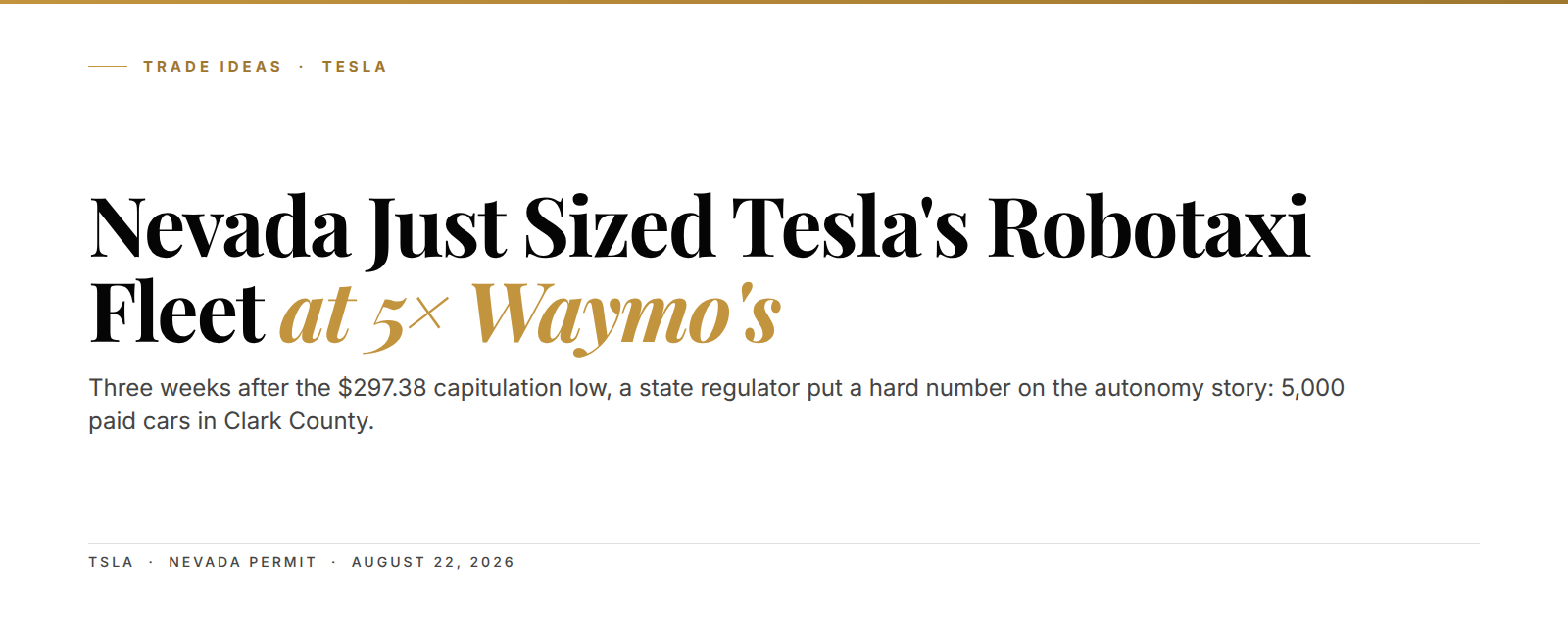
Tesla closed Friday, August 21, at $362.86, up 5.1% on the day. The week added 6%, its best stretch since early May. And the move has a paper trail. On Thursday, August 20, the Nevada Transportation Authority approved a commercial permit for paid rides in up to 5,000 driverless Teslas across Clark County. Waymo got 1,000. Consensus spent all of July calling the robotaxi story a distraction from a broken earnings model. A state regulator just put a number on that story, and the number is five times Waymo's.
The setup in 3 lines:
- Nevada approved Tesla for 5,000 robotaxis in Clark County on August 20, while Waymo and Uber's Aviari unit were capped at 1,000 each.
- July's 26% collapse priced Tesla's $5.79 billion capex quarter as spending without a customer, and the permit is the first outside document that argues otherwise.
- The July 29 low at $297.38 defended the round $300 floor, and Friday's 5.1% advance was the strongest single session since that low.
The scene itself is worth replaying, because it wasn't a press release. On Thursday morning the commissioners of the Nevada Transportation Authority sat through their August General Session in Las Vegas. Their vote to let three companies sell driverless rides was unanimous. Tesla's application came back with a first-year fleet cap of 5,000 vehicles, while Waymo and Aviari, the Uber subsidiary, got 1,000 apiece.
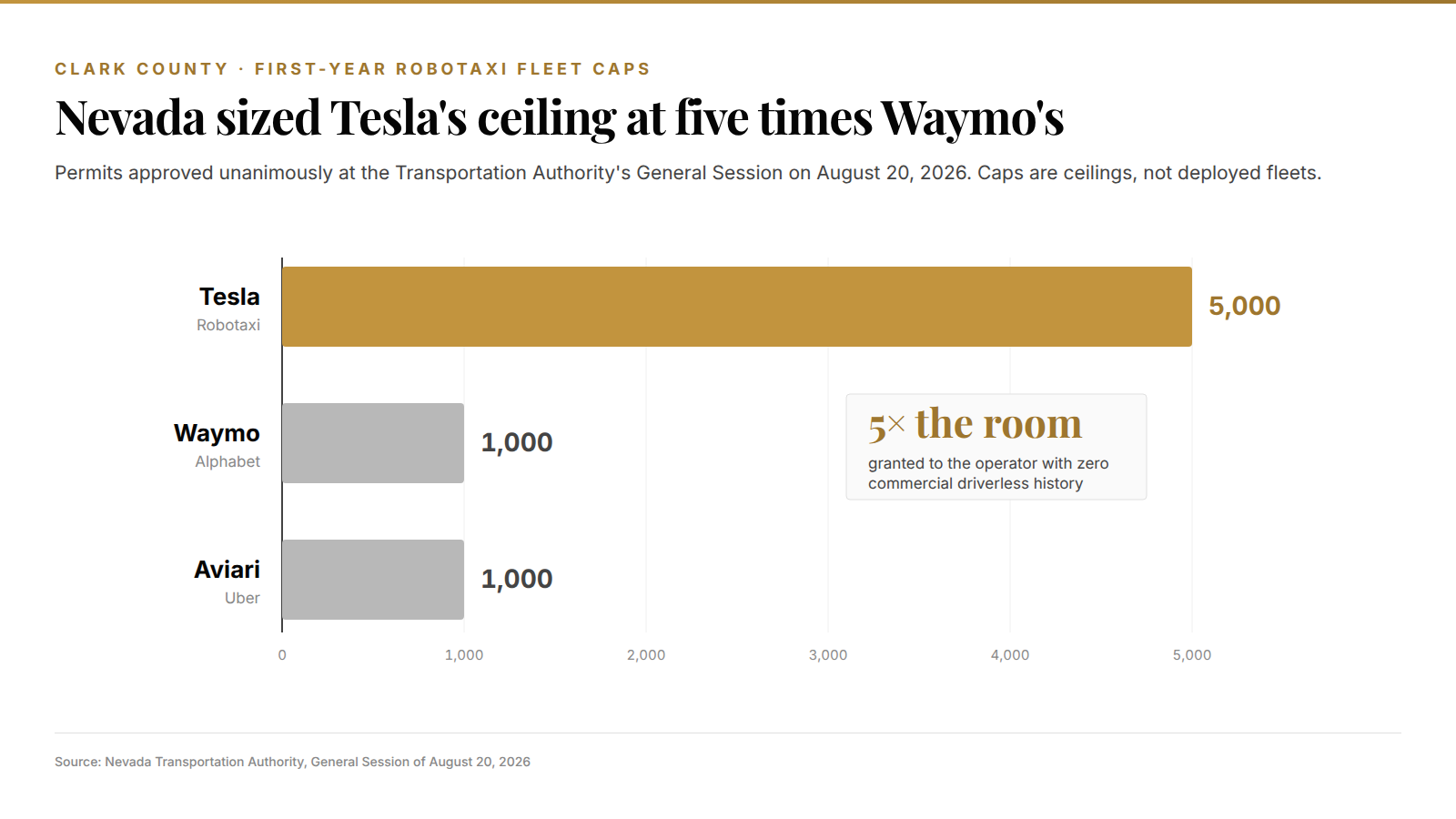
Nevada handed Tesla a 5,000-car cap and gave Waymo a fifth of that
Start with what the permit actually covers, because the details carry the signal. All three companies can now run paid autonomous rides on public roads across Clark County. That includes the Strip and the roads around Harry Reid International Airport, though airport pickups still need a separate sign-off from the county's aviation department. So the busiest queue in town isn't open yet.
The caps are ceilings, not orders, and that distinction cuts both ways. Tesla doesn't have 5,000 robotaxis staged in a Nevada lot, so the fleet will start far smaller. But regulators size ceilings to what the safety case supports. The state examined both operations and gave Tesla five times Waymo's room. And Waymo has sold driverless rides commercially since 2020.
In plain terms: a state regulator, the most cautious actor in this story, just treated Tesla's system as the one built for scale. That is a data point, not an opinion. It landed three weeks after the market decided the opposite.
July priced Tesla off $0.33 of earnings and ignored 480,126 deliveries
To see why Thursday's vote moves the stock, you have to go back to July 22. Tesla's second-quarter report was a strange document. Because the demand side did everything the bulls asked. Revenue of $28.24 billion beat estimates, and deliveries hit a record 480,126 vehicles.
The bottom line did not. Adjusted earnings came in at $0.33 per share, a 35% miss against expectations. Operating expenses jumped 47%, and free cash flow (the cash left after all spending) swung to a $1.09 billion deficit.
So the market did what it does when spending outruns proof. The shares fell 12% the next day and ended July down 26%, echoing the failed bounce we mapped in Alibaba's earnings gap. Elon Musk spent the call repeating the robotaxi and Optimus promises he's made for years, and the tape heard an admission that promises were all there was.
Translation: July's crash was never about selling cars. It was the market refusing to fund an AI-sized capex bill on carmaker margins without a receipt.
Three probes of $300 built a floor, and the character of the tape flipped
Now put that news flow on the chart, because the structure is cleaner than the headlines. From the December 16 high at $489.88, Tesla fell in three legs: down into March, back up to a lower high at $453.40 on May 13, then down again through July. That down-up-down shape is the classic look of a completed correction (a three-leg pullback inside a bigger trend), not the start of something worse.
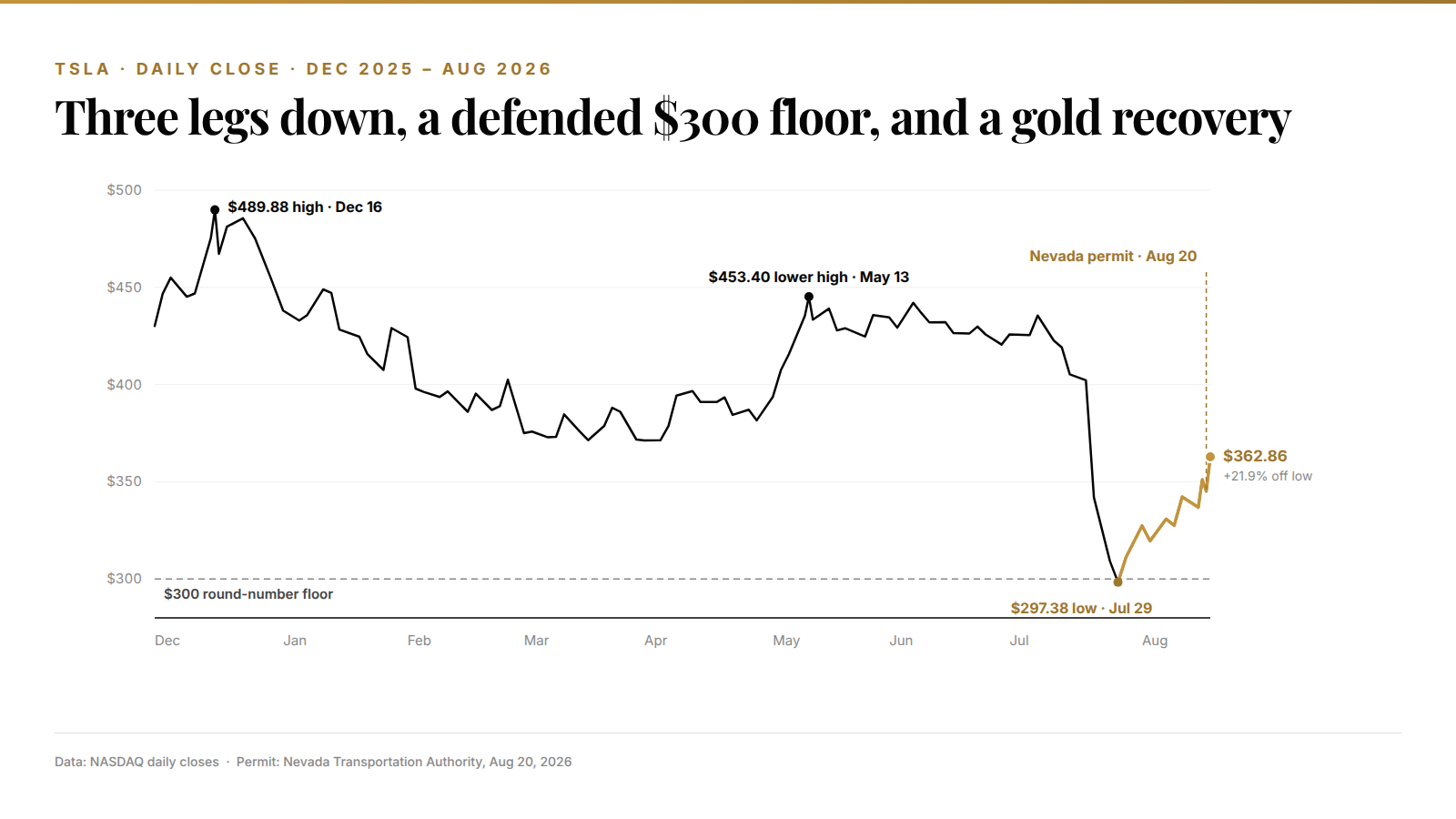
The low itself is the part you should study. Across four straight sessions in late July the stock probed the $300 area and closed below it exactly once, at the $297.38 extreme on July 29. Sellers had every headline they needed and still couldn't hold price down there.
That's absorption at work. It's the same behavior we traced when a whale's 43,000 BTC sale got swallowed at Bitcoin's floor, and the same trap mechanic from our Wyckoff spring breakdown.
Four probes, one close below. That was the entire late-July battle for $300, and the sellers lost it.
Since then the tape has changed character. August built a stair-step of higher lows, and the stock gapped up 4.2% on August 19 ahead of the vote. Friday then stretched the range to $366.50, a 21.9% advance off the low in three weeks. Accelerating into news instead of fading it is the drawdown-ending signature that marked Palantir's 149 print.
The $5.79 billion capex quarter needed a receipt, and the permit is one
Here's the mechanism connecting a filing to a wave structure. The line item that broke the stock in July was capital spending: $5.79 billion in one quarter, up 142% year over year. Spending like that is only a problem without a customer.
Think of a developer pouring concrete on the Strip. For two years the bears have priced the concrete as a hole in the ground, because the spend shows up long before the first guest checks in. What Nevada issued on Thursday is, functionally, the occupancy license: it doesn't fill the rooms, but it ends the argument over whether anyone may legally check in.
That reframing is why the gains held into Friday's close instead of fading by lunch, the usual fate of pure-headline pops. The same handoff happened when Micron's export-curb rebound turned a policy shock into a repricing of capacity. Tesla is one of the assets on the Kunkel Capital rotation: members get the full structure map with entry, exit and invalidation refreshed on a fixed cycle.
Napkin math says 5,000 robotaxis gross about $440 million a year
Let's be honest about the revenue side of this. The bull case doesn't need inflating anyway. Assume a mature fleet does 20 paid rides per car per day at a $12 average fare. Across 5,000 cars, that grosses roughly $440 million a year in bookings.
The company runs near $113 billion in annualized revenue. So Vegas is worth about 0.4% of the top line. We'll admit our first instinct was to file the permit under public relations for exactly that reason. But the 5,000-car ceiling changed the read, because the value isn't the fare box.
It's that unsupervised autonomy finally gets a live unit-economics test at real scale, under a regulator's eye, with fleet counts and incident data on public record. Until Thursday, every robotaxi number rested on Musk's word. Now the state of Nevada publishes the receipts.
There's genuine uncertainty here, and we'd rather name it than hide it. Tesla may deploy only a few hundred cars in year one. After all, a cap is not a fleet. What the market repriced this week is the ceiling and the sequence, not the revenue.
0.4% of revenue, 100% of the argument. The permit's fare math is small, and its evidentiary value is not.
Where the thesis breaks: two conditions that put Tesla back in the July regime
Pull it together and the read is this: July was the capitulation of the margin story, and the three-leg decline from $489.88 completed at a defended round-number floor. The regime driver has handed off from quarterly margins to autonomy execution. With the S&P 500 grinding at records, the macro tape isn't fighting the setup either.
The recovery's job from here is simple to watch: keep making higher lows while the Vegas fleet turns from paper into cars. You won't need our data for that part.
So here is where the thesis breaks, in two watchable conditions. First, the permit stays paper: no paid Vegas rides for months while the stock closes a week back inside its pre-vote range. Second, the floor fails: any daily close beneath the July 29 low says the capitulation never finished.
Both conditions sit on a free chart and a public registry, which is deliberate. Where we are wrong should never need our numbers.
The recap, in six points:
- Nevada's Transportation Authority approved Tesla for up to 5,000 paid robotaxis in Clark County on August 20, five times Waymo's cap.
- July's 26% drawdown was a verdict on $5.79 billion of quarterly capex, not on demand, since deliveries set a record.
- The decline from $489.88 unfolded in three legs and ended at $297.38, where four probes of $300 found buyers.
- The advance off the low is 21.9% in three weeks and accelerated into the news, which is trend behavior, not short covering.
- Fare revenue from Vegas is trivial near term, and the audited unit-economics data is the actual prize.
- The read fails on a paper permit plus a weekly close back in the old range, or on any daily close under the July low.
Frequently asked questions
What did Nevada approve for Tesla on August 20, 2026?
The Nevada Transportation Authority unanimously approved a commercial permit allowing Tesla to run up to 5,000 fully autonomous vehicles for paid rides in Clark County, including Las Vegas. Waymo and Uber's Aviari received parallel permits capped at 1,000 vehicles each. Airport pickups at Harry Reid International still require a separate aviation-department authorization.
Why did Tesla stock crash in July 2026?
Second-quarter results on July 22 paired record deliveries with a 35% earnings miss at $0.33 per share. Costs jumped, and free cash flow swung to a $1.09 billion deficit. The market read the spending as unfunded promises and cut the stock 26% for the month.
Is the Tesla robotaxi rally just short covering?
The pattern argues against it. Short-covering bounces fade into confirming news, but this advance ran 21.9% in three weeks and expanded its range on the permit itself. Squeezes also rarely begin at a four-times-defended round-number floor.
What would prove this Tesla read wrong?
It would take one of two conditions. A permit that produces no paid Vegas rides while price closes a week back inside its pre-vote range, or any daily close beneath the July 29 low. Either one puts Tesla back in its July regime, where the autonomy spend gets priced as waste.
When do Tesla robotaxis start driving in Las Vegas?
The permit is effective now, but deployment starts small and scales with registered vehicles. Watch Nevada's public fleet registrations rather than announcements. That registry, not a keynote, will show whether Tesla converts a 5,000-car ceiling into an operating business.
Know your entry, your exit, and where you are wrong on Tesla
The Nevada permit and the defended $300 floor are the surface signals. Tesla is on the Kunkel Capital watchlist: the full research maps the current wave count to a defined entry zone, an exit target and the exact invalidation level. Levels refresh on a fixed rotation, with alerts when they hit. €19.99 first month, then €34.99. Cancel anytime.
Sources: Nevada Transportation Authority General Session of August 20, 2026, plus Tesla's Q2 2026 shareholder update and SEC filings.
Last updated: 2026-08-22